

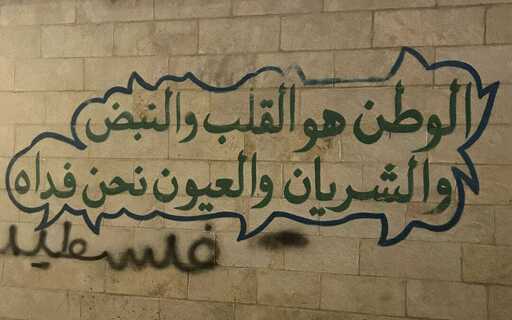
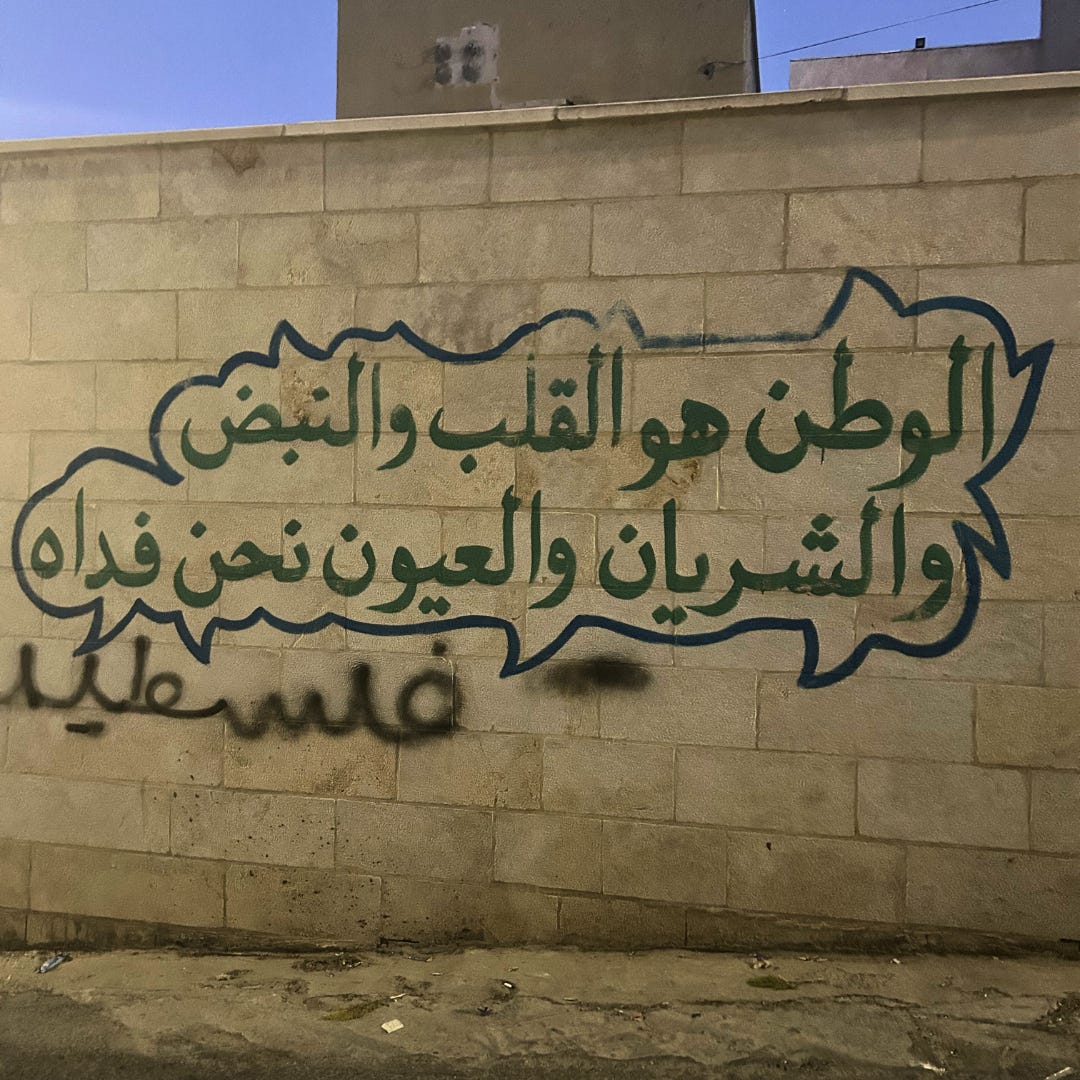
Graffiti on a wall in Jordan, captured in July 2023. “The homeland is the heart, the pulse, the artery, and the eyes. We are its sacrifice. Palestine.”
As a Palestinian born in the 21st century, I am the generational product of Nakba survivors and the trauma that came with it. As distant as it may seem, I am only two generations removed from the 1948 Catastrophe of Palestine, where over 750,000 Palestinians were displaced from their land, and thousands were massacred. Zionist militias backed by the British Empire razed Palestinian villages, killing, raping, displacing, and imprisoning anyone they could find, all to establish the brand new settler colonial project of Israel. This single day in Palestinian history would stain the soil with blood spilled and trauma gained for decades to come.
CODEPINK Substack is a reader-supported publication. To receive new posts and support our work, consider becoming a free or paid subscriber.
Both sets of my grandparents are older than the state of Israel, each born a few years before the Nakba. May 14th, 1948, was probably a rather normal day in my grandparents’ childhood. They would have been inside their homes with their families, or playing outside like any other day.The next day, everything changed. On May 15th, Zionist militias stormed their hometowns, slaughtered their neighbors, and destroyed entire villages. My grandparents’ childhoods were stripped away, and their entire lives uprooted.
After the Nakba, everything changed. The people of Palestine now live under the occupation of racists who despise and dehumanize them. These foreigners decided what rights they could and couldn’t have in their own homelands, and the threat of violence was always present. My great-grandfather was shot in the head by a settler. The Palestinian education system was dramatically defunded, leading my mother’s parents to leave for Europe for university. When they tried to come back home after the 1967 Naksa, foreign soldiers somehow had the authority to bar them from ever entering again. They had to move to Jordan and start a new life. They were only 2 hours away from their families, but they didn’t know if they’d ever be allowed to make the short trip back. My grandmother has only been to Palestine once since then, and my grandfather twice.
My other set of grandparents remained on the land, but now had to live a life of heavy restriction and limited movement. It’s hard for me to imagine what it was like to witness the plundering of our homeland by foreign invaders, but I can never truly understand the magnitude of seeing the gradual colonization that seemed to only get worse throughout the decades. I will never forget when my grandfather, who was a bus driver back in the day, told me that he was once able to drive to Beirut or Baghdad, and then return home on the same day. Now, such an idea is unfathomable.
Ever since I was old enough to comprehend things, I knew Palestine was my homeland and that it was being hurt by something called Israel. Israel was the reason my mom was born in Jordan instead of Palestine, the driving force that led my parents to move to the U.S. for better education and work. It is the thing that separates me from the rest of my extended family, preventing me from knowing them wholly and truly. Israel is why I only see my grandparents every few years, why I have to watch my younger cousins grow up through a phone screen. As a Palestinian who grew up in the States, I was immersed in Western culture and disconnected from my own, and Israel is the reason.
This was my norm, the reality I was born into. After a while, the daily reminders of being disenfranchised, the cruelty of it all, become something you just get used to. You begin to get settled with the unsettling feeling that this may be the fortune of a Palestinian in this world: a life of displacement and diaspora, with the occasional travesty, like the previous bombing campaigns of Gaza in 2008, 2012, and 2014. This process of desensitization is imprinted in my generational DNA; I was practically born already accustomed to the injustice of being Palestinian.
The brutal truth was that the Nakba never ended. We all instinctively knew this, but especially after the Oslo Accords’ normalization efforts, a sense of false comfort plagued the Palestinian community for the two decades following its signing. The reality before October 2023 was the occasional protest and the occasional outrage, only to be quelled by half-hearted statements of sympathetic apathy by politicians. I became involved in student organizing for Palestine in 2021, and although we were constantly working, the landscape back then was much quieter and smaller.
Then, two and a half years ago, the current stage of genocide in Gaza began. I don’t think I will ever experience life the way it happened that fall. I had gone to sleep on October 6th, where everything was relatively “normal”, then I woke up for my morning shift at 4:30 AM to my phone practically blowing up with notifications. I remember going to my barista job with headphones in the whole time, watching Al-Jazeera while I made coffee for people who had no idea what had just shifted in the world.
In the wake of October 7th, the protests became consistent, the outrage became something so eternal that you felt like it could consume you and burn you to ash. What was once a few hundred people in the streets became thousands, and in some places, millions would turn out.
It was the beginning of a period of exhaustion, having something so important to organize for every single day, to the point that my studies didn’t even matter anymore. It was tough, but what was happening to those in Gaza was far worse, and it became a matter of expending everything you have for those who have nothing. Millions felt the same all over the world, and this sparked the mass-education and mobilization of the Palestine solidarity movement we see today.
Since October 2023, the images out of Gaza resembling the Nakba have flooded our timelines. After nearly three years of the most inhumane, dehumanizing, genocidal campaign by the U.S. and Israel, one might assume that a sense of hopelessness would take hold, as it did after the 1948 Nakba. But I see this moment as the catalyst for the exact opposite to happen.
Israel believes it can continue what it has always done. It can embark on an outright genocide with the intent of wiping Palestinians off the map, then agree to multiple ceasefires only to break every single one of them. After all, you cannot cease a genocide while the genocidal entity still operates with impunity. The difference this time around is that people around the world actually know what’s going on. Israel, along with its benefactor, the U.S., has backed itself into a corner I doubt it will ever escape from.
And that’s the fuel to my revolutionary optimism. Sometimes, it’s hard to think liberation is near when faced with so much death and destruction. But it’s even harder to ignore the cracks in the facade of the U.S. and Israeli machine. They were both built on false foundations that were already rotten and cracked, and nothing built on the crushed livelihoods of millions will ever persevere. People are seeing the rot come up to the surface, and they are utterly disgusted with the state of our world that has perpetuated genocide, all held together by an ultra-wealthy ruling class, agonizing capitalism, and white supremacy.
When Israel was once known as the democracy of the Middle East, it’s now the stain, the villain that has reigned chaos, death, and destruction all over the region. When getting AIPAC money once meant you were a strong candidate, now it’s a sure death sentence in local American elections. When American institutions like the American Medical Association once deemed it acceptable to stay silent on Palestine, they are now condemned for it. When our media and news outlets operated as tools of Israeli propaganda, they are now seen as tools of war and oppression. It is our work and dedication as activists that have changed the perception of all these things that were once deemed normal.
In 1948, a time when news travelled slowly, Israel and the West believed they had conquered a territory forever. In 2026, that “forever” territory is still fighting back against years of occupation and genocide. That’s the difference: the struggle for Palestine was built on the sacrifice of our martyrs and revolutionaries, on principle, and on love for our land and people. It is a beautiful, rich foundation that can withstand whatever force attempts to tear it down.
Most of my family remains on the land, or near it in Jordan. I see this as a consistent win against the oppressor every day. As long as we keep our homes, livelihoods, and stories, the Palestinian identity will never die, and my family is fighting that battle every day. If desensitization has an imprint on my DNA, so does resilience and the steadfast faith that Palestine will be liberated soon.
Take action for a Free Palestine, join our Palestine Working Group!
Jenin is CODEPINK’s Palestine Campaigner.
Jenin graduated with a bachelor’s degree in Public Policy from the University of Illinois at Chicago in December of 2023. For over five years, Jenin has been a community organizer and dedicated individual focused on the Palestinian movement through advocacy, digital storytelling, and grassroots mobilization. She is a firm believer in intertwined struggle and liberation for all.
From CODEPINK Substack via This RSS Feed.