

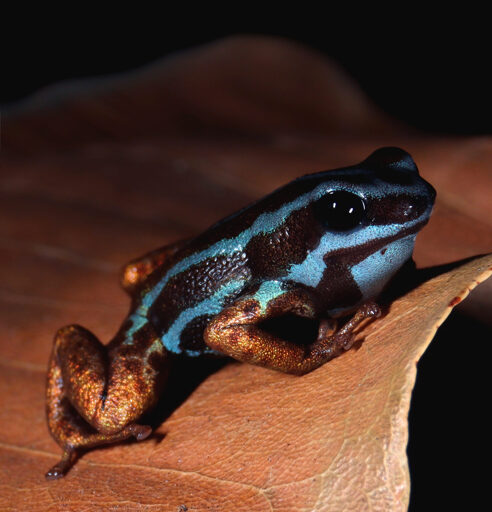
MANAUS, Brazil — Crouched over the leaf litter, where dry leaves accumulate on the forest floor, a researcher tries to capture a distinct croak using a directional microphone. Identifying the sound of a small frog is often one of the conclusive proofs that a new species has been found. It’s nighttime. He wears long clothing as protection against mosquitoes and ants, and boots to keep his feet dry. Finding amphibians in the Amazon doesn’t require high-tech equipment; it actually dates back to explorations by early-20th-century naturalists. That’s how biologist Igor Kaefer, a professor at the Federal University of Amazonas in Brazil, describes a typical day of fieldwork in search of amphibians in the Amazon. Kaefer was part of a group responsible for describing Amazophrynella bilinguis in 2019. The very description of the little toad gives an idea of how difficult it is to find: females measure about 2 centimeters (less than an inch), and their brown head and back make them “disappear” among the leaves and branches. Home to an estimated 1,525 species of amphibians, the Amazon Basin is the most diverse ecosystem in the world when it comes to frogs, an order that includes toads and tree frogs. However, occurrence records have been confirmed for only about 810 of those. So going into the field and finding a new-to-science species is not unlikely. “In almost every inventory conducted in a remote area, you come back with more than one new species for synthesis,” Kaefer says. But finding a species…This article was originally published on Mongabay
From Conservation news via This RSS Feed.