

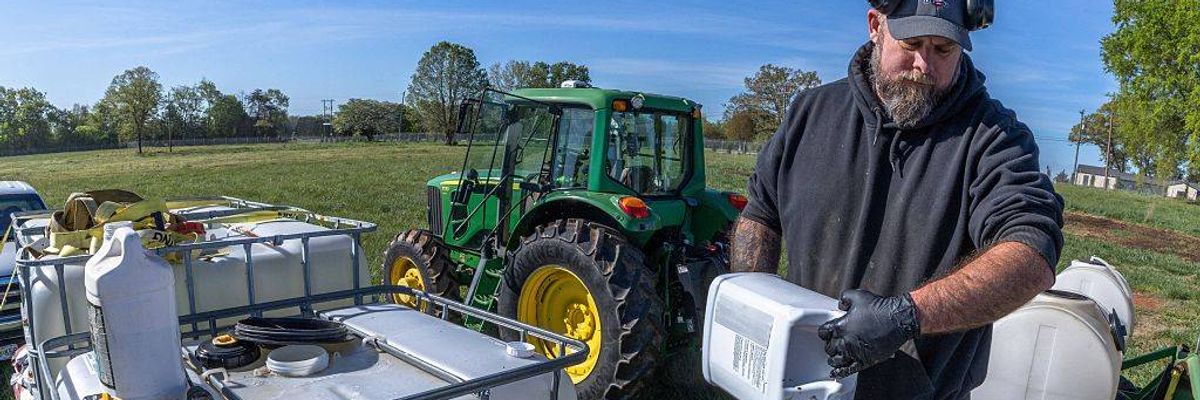
Democratic lawmakers on Wednesday underscored how the US-Israeli war on Iran and Trump administration trade policies are hurting farmers and consumers while Big Ag profits from fast-rising fertilizer and food prices.
President Donald Trump’s illegal war of choice has resulted in the closure of the Strait of Hormuz, through which around 30% of the world’s fertilizer and 20% of its oil previously passed. In addition to increasing the risk of a global food crisis, the strait’s closure has sent fuel and fertilizer prices soaring, with US farm diesel costing nearly 50% more than it did on the war’s eve in February and nitrogen fertilizer rising by a similar percentage.
Meanwhile, Trump’s erratic tariff war has further squeezed farmers and consumers. Tariffs have increased short-term prices, market volatility, and farmer costs while temporarily reducing import flows.
Vermont farmers “are footing the bill for Trump’s reckless war in Iran,” Rep. Becca Balint (D-Vt.) said Wednesday on social media. “Fuel and fertilizer costs are surging right amid planting season, hitting family farms that are already stretched thin. This needs to end.”
Rep. Shri Thanedar (D-Mich.) said on X that “food prices are skyrocketing because 70% of farmers can’t afford fertilizer, due to Trump’s reckless Iran War,” adding that “perhaps Trump should help them out by lending some, given that he’s full of crap.”
Rep. Betty McCollum (D-Minn.) noted Tuesday on Bluesky that “Minnesota’s farmers are dealing with tariffs, high fertilizer costs, expensive feed, and exorbitant fuel prices,” while Trump is “planning to lay off dozens” of US Department of Agriculture workers “who help farmers protect their land and water.”
The lawmakers’ posts followed Tuesday’s US Senate Agriculture Committee hearing on fertilizer market challenges, during which members of the Republican majority spoke vaguely of “trade disputes” and the “recent conflict in the Middle East” without naming names.
When it was her turn to speak, Ranking Member Amy Klobuchar (D-Minn.) noted the “direct link” between the soaring price of nitrogen fertilizer components and Trump’s actions.
“In the months since the president started the war, with no consultation or authorization from Congress… urea has spiked more than 40%, the cost of diesel has hit near record highs in Midwest states,” she said. “Now, why? Well, nearly half of the global urea goes through the Strait of Hormuz. Thirty percent of ammonia goes through the Strait of Hormuz.”
Farmers are facing fertilizer prices that are through the roof because of the across-the-board tariffs, market consolidation, and uncertainties stemming from a war in Iran that was started with no consultation or authorization from Congress.
[image or embed]
— Senator Amy Klobuchar (@klobuchar.senate.gov) May 12, 2026 at 5:51 PM
“Yet, even before the war, farmers were walloped by the presence of across-the-board tariffs,” Klobuchar continued. “An analysis by North Dakota State University… found that [International Emergency Economic Powers Act] tariffs added nearly $1 billion in costs to critical inputs like fertilizer, seed, machinery, and chemicals from February through October of last year.”
“Acting now will ultimately help stabilize prices and give farmers the certainty they need,” the senator added. “But it is going to have to be a combination of things: ending the tariffs, or reducing them, or making them much more targeted; ending this war; finding a way to resolve it, so the Strait of Hormuz is open again; and then going at this long-term systemic problem about the lack of competition in this area.”
According to the advocacy group Farm Action, a handful of companies—primarily Nutrien, Mosaic, and CF Industries—dominate the North American fertilizer market, operating as an oligopoly that controls over 90% of nitrogen and potash production. Saskatchewan-based Nutrien, the world’s leading potash producer, last week reported net first-quarter earnings of $139 million, up from $19 million one year ago.
“Fertilizer companies raise their prices because they can, and that’s the market power that they have,” Sen. Tina Smith (D-Minn.) said during Tuesday’s hearing.
Noting record gains reaped amid the tumult of Russia’s ongoing invasion of Ukraine, Smith said that during 2021-22, “the nine largest fertilizer companies made an estimated $84 billion in profits.”
“In 2022, major fertilizer companies saw profits increase somewhere between 100 and 200%,” she continued. “Their input costs did not go up by that much… How much do you think the profits of the average farmer in South Dakota [went] up during that time period?”
Pointing to new reports of robust fertilizer industry profits, South Dakota Corn Farmers president Trent Kubik replied, “during these last 75 days, a lot of money was being made, but it wasn’t by farmers.”
Addressing the question of “what can we do to change the behavior of companies that are in a position where they can charge such high prices and get such exorbitant profits,” Smith suggested considering a “windfall profits tax” to “make the market more fair, particularly for folks that are doing the work.”
The Trump administration’s plan to counter high fertilizer prices includes reopening the Biden-era Fertilizer Production Expansion Program, which provides grants and financing to build or expand domestic manufacturing capacity. Some critics have slammed the program as a form of corporate welfare.
The administration is also considering further expanding a multibillion-dollar bailout program, which critics say has mainly benefited large-scale, export-oriented commodity farms.
Responding to recent reports of strong profits for nitrogen fertilizer producers, Greenpeace Aotearoa (New Zealand) Big Ag project lead Amanda Larsson said Tuesday that “the illegal US-Israeli attack on Iran has sent global fertilizer prices soaring, and while a few agrochemical giants shamelessly reap bumper profits, farmers are watching their livelihoods wither on the vine."
“This is war profiteering facilitated by a broken, fossil fuel-dependent food system—with farmers and consumers paying the price,” she continued.
“Synthetic nitrogen fertilizer causes water and climate pollution, while propping up a system of industrial over-production, particularly to produce monoculture feed crops for livestock," Larsson said. “We are sacrificing our rivers, our climate, and our financial security to prop up a system that serves billionaires, not communities.”
“We cannot buy food security on a volatile global chemical market," she added. "The only path to true food sovereignty and resilience is through a transition to ecological farming. By moving away from synthetic fertilizers and toward diverse, nature-based practices, we can break the cycle of chemical dependence, protect our water, and ensure that the price of food is no longer dictated by the whims of war and corporate greed.”
From Common Dreams via This RSS Feed.