

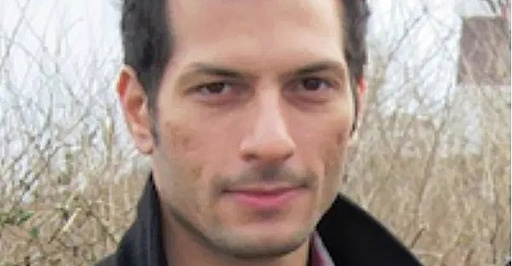
Janine Jackson interviewed Media Matters’ Angelo Carusone about Media Matters v. FTC for the May 8, 2026, episode of CounterSpin*. This is a lightly edited transcript.*
https://media.blubrry.com/counterspin/content.blubrry.com/counterspin/CounterSpin260508Carusone.mp3
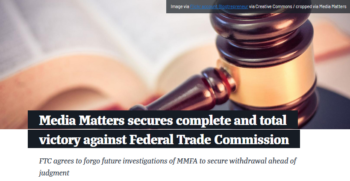
Media Matters (5/4/26)
Janine Jackson: With our First Amendment rights under threat everywhere, it’s heartening to see folks pushing back, and that pushback having impact. But advocates sometimes seem to spend more time lamenting setbacks than understanding victories.
So let’s pay attention to this story: The Federal Trade Commission, weaponized along with so many nominally nonpartisan agencies in service of MAGA and Trumpism, launched a particular sort of legal attack on the group Media Matters because of a report they produced that rattled Elon Musk. Three years later, the FTC is throwing in the towel on that bullying with a legally binding settlement.
Media Matters president Angelo Carusone says the victory “shows the importance of holding power to account and the importance of fighting instead of folding.” He joins us now by phone. Welcome to CounterSpin, Angelo Carusone.
Angelo Carusone: Thanks for having me.
JJ: Well, congratulations on the win, first of all. And thank you for fighting for it, because really it’s a win for free speech, and everybody who values that.
AC: Thank you.
JJ: Folks can get the detailed story, with all of the legal back-and-forths, on MediaMatters.org. But for those who might not have heard of it, I’ll ask you just to talk through the key events. What, first of all, was the report and the fallout that made Elon Musk himself initially threaten a “thermonuclear lawsuit” against you?

Media Matters (11/17/23)
AC: I’m glad you started there, because it is all connected. Back in the fall of 2023, we published some reports about ad adjacency for big advertisers and pro-Nazi content. And Elon Musk was very upset about that, and he didn’t just threaten, but ultimately initiated what he describes as “thermonuclear lawsuits” in Texas, in Singapore and Ireland.
But at the same time that that happened, Stephen Miller, who was not the deputy chief of staff at the time, because Trump wasn’t reelected, said publicly, in addition to your lawsuits, you should get Republican attorney generals to investigate Media Matters as well. And that’s what happened. They ginned up these investigations where Ken Paxton and Andrew Bailey in Missouri launched them.
And we sued to get injunctions against those investigations, and that was a novel theory that we had at the time. We got some new case law, some new precedents.
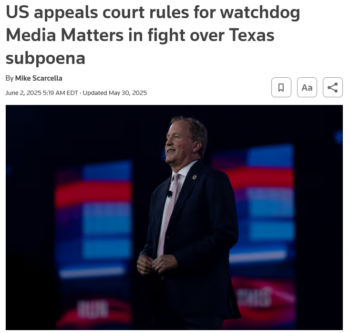
Reuters (6/2/25)
And it wasn’t just about protecting ourselves. We saw this new playbook emerging. So if you fast forward, one of the things that happened is we got new precedent, Ken Paxton appealed, he lost at the appellate court.
So now we’re in May of 2025, so Trump is back in office. The same week that the circuit court secured our victory against and shut down fully the other investigations, the FTC, Trump’s administration, took up the charge, and basically issued a nearly identical investigation.
They claimed it wasn’t related to Texas at the time, but as we later found out, there was tons of overlap and cross pollination. In fact, apparently Ken Paxton was working with the FTC on some of these matters, and they even referenced the articles that we published as a part of it.
And the investigation was expansive. It went back all the way to 2019. The types of materials they were seeking had nothing to do with what you would expect.
And, also, we’re a nonprofit. So it wasn’t about getting to some kind of core commercial interest. It was about, as you noted in your intro, using the levers of government to either bully or intimidate or maybe break, through a whole bunch of means, including just the cost of complying, because of the process of the punishment.
And so we sued to get an injunction, and there’s a little bit of back and forth there. But what happened is we got an injunction, and then they filed an emergency appeal and they lost the emergency appeal, and then they filed a secondary appeal. And in the circuit court, it looked like they were going to lose, that they were going to get a bad judgment. And so they withdrew their demand, and they said, “OK, we can go home now. We’re no longer investigating. It’s all over.”
And so when we talk about a settlement, a lot of times, usually, that’s a bad thing, because it means that you caved in some way. But it’s the opposite here. We secured victories in court, and then we didn’t let them off the hook. When they tried to withdraw, we said, “No, no, no, not so fast. If you want to withdraw, you’re going to need to give assurances and protections that are extended beyond just letting this whole thing be done. We’re going to need to know this can’t happen again, and that we’ll be able to battle this out in the future, if we need to, in jurisdictions that are safe, or that are at least relevant for us, like DC,” as opposed to letting them drag us to Florida or someplace else.
So that’s the genesis, a lot of legal back and forth. But it has been two years and eight months of investigations, and yesterday was the first day where the organization was not under investigation from some hostile government entity.
JJ: Let me ask you, as a point of clarification: People hear the FTC was “going to investigate,” but you’re talking about investigative demands. It wasn’t so much they were going to do homework and learn about Media Matters. They were demanding things from you. What was that like?

Angelo Carusone: “What we showed is that you don’t have to take this. You could go to court, and you can get these demands shut down before they even get a chance to start.”
AC: Yes. And that’s the tell. What they asked for was seven years’ worth of records, and the records included everything from all of our donors, all of our fundraising communications, all of the staff that ever worked at Media Matters, included during that time period, all of the editorial decisions that were made for every piece of content that we published, every article, all sources that we relied on, that we talked to.
We have reporters on staff. They wanted a list of all the sources and all the articles that they connected with, and that’s just one page.
They asked for a copy of all of the discovery material in the Musk cases, the Texas cases, which is millions of documents. And they asked for all of our communications with name and entity, whether it be news outlets, third parties, civil society organizations, voting rights organizations. I mean, it’s expansive.
And part of what is so significant about this, and I think this is the real tell, is that because these demands are always such a huge amount, they have a lot of power, because then you typically want to negotiate with them, and that’s what other players are doing, because then you say, “I’ll give you half. Let’s just make this go away.” But they have a lot of power to do these investigations, without having to get warrants or other things. They could sue you in court, and usually they get a lot of latitude to do that.
What we argued, and why it’s so significant, is not just that it protects us. We actually got a lot of new precedent. And what we showed is that you don’t have to take this. You could go to court, and you can get these demands shut down before they even get a chance to start. You don’t have to be trapped in the administrative bureaucracy, which, as we know, right now is being weaponized by the Trump administration. And that’s the significance. The real takeaway from all of this is not just that we’re having a sigh of relief, it’s that a lot of civil society organizations and news outlets, they now have a new tool in the toolkit to say, “I don’t need to negotiate. I can go to court, and I can get you to stop this without trapping me under the administrative process.”
JJ: And it’s an example that you can say, “you can try that, and it can work,” rather than, “In theory, maybe this is something we should try.” You have actually a case in which it succeeded.
AC: That’s right.
JJ: Can I ask you to take a second here to define “jawboning”? Because I think some might say, “Well, it was onerous, but the FTC was just asking for information, and that’s not retaliation. So we shouldn’t be bringing the First Amendment into it. ” But jawboning—and we can talk about what that means—it does come under the First Amendment.
AC: It does. It’s a form of using really intense, coercive pressure from a government entity, or legislative entity, to force a desired result. So it’s using some official channels, and the specter of those official channels, to make you comply in one way or another.
A lot of times, in the Trump era, people talk about it as sort of anticipatory obedience, and it’s that you know they’re going to misuse their power, the government. And so a lot of entities, big and small, say, “OK, I’ll give you what you ask for, so I don’t have to deal with this. ”
And it’s true, government agencies do investigations, they can do demands, but there are tells that it’s jawboning, and that it’s retaliatory. One is, who was involved in this? Some of the key decision-makers, or those that were involved at the FTC, have been on the record publicly, before they got into these positions, talking about their intention to use their power to go after organizations like Media Matters, even naming us.
So that was one example. The other is that, as I noted in that long intro, the arc, they keep coming at us to get the same information, which is, “What were you doing in 2020 related to the election? And what were you saying about what you’re claiming is disinformation to these other civil society organizations? And tell us your donor information.” And they keep coming.
And also that it’s not connected to anything related to the work that we did with respect to X.
And yet, as evidence came out, it was clear that they were coordinating with Paxton, when they jawboned the major advertisers into giving them a settlement. And when they filed their stipulation, they did it in Texas, even though they didn’t need to—the FTC, that is.
So it is a real thing to consider. And that’s the environment we’re in now, is that the Trump administration will use the levers of government power, not just to prosecute, but to ultimately achieve a desired result through these other coercive tactics.
JJ: You can think of Brendan Carr from the FCC talking about Jimmy Kimmel last fall, and saying:
We can do this the easy way or the hard way. These companies can find ways to change conduct, to take action, frankly, on Kimmel, or, you know, there’s going to be additional work for the FCC ahead.
That sounds like what somebody says with a knife to you. That doesn’t sound like someone’s “suggesting” policy, the way they’d like to see it go. It’s clearly coercive.
AC: Totally. And these administrative agencies, the assumption has been, I mean, we live in a world of norms, right? We’ve benefited from having some stability in our governance, even though we’ve known for a long time that it’s unfair, the advantage is to the powerful, it is a new twist to blow up all those norms, and at the same time weaponize all the instruments of these agencies. And as we’re seeing it play out, time and again, that is very significant.
And the part that I think is one of the “so what’s” of this is, at the same time that we were receiving [demands from] the FTC, they were pressuring all these major entities into giving them consent decrees, which is essentially an agreement from one of the targets. They got major media buyers to agree they would no longer move advertisements off places that were considered controversial, which has been a hobby horse of right-wing media for a long time.
And it was all the spectre of using these investigations, and their investigatory power to do it. They’re the companies, they’re the entities that have the deepest pockets to fight these fights. And so when they took themselves off the field, what they basically did was sharpen the blade for the administration to use this tactic against other players, because other players are smaller and have less resources and less ability to fight. So it became all the more important to try to do something proactive, that created some new case law to then give a tool in the toolkit.
And I’ll give the example that, even in the first year, that original precedent that we established in the Paxton case, it was applicable in our victory against the FTC, but it’s also been used in almost 30 cases against the Trump administration’s overreach against individuals and other entities. So it has provided a really useful tool to protect against the types of jawboning and other coercive tactics that they could deploy.
JJ: I thought it was interesting that Media Matters v. FTC had an amicus brief from the Cato Institute, who many probably don’t think of as progressive warriors, but because they said, “This is a violation of the First Amendment, and we’re against it. ” So this wasn’t even a partisan issue, if you think about it.
AC: No, and we had 48 amicus briefs, one of which was a whole bunch of news organizations, the AP, the New York Times, Reuters, many major news outlets filed advocacy on the same thing. Everybody came at it with a similar angle—it’s an attack on the First Amendment—but in slightly different ways. News outlets were looking at it from the free press perspective, places like Cato were on the expression.
We had a whole bunch of voting rights organizations and civil society organizations come at it from the free assembly perspective. Because if you think, one of these things they were looking for, like I said, was the donors. That’s not relevant. Even if everything they claimed they were investigating was significant, who was funding it is not their charge. And getting access to nonprofits’ donors is designed to be protected, because the effect is if they can get that, they can harass them, and ultimately chill the contributions to civil society.
And there was a fairly wide buy-in that this was a critical case, and you don’t get to the amicus stage unless you stand up the first time around. And I think that, to me, is the ultimate takeaway. It sucks, and it’s unfortunate that we have to do it, but if you don’t fight, you’re guaranteed to lose, and you just don’t lose for yourself, you actually make it easier for them to do it again and again and again. And that, I think, is the big takeaway from all of this, is that there does need to be a little bit of a stiff spine if we’re all going to get through this with some of our rights intact.
JJ: It’s not identical to Trump’s EEOC bringing suit against the New York Times because a white man didn’t get the promotion he felt he deserved, but it feels like the same project.
AC: Yeah. Part of Miller’s strategy early on was to do these one-two punches of deploying civil lawsuits and state power in some way. And this is before Trump got back into office, but one of the projects that he had been engaging in, and that’s where that AG idea came from, is that when you launch these broad scale of suits, follow that up with these types of investigations, because you can box in your target. And even if you’re not successful, you get them to change their behavior in anticipation of the next one. And now that they’re in government power, they’re using it. And I think that’s, to your point, it’s the same thing. They’re leveraging this repeated civil lawsuits, and then some type of follow-up of a government attack, because it weakens the target even more.
JJ: Finally, and you’ve kind of answered this, but I think if folks hear the story, and they get the short version—”Oh, Media Matters fought the FTC and they won”—they miss a lot, because, as you’ve indicated, there have been costs to the group, on your time, on your resources. And it’s not like those impacts are erased with a legal settlement, and it’s not like another group would’ve been able to do exactly what you’ve done, depending on their size and their strength.
And then the other piece of that, which you’ve also addressed, but what has been the real cost to the government? Because their coffers aren’t going down. And so what is really, materially, to dissuade them from doing this again and again? So in terms of impacts on you and on them, it’s not like everything goes back to zero because you’ve won this settlement.
AC: No, it’s so true. And when Trump first got into power, and they went after big law firms, I think one of the big takeaways from all of that is that if you get all those big firms that do a lot of the pro bono work, you make it a lot easier to engage in these types of attacks, because you suck out the resources from the community that would need to fight back.
And I’m really grateful that, at least at the appellate level, we were able to secure some pro bono support from Washington Litigation Group, and we lucked out. But in this environment, that’s rare, because of how little pro bono resources remain, just given the Trump wave of attacks.
And it gets to your point: They’re willing to do a trench warfare approach, and inch this along if they have to, to keep moving the needle. It doesn’t go back, but the one thing that I think has been guiding a lot of our thinking around these fights is that you can’t stop people from speeding, but if you put some speed bumps in, you can slow them down.
And that’s kind of how I think about this. I’m not wide-eyed about it. It is bleak and brutal, but there are some speed bumps now, and hopefully others can pick that up, and continue to undermine and neutralize these jawboning tactics.
JJ: It certainly has provided some hope for lots of us.
So we’ve been speaking with Angelo Carusone, president of Media Matters. They’re online at MediaMatters.org. Thank you so much, Angelo Carusone, for joining us this week on CounterSpin.
AC: Thank you.
From FAIR via This RSS Feed.