

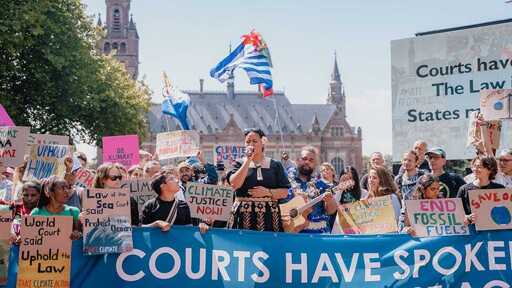
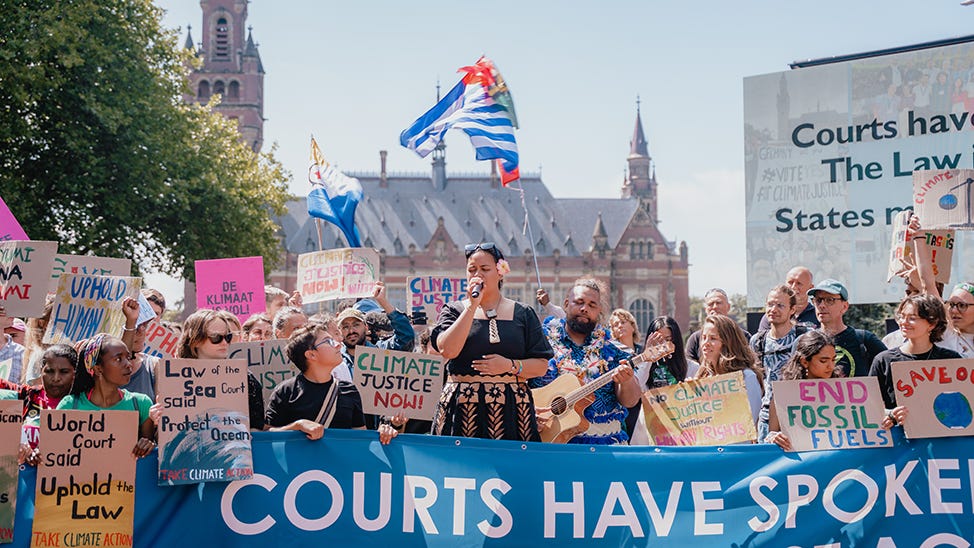
Photo Credit: Pacific Islands Students Fighting Climate Change
In late April, as the world’s official climate process continued to stall, a different kind of gathering took shape on Colombia’s Caribbean coast.
In Santa Marta, representatives from 59 countries convened for what organizers called the first-ever international conference dedicated not to debating whether fossil fuels should be phased out—but how to actually do it.
The “Transitioning Away from Fossil Fuels” conference, co-hosted by Colombia and The Netherlands, marked a decisive break from the decades-long gridlock of the United Nations’ annual climate summits, known as COP (Conference of the Parties). For many in attendance, it wasn’t just another meeting. It was a response to failure.
And a warning.
CODEPINK Substack is a reader-supported publication. To receive new posts and support our work, consider becoming a free or paid subscriber.
The Breaking Point
For more than 30 years, COP summits have been the central arena for global climate negotiations. But critics argue the process has become structurally incapable of delivering meaningful change.
“There’s been dissatisfaction for years,” said climate organizer Aaron Kirshenbaum of CODEPINK’s War Is Not Green campaign. “The conference itself has struggled to rid itself of the extraction and capitalism undergirding the major countries present there.”
At the most recent summit in Brazil, contradictions reached a peak. Hosted in the Amazon rainforest, the conference required infrastructure that contributed to deforestation. Indigenous communities struggled for representation. And most strikingly, the final agreement failed to even mention fossil fuels.
Meanwhile, fossil fuel lobbyists maintained a strong presence—reportedly making up roughly one in every 25 attendees.
The problem, Kirshenbaun explains, is not just influence—but structure. COP operates by consensus, allowing a handful of powerful states to stall progress indefinitely. Those same states, primarily in the Global North, are also the world’s largest consumers of fossil fuels.
A “Coalition of the Willing”
Frustrated by the impasse, Colombia proposed something different: a “coalition of the willing” that would move forward without waiting for universal agreement.
The Santa Marta conference was the result.
Unlike COP, it was not designed as a negotiating body. Instead, it aimed to lay out a roadmap—a practical and political framework for phasing out fossil fuels in real terms.
Participants included governments of nations who signed onto the Belém Declaration on the transition away from Fossil Fuels, as well as countries that are members of international alliances such as the Beyond Oil and Gas Alliance and the Fossil Fuel Treaty Initiative. Equally important, the gathering brought together around 1,000 civil society organizations, social movements, and grassroots groups.
This parallel gathering—the People’s Summit for a Fossil Fuel-Free Future—would prove just as significant as the official conference itself.
The Missing Piece: Power
At the heart of discussions in Santa Marta was a reality often sidelined in mainstream climate discourse: the global energy system is not just economic—it is political, military, and deeply unequal.
“The Global North consumes the majority of fossil fuels,” Kirshenbaum said. “But extraction happens in the Global South.”
This imbalance is not accidental. It is rooted in centuries of colonialism and maintained through modern systems of debt, trade, and military power.
Countries in the Global South, burdened by external debt, are often forced to expand extractive industries—oil, gas, mining—to generate export revenue. Those resources are then shipped abroad, refined, and sold back as imports at higher value.
“It’s a cycle,” Kirshenbaum explained. “Extraction to pay debt, which locks countries further into extraction.”
Efforts to transition away from fossil fuels, then, are constrained not just by technology or policy—but by sovereignty.
“You can’t start transitioning,” he said, “if you don’t have control over your energy infrastructure and finances.”
The Elephant in the Room
One issue loomed particularly large in Santa Marta—though it remains largely absent from official climate negotiations: the role of the U.S. military.
“The U.S. military is the largest institutional polluter in the world,” Kirshenbaum said.
Its global footprint—hundreds of bases across dozens of countries—relies on vast quantities of fossil fuels. But its environmental impact goes far beyond fuel consumption.
Military emissions accounting excludes not only combat operations, but also supply chains, weapons production, post-war reconstruction, and environmental devastation caused by conflict.
This exemption dates back to the Kyoto Protocol, where U.S. lobbying successfully removed military emissions from reporting requirements.
The result is a major blind spot in global climate policy.
“You can’t have a transition away from fossil fuels,” Kirshenbaum argued, “when the U.S. military exists as an enforcement mechanism for the fossil fuel economy.”
From securing oil supply routes to intervening in resource-rich regions, military power has long been intertwined with energy interests. For many at the conference, addressing climate change without confronting militarism is not just incomplete—it is impossible.
The People’s Summit: Naming the System
While official delegates debated pathways and policies, the People’s Summit went further—directly naming the systems driving the crisis.
Its final declaration, developed by hundreds of organizations, placed climate change within a broader framework of capitalism, colonialism, and imperialism.
It also explicitly linked the climate crisis to ongoing U.S.-Israeli-led global conflicts and imperial violence, including wars and sanctions that shape energy production and access.
“The declaration reflects what people on the front lines are actually experiencing,” Kirshenbaum said.
Among its core demands:
- A complete and equitable phase-out of fossil fuels
- A just transition to 100% renewable energy
- An end to structural barriers, including militarism and economic coercion
- A transformation of global systems toward justice and sovereignty
Additionally, the document outlines 15 principles, including one on “sovereignty, peace, and self-determination.” It also emphasizes People(s)-Centered Human Rights and collaboration for Indigenous peoples, Afro-Descendants, workers, women, and other marginalized and impacted communities. Territorial sovereignty, a rejection of false solutions like carbon markets and capture, and the need to move beyond extractive systems entirely—even in the context of renewable energy—are also centered in the declaration.
Beyond Fossil Fuels—Or Just New Extraction?
One of the most urgent debates at the conference centered on the risks of a “green transition” that replicates existing patterns of exploitation.
As demand for renewable technologies grows, so too does demand for critical minerals such as lithium and cobalt—often extracted from regions already subjected to environmental degradation and political instability.
From Latin America’s “lithium triangle” to mining operations in Central Africa, these resources are increasingly tied to geopolitical competition.
“We need to avoid extraction in any form,” Kirshenbaum said. “That was a consistent point throughout the conference.”
For Indigenous communities, this is not an abstract concern. Their lands are frequently targeted for both fossil fuel and renewable resource extraction.
“They protect extraordinary amounts of biodiversity,” he said. “But their sovereignty is consistently disregarded.”
A Fracture in the Global Order
The Santa Marta conference also revealed a growing divide between countries willing to move forward on fossil fuel phase-out and those still invested in maintaining the status quo.
Notably absent were many major Global North powers.
France, however, did participate, proposing measures to phase out coal and fossil gas. While some viewed this as a positive step, others pointed out the contradictions.
“France is still part of NATO,” Kirshenbaum noted. “If military emissions and neocolonial extraction aren’t addressed, there’s a long way to go.”
The same applies to The Netherlands, a co-host of the conference. NATO’s 2025 3.5% spending increase was projected to create an extra 2,330 MtCO2e (Metric Tons of Carbon Dioxide Equivalent) of total carbon emissions by 2030—almost the total annual emissions of Brazil and Japan combined.
These tensions underscore a broader question: can countries lead on climate policy while remaining embedded in systems that drive environmental destruction?
What Comes Next
The Santa Marta gathering was never intended to produce binding agreements. Its goal was to shift the conversation and begin building an alternative path.
That process will continue next year, when the conference reconvenes in Tuvalu, co-hosted with Ireland.
For frontline nations, particularly small island states threatened by rising sea levels, the stakes could not be higher.
Meanwhile, organizers and activists are working to expand the coalition, strengthen the People’s Declaration, and push for a global Fossil Fuel Non-Proliferation Treaty.
Whether this effort can succeed where COP has struggled remains to be seen.
But one thing is clear: a growing number of countries and movements are no longer willing to wait.
A Different Kind of Climate Politics
If COP represents the official face of global climate governance, Santa Marta offered a glimpse of something else: a politics that does not separate climate from war, or energy from empire. A politics that asks not only how to reduce emissions, but who controls resources, who bears the costs, and who gets to decide.
For activists, that shift may be the most important outcome of all.
As Kirshenbaum put it:
“We shouldn’t be having separate movements—environmental, anti-war, economic justice. The same systems are driving all of it. And we have the same targets.”
Learn more about transitioning away from fossil fuels with our War is Not Green Campaign!
Aaron Kirshenbaum is CODEPINK’s War is Not Green campaigner and East Coast regional organizer. Based in, and originally from, Brooklyn, New York, Aaron holds an M.A. in Community Development and Planning from Clark University. They also hold a B.A. in Human-Environmental and Urban-Economic Geography from Clark. During their time in school, Aaron worked on internationalist climate justice organizing and educational program development, as well as Palestine, tenant, and abolitionist organizing.
Teri Mattson currently works with the Venezuela Solidarity Network. She is an activist with the SanctionsKill coalition and CODEPINK’s Latin America team. Her writing can be found at Anti-War.com, CommonDreams, Jacobin, and LAProgressive. Additionally, Teri hosts and produces the YouTube program and podcast WTF is Going on in Latin America & the Caribbean.
From CODEPINK Substack via This RSS Feed.