

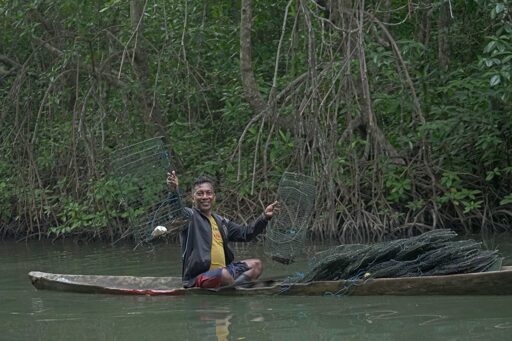
JAKARTA — On small islands across eastern Indonesia, coastal communities are reviving customary rules, seasonal fishing closures, turtle protection and mangrove stewardship to protect marine ecosystems threatened by blast fishing, turtle hunting and habitat loss. Their efforts are the focus of Jejak Wallacea, a new documentary produced by Burung Indonesia and Arise! Indonesia as part of the Wallacea Partnership Program II, a conservation initiative supported by the Critical Ecosystem Partnership Fund. The film follows communities in the provinces of East Nusa Tenggara, South Sulawesi, Southeast Sulawesi and Central Sulawesi that use locally rooted systems to manage coastal ecosystems. These include customary sanctions, community patrols, octopus fishing closures, coral reef restoration, turtle hatcheries and mangrove-based livelihoods. For Burung Indonesia, the local affiliate of BirdLife International, the film is also an attempt to show that conservation in the eastern Indonesian islands that make up the Wallacea region, one of the world’s richest marine biodiversity regions, cannot depend only on formal protected areas or top-down enforcement. “The Wallacea Partnership Program is essentially aimed at strengthening the capacity of civil society in site-level conservation,” said Angga Yoga, a terrestrial program specialist at Burung Indonesia. “That’s why the NGOs are not very visible in the film, because the communities themselves are the ones we empower.” Angga contrasted the approach with more exclusionary conservation models, saying the initiatives featured in the film were designed by communities themselves through customary systems rather than imposed mainly through prohibitions. “Instead, it works through customary systems, meaning the communities themselves…This article was originally published on Mongabay
From Conservation news via This RSS Feed.