


Italy is an old owl. And this owl, once queen of the night, finds it increasingly difficult to spread its wings. Its skeleton stiffens, its joints creak, and the gaze that once swept across the horizon now looks ever more downwards, towards the water’s surface. For many Italians, this metaphor speaks directly to the country’s present reality: a nation increasingly defined by declining birth rates and an ever-ageing population.
In 2025, Italy recorded 355,000 births compared with 652,000 deaths. This is not a balanced figure, but a net loss of almost 300,000 people in a year. In fact, it represents the lowest figure on record since 1861… An era predating Italian unification in much of its modern form.
At the same time, Prime Minister Giorgia Meloni has made the birth rate an obsession. She has repeatedly promised to place families and natality at the centre of public policy, yet existing measures remain fragmented and insufficient to address the structural causes behind Italy’s demographic decline, from precarious employment and stagnant wages to soaring housing costs, limited childcare services, and restrictive immigration policies.
A snapshot of decline
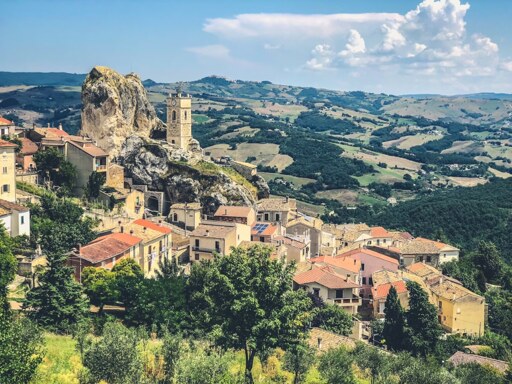
The region of Molise is a snapshot of what Italy will look like in the coming years. Here, there are 123,000 pensioners, whilst the number of people in employment stands at just 103,000.
The town of Sant’Elena Sannita, in Upper Molise, represents the most extreme case: over the past 80 years, its population has collapsed from 3,000 inhabitants to fewer than 300.
In 2024, fourteen municipalities recorded not a single birth; there were nine in the province of Campobasso and five in the province of Isernia. Small villages with only a few hundred residents are now facing administrative extinction.
At the same time, Molise possesses a unique historical identity, shaped by longstanding ties with the Balkans and the presence of a Croatian minority. This cultural and economic bridge remains largely underused, despite immigration continuing to dominate political debate and challenge Giorgia Meloni’s government. Yet these opportunities remain untapped. This situation is not limited to the South of the country: similar trends are already being observed in Liguria and Umbria.
Don’t blame the young
Young men and women cannot be blamed if they prefer to emigrate and not have children in Italy. Daniele Vignoli notes that, in 2008, the fertility rate had reached 1.5 children per woman – the highest level since the 1980s. This marked what was described as “a new spring of fertility in Italy” – something that, today, many Italians can hardly even imagine.
One only needs to look at the data to understand how striking it is that, less than two decades ago, the figures were moving in a completely different direction. The fertility rate has plummeted to 1.14 children per woman. To put this into context: the figure of 2.1 is considered the ‘replacement rate’ necessary to maintain a stable population without immigration. Italy is not merely below this threshold; it is dramatically far from it.
Anti-immigration + low birthrate = crisis
Germany, Spain, Portugal, and other European countries are following similar trajectories. Italy, however, reached the crisis point first. Every year, the numbers drop another notch. Giorgia Meloni speaks of immigration as a threat to Italian families, claiming it is a catalyst for their dissolution. But immigration could be the revitalising force that this society is unable to generate on its own.
Every year, the numbers drop another notch, and then another, towards the abyss. Reopening and providing structural funding for schools, making serious investments in the healthcare system, and creating decent living conditions, including affordable housing, fair wages, and genuine residence permits for immigrant residents, should be seen as essential countermeasures to avoid ending up with an increasingly ageing population.
The government frames immigration as a threat to social cohesion. But this is where the cognitive disconnect lies: a society that fails to produce its own citizens cannot afford the luxury of rejecting those who could revitalise it. Fewer births yesterday mean fewer parents today, fewer births tomorrow, and even fewer the day after. A United Nations report predicts that Italy will lose five million inhabitants over the next 25 years, down from 59 million.
The owl may yet awaken. Concrete actions are needed: real infrastructure in small towns, open schools, functioning healthcare, affordable housing. Italy needs policies that treat immigration not as an invasion, but as a transfusion of new blood.
Featured image via Lonely Planet
From Canary via This RSS Feed.