

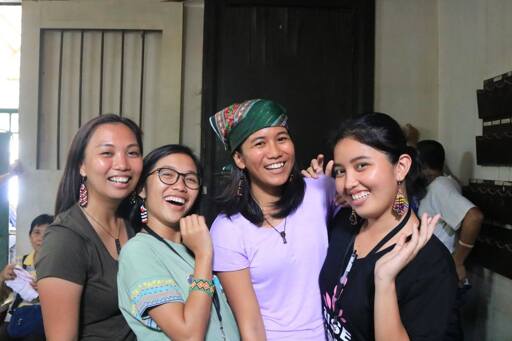
By Cris Fernan Bayaga
CEBU CITY – Years of detention, red-tagging, and abduction attempts has not stopped women alternative media journalists from exposing the plight of marginalized communities.
For former correspondents of Aninaw Productions, a Cebu-based alternative media group, community journalism is necessary amid worsening repression of progressive organizations, activists, and media workers.
Aninaw Productions aims to help people discern and understand social realities clearly, reflecting the direct meaning of the Bisaya word “aninaw.”
The revival of the media outfit in 2017 was led by University of the Philippines Cebu (UP Cebu) Mass Communication graduates Dyan Gumanao and Myles Albasin, alongside other community development workers.

Gumanao (in mint green shirt) and Albasin (in purple shirt) during their college days when they were still students at UP Cebu (Photo courtesy of Dyan Gumanao)
They sought to revive alternative media during the height of the transport sector and progressive groups’ campaigns against the jeepney phaseout, helping jeepney drivers and urban poor communities in Cebu to amplify their calls and demands.
Gumanao now serves as the national vice chairperson of Hustisya – Pagkakaisa ng mga Biktima para sa Hustisya (Victims United for Justice) while Albasin works as communications officer at Manila Observatory – KLIMA Center and as paralegal at La Viña Zarate (LVZ) Law.
Gumanao served as an anchor for the radio program Usapang Pambata which received the Kapisanan ng mga Brodkaster ng Pilipinas (KBP) Golden Dove Award for Best Children’s Radio Program. She was also recognized as Best Anchor in the 2014 ABS-CBN Campus Patrol Competition.
Albasin served as Aninaw Productions’ video editor and researcher, focusing on multimedia releases and video documentation focused on local campaigns against human rights violations during Duterte’s administration.
Community work through communications
While both have taken different paths within the progressive movement, they continue to uphold the importance of community journalism and the role it plays in documenting issues often overlooked by mainstream media.
Gumanao now leads campaigns for victims of human rights violations across the country through Victims United for Justice. On February 23, she led a Duterte Crimes Watch activity in Cebu City for victims of the Duterte drug war to witness the start of the International Criminal Court’s (ICC) confirmation of charges hearing.

Gumanao leads Duterte Crimes Watch in Cebu City during the ICC’s first confirmation of charges hearing (Photo courtesy of Cris Fernan Bayaga/Bulatlat)
Albasin said that continued working for her causes after detention because the acquittal was never the end of their struggle. “I wanted to show that the Mabinay 6 did not just stop at acquittal, but continued the calling to serve the people.”
She said that she is inspired by the lawyers and human rights defenders who stood by them throughout their legal battle, motivating her to become a people’s lawyer who will stand with political prisoners and individuals facing unjust persecution.
“I will follow the footsteps of those who bravely defended us in court and outside the court. I want to be one of the people’s lawyers who will be at the forefront of the struggles of those who are being harassed,” she said.

Atty. Tony La Viña of LVZ Law when he served as Albasin and the rest of Mabinay 6’s legal counsel (Photo courtesy of Tony La Viña)
As undergraduate students, Gumanao and Albasin became roommates in their sophomore and graduating years. Coming from Mindanao and moving to Cebu for college, they said that they found a sense of home in each other “like sisters.”

Gumanao in red shirt doing a peace hand sign and Albasin in purple shirt posing in front of UP Cebu’s entrance gate (Photo courtesy of Dyan Gumanao)
For them, college became more than an academic pursuit. It was during their undergraduate years that they realized communication was not limited to theories discussed inside classrooms. It could also become a tool for social engagement and collective action.
During this time, they became involved in the progressive movement. Gumanao said that the country’s education system, even at an early age, encourages an individualistic mindset focused on personal advancement. However, she later came to understand education as something that should also contribute to social development.
Being a UP student, she said, broadened her understanding of success beyond self-fulfillment or securing corporate opportunities with high salaries. She came to believe that education must ultimately serve the people.
Albasin learned to see communication as a means of shedding light on social realities and giving visibility to underrepresented communities.
She said that after college, she knew she wanted to use journalism to give back to communities through the skills she had developed in school.
For Albasin, joining Cebu’s alternative media community became a way to serve the people by documenting grassroots initiatives and humanizing the issues communities face through “on-foot and live coverages.”
State-sponsored attacks
A year after graduating, Albasin pursued community reporting as a correspondent for Aninaw Productions. Part of her research work involved documenting issues in Barangay Luyang, Mabinay, Negros Oriental, particularly the struggles of peasant and youth sectors in the area.
On March 3, 2018, during her fieldwork, members of the Philippine Army’s 62nd Infantry Battalion arrested her alongside five peasant and youth advocates, accusing them of being “fully armed” guerrillas. The group later became known as the Mabinay 6.
The arrest led to charges involving the alleged possession of firearms and explosives which rights advocates and supporters claimed as fabricated accusations against the group.
Seven years later, on September 22, 2025, the Regional Trial Court Branch 42 in Dumaguete acquitted all members of the Mabinay 6 of the 12 criminal charges filed against them.

Albasin raises fist as she pleads not guilty during her arraignment at Bais City Municipal Trial Court on May 2, 2018 (Photo courtesy of Aninaw Productions)
The court cited inconsistencies in the evidence presented by soldiers, including paraffin tests that yielded negative results for gunpowder residue among all members of the group.
Albasin’s research work in Negros Oriental also exposed issues involving water supply systems in the area, while her reporting assignment focused on documenting the struggles of farmers in Luyang.
For Gumanao, Albasin’s work reflects the essence of alternative media reporting: refusing to remain silent about the conditions experienced by marginalized communities.
She said that immersion among communities is essential in understanding the realities journalists seek to report.
“If you’re an alternative media reporter, in order to find the truth, we should be there, we should immerse ourselves, and experience the struggles for us to see it ourselves, to truly understand and report about these issues,” she said.
For Gumanao, it is not enough for journalists to merely claim that poverty is worsening in the Philippines without directly engaging with affected communities.
She said that journalists must leave their “ivory towers and air-conditioned offices” and pursue field reporting.

Gumanao represented Aninaw Productions in a discussion on the media’s role in addressing the push to build coal-fired power plants in Cebu (Photo courtesy of Aninaw Productions)
“As researchers and members of alternative media groups, we do not confine ourselves to social media, secondhand, thirdhand information. We do not confine ourselves to desks,” she said.
Read: Mabinay 6 freed after 7 years in unjust detention
Two years later, while Albasin remained detained, Gumanao was also arrested on June 5, 2020, after a mobilization at UP Cebu against the Anti-Terror Act during the height of the COVID-19 pandemic.
She was arrested alongside seven other progressive individuals, later referred to as the Cebu 8. Their legal counsel, Kristian Jacob Abad Lora, condemned the arrests and said that the law was being weaponized against progressive groups.

Gumanao alongside seven of Cebu 8 at Camp Sotero Cabahug after their illegal arrest (Photo courtesy of College Editors Guild of the Philippines Cebu)
In 2024, the court cleared Cebu 8 of the charges filed against them, stating that their mobilization did not violate the Public Assembly Act of 1985.
Read: Court clears ‘Cebu 8’ protesters of charges after 4 years
On January 10, 2023, Gumanao and her partner, UP Cebu National Service Training Program (NSTP) educator Armand Dayoha, went missing after arriving at the Cebu City Port from a holiday trip in Cagayan de Oro.
The two later said that they were abducted by police officers and forced into a vehicle and were brought to an unknown location.
Two days after they were reported missing, Gumanao and Dayoha were able to contact their relatives. They were later found in a resort in Carmen, Cebu after allegedly being abandoned by their abductors.

Gumanao speaks about their experience 14 days after their abduction, alongside members of other progressive groups in Quezon City (Photo courtesy of Mark Saludes/Altermidya)
Read: Missing Cebu-based activists found; parents mulling to file charges
Alternative media matter
Despite these experiences, Gumanao said that resistance remains necessary as long as the conditions faced by ordinary Filipinos persist.
She said that attacks experienced by activists and journalists reveal broader efforts to suppress truth-tellers and weaken the progressive movement.
“Those in power right now are facing a crisis of decline. That’s why they are very desperate to exhaust all measures to decrease the resistance of the people, because it is inevitable that social change is possible,” she said.
For Gumanao, these further affirm the need for journalists to document the struggles of underrepresented and repressed sectors.
Albasin agreed that community reporting comes with risks, but said that she continued pursuing this kind of journalism because ordinary people remain eager to share their stories through larger platforms.
She said that many communities are often preoccupied with daily survival and sustaining their families, leaving them with little opportunity to make their issues visible.
Alternative media, she said, helps bridge that gap.

Albasin’s first speakership after acquittal at her home college, UP Cebu College of Communication, Art, and Design, during the 2026 Convocation of CCAD Awardees, where she spoke about her life as a community journalist (Photo courtesy of Lanog)
“We have this understanding that systemically there is something wrong and because of that, there are more kinds of problems that can’t be covered by traditional means. We need to find another platform for the masses,” she said.
Gumanao described alternative media as “a movement on its own,” saying that journalists who understand the realities faced by marginalized sectors have a responsibility to resist oppression through reporting.
“If they can silence community journalists, then it’s much easier for the state forces to potentially attack the most vulnerable sectors who do not have an immediate community that can help them. These are sectors whose struggles are not usually covered by the media,” she said.
For her, the core of alternative media work lies in caring for communities in remote areas who have little access to platforms where they can tell their own stories.
Fearless journalists
Albasin said that misinformation online has made it difficult for the realities experienced by communities to surface publicly. Because of this, she challenged the notion that journalism is entirely objective.
“That is not true, we choose to enter the media because we acknowledge that there is a need for voices to be amplified, to be listened to, because for the longest time, they tried to silence these voices,” she said.
She said that she looks up to journalists like Frenchie Mae Cumpio and RJ Ledesma who continued documenting the struggles of marginalized communities despite legal attacks and harassment.
Albasin said that despite the cases filed against Cumpio, and despite previous rulings dismissing similar allegations, the journalist continues to fight.
She also reflected on Ledesma’s situation, saying that it affected her because they belong to the same generation.
At a young age, she said, journalists like Ledesma devoted their time to amplify the struggles faced by communities in Negros.
For Gumanao, continuing community reportage is necessary during moments of crisis because people must respond to the call not to remain silent.
“The moment we choose to fight for accountability, to fight for justice, is the moment we commit ourselves to becoming part of the struggle for genuine social change,” she said.
Albasin said that when journalists stand with communities, they recognize the importance of ensuring that people’s concerns are heard and understood.

Albasin after her acquittal during the Regional Trial Court (RTC) 7 declaration that Mabinay 6 is not guilty of all 12 trumped-up criminal charges filed against them (Photo courtesy of Beatrice Jubilee Orbiso/Aninaw Productions)
“The state is very desperate to find ways to silence those who would like to tell the truth that are experienced by the masses, even at the expense of killing a journalist,” she said.
While she acknowledged the chilling effect experienced by media practitioners, including what she personally experienced during detention, she said someone still needs to continue the work community journalists have started.
Albasin urged communication students aspiring to become journalists to never stop asking why atrocities, oppression, and inequalities continue to persist.
She said that students must use their talents in whatever form possible to help communities and address the injustices they witness.
“As long as we see, even at the slightest, an incident that doesn’t sit right with us, we have to ask why. Once we start asking why, that’s when we realize that we can do something about it as journalists,” she said.
Gumanao stressed that under current social and political conditions, no one is truly insulated from systemic problems.

Gumanao speaks about their abduction during the 2022 United Nations Human Rights Council (UNHRC) 4th Universal Periodic Review (UPR) on the human rights situation in Geneva, Switzerland (Photo courtesy of Karapatan)
Even those who are not directly targeted politically, she said, continue to experience the effects of economic, cultural, and political oppression.
“It’s just a delusion to say that there’s a safer place. For as long as imperialism, capitalism, and an oppressive state exist, there’s no safe place because of these systemic issues. We have no choice but to fight,” she said.
Albasin reminded people within the movement that even during moments of exhaustion, fear, and uncertainty, collective support remains essential.
She said that one thing she learned as an alternative media journalist is to “salig ug sandig ka sa masa” (trust and lean on the masses) because their support is far greater than people often realize.
“If we trace history, there’s a long-term reason why there’s a progressive movement. We’re here for each other and for the people we serve,” she said. (RTS, DAA)
The post Cebu women journalists fight state repression appeared first on Bulatlat.
From Bulatlat via This RSS Feed.