

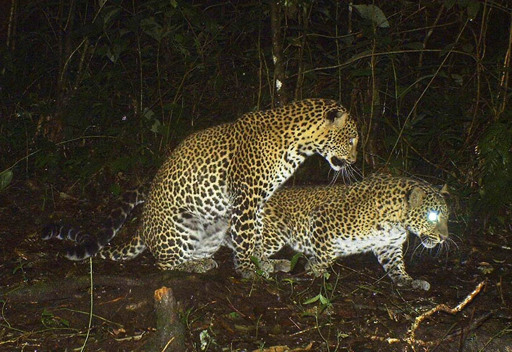
Reforestation done right could be key to helping rebuild habitat connectivity for Javan leopards on an island with one of the highest human densities on Earth, a new study says. It frames strategic forest restoration — linking up fragmented patches of forest to create contiguous corridors — as offering a rare pathway to balance rapid infrastructure expansion with the conservation of the endangered big cat. “And to implement this, strong commitment from various stakeholders is needed, given Java’s highly fragmented landscape; this will undoubtedly be a significant challenge,” study lead author Andhika C. Ariyanto, a Ph.D. candidate at the University of Twente in the Netherlands, told Mongabay by email. Camera-trap image of a Javan leopard on Mount Sanggabuana, West Java province. Image courtesy of Sanggabuana Wildlife Ranger. The study is the first to produce an islandwide model of habitat connectivity for the Javan leopard (Panthera pardus melas), offering conservationists a new tool to identify which forest corridors should be protected and restored as infrastructure development expands across Java, Andhika said. By comparing the impact of new roads and railways with a scenario in which degraded forests were restored, Andhika and his colleagues found that replanting trees in key areas could help reconnect fragmented habitats throughout Java and give wildlife, including leopards, more room to move and survive. They looked at key forest areas used by leopards across Java, an island half the size of the U.S. state of Texas with five times its population. This high human population density has…This article was originally published on Mongabay
From Conservation news via This RSS Feed.