

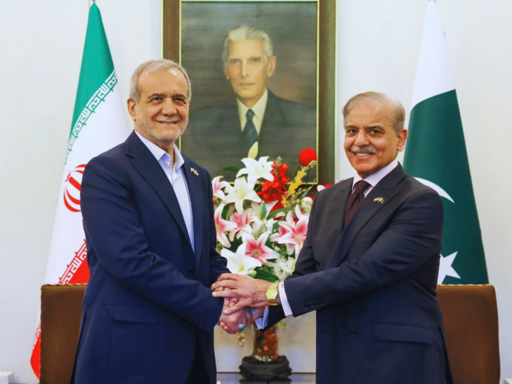

Pakistan has reiterated plans to issue a yuan-denominated “Panda bond” as it seeks to shore up its economy. This move comes amid inflationary and geopolitical pressures triggered by Trump’s war on Iran. The longer-term strategy is to reduce Pakistan’s reliance on the dollar. Meanwhile, Pakistan aims to raise funds through Chinese capital markets.
These plans, announced by Pakistan’s finance minister, Muhammad Aurangzeb, are expected to take effect next week:
God willing, next week you will hear good news that for the first time, we will be accessing Chinese capital markets through Panda bond.
View this post on Instagram
Pakistan’s initial $250 million Panda bond, backed by the Asian Development Bank and the Asian Infrastructure Investment Bank, is part of a $1 billion package.
The dual shock of soaring inflation and collapsing remittance incomes has put Pakistan’s economy in a squeeze, alongside others across Asia. They’re reeling as a direct consequence of disruptions to the Strait of Hormuz, cutting off 20% of the world’s oil and gas supplies.
In South Asia, inflation is set to rise from 2.9% in 2025 to 5.0% in 2026, driven by higher food and energy prices.
Abandoned by the UAE
Pakistan was recently also rocked by the UAE’s refusal to renew a $3.5 billion financial facility, a move viewed by Islamabad as a betrayal. Saudi Arabia stepped in with $3 billion in additional support to help bridge the multi-billion-dollar gap in the country’s finances.
According to the FT, the UAE’s decision follows growing frustration with Pakistan’s deepening ties with Saudi Arabia and what it considers Pakistan’s meek response to Iranian attacks on the Gulf.
Recent UAE developments, including the US dollar swap request, exit from OPEC, and expulsion of 15,000 Pakistani Shias, can be read as interlocking signs of the Gulf state’s increased subservience to the US/Israel axis.
Michael Kugelman of the Atlantic Council, a pro-war group, in an interview with DW, said that Pakistan’s role as a mediator was to protect itself because of its vulnerability. The country depends heavily on Gulf remittances from overseas workers, and energy imports from the Middle East.
Pakistan’s need to protect its fiscal position is shaped in large part by the need for cash in a cash-strapped, politically turbulent region.
By contrast, the US interests, which Kugelman presumably thinks are altruistic, are applauded… American exceptionalism and all.
What he presents as opportunistic behaviour by Pakistan is, in fact, a question of survival. After all, his institution’s backers in Washington and Tel Aviv are the ones who started the war. So, are countries in the Global South expected to absorb these consequences without protest? Or should they do so without mitigation?
The curse of IMF loans
Pakistan has received $4.8 billion from the International Monetary Fund so far. These funds were received under two separate programmes.
The first is the Extended Fund Facility, a 37 month arrangement approved on September 25, 2024. This is the main bailout program. In addition, the second is the Resilience and Sustainability Facility. It is a 28-month arrangement approved on May 9, 2025. It focuses on climate and disaster resilience.
IMF is a Western neoliberal international finance institution that offers the poorer nations no viable exit from the death spiral of debt.
According to the Tricontinental Institute:
the IMF not only engineers austerity-driven debt crises, but its policies are designed to ensure and manage a permanent debt crisis, not to erase debt.
Ali Hasanain, a professor at the Lahore University of Management Sciences, explained on Al Jazeera that Pakistan entered the Iran war crisis with virtually “no economic cushion”. This was because it had already been subjected to a long-standing IMF-managed austerity programme.
As a result, the government was unable to shield ordinary people from rising energy prices. Consequently, it was forced to pass most of the inflation directly onto consumers.
The US-Israeli war on Iran has impacted fiscally vulnerable nations like Pakistan. Hence, its entry into the Chinese capital market through the Panda bond is a much-needed lifeline.
Featured image via the Canary
By The Canary
From Canary via This RSS Feed.