

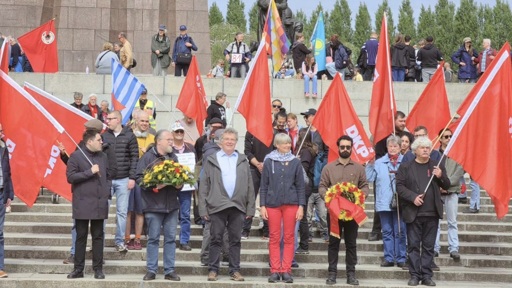
On May 8 and 9, left and progressive movements in Europe marked Victory Day – the 81st anniversary of fascism’s defeat in World War II. “For the Left this cannot be merely an act of remembrance,” wrote the European Left Party. “It is a call to continue the struggle for a peaceful and antifascist Europe.”
Victory Day memorializes Nazi Germany’s official surrender in 1945, marking the end of war in this part of the world and the victory of partisans, national resistance movements, Red Army soldiers, and allied forces. The extreme atrocities committed by Nazis and fascists over previous years – notably mass persecution, torture, and killing of Jews, Roma, communists, and other groups – resulted in millions of deaths, with many more killed in combat and bombardments: the USSR alone lost 27 million citizens during World War II.
Read more: Victory Day: reclaiming the Global South’s legacy
Events took place across the region to commemorate the anniversary. Many emphasized similarities between trends that led to the rise of fascism and today’s militarization and armament, calling for urgent action. The European Left Party echoed words of Mauthausen concentration camp survivors, who pledged after liberation: “We are determined to carry on the struggle against imperialism and nationalist hatred. The construction of a new world of peace and freedom is our goal.”
While progressives view Victory Day as a lesson for future action, many local, national, and EU bodies paid lip service to the day’s origin while erasing contributions of communist and resistance groups from official history. European Commission President Ursula von der Leyen and High Representative for Foreign Affairs Kaja Kallas focused exclusively on Europe Day – occurring in the same period – featuring EU flags and highlighting the bloc’s stated aims of “unity, cooperation, and democratic values.” During a press conference, Kallas stated that not all EU countries can celebrate May 8-9 as Victory Day because of their Soviet past – which she described as a period of “atrocities.”
Read more: Nobody is forgotten, nothing is forgotten: The 80th anniversary of a victory still contested
Berlin authorities pursued a similar discourse, banning, once again, the display of USSR and communist symbols during celebrations traditionally held next to Soviet memorials. The ban extended to Russian Federation flags and songs like “Katyusha” and “Kalinka”. “Since according to Russian propaganda, Russian soldiers are fighting Nazis in Ukraine, there is a direct link between the victory over fascism in World War II and the Russian Federation’s current war in Ukraine,” Berlin Police wrote when announcing the ban.
“The ban,” wrote the German Communist Party (DKP), “is a slap in the face to all those who, on May 8 and 9, pay tribute at Soviet memorials to the tens of thousands of Soviet soldiers who fell in the battle of Berlin. At the same time, it is an insult to the peoples who, as part of or alongside the Red Army, liberated Europe from fascism.”
“Despite anti-Soviet bans and restrictions, we remembered in humility the fallen soldiers of the Red Army and their families, who sacrificed everything in the fight against German fascism,” the DKP added.
Read more: Liberation Day in Italy marked in solidarity with Cuba and Palestine
In Italy, a large demonstration took place in Rome, reclaiming the narrative around World War II from revisionists. Potere al Popolo’s Marta Collot stressed the importance of ensuring solidarity with ongoing popular struggles around the world – notably in Palestine and Cuba – drawing inspiration from sacrifices made by communist movements and activists. It was largely communists and partisan fighters who gave their lives to defeat fascist forces, she emphasized, driven by a vision of a different world.
“They are the ones who have lifted millions and millions of people out of poverty,” she said. “They are the ones who believe that, in the face of barbarism, human dignity comes before any kind of profit.”
“Socialism, as well as communist men and women, remind us that there is always an alternative to barbarism; that there is – and that we need – a vision that allows us to imagine a different world so that we can build it,” Collot added. “In the face of barbarism, the only possible alternative is communism.”
The post Victory Day in Europe: EU revisionism continues, while Left honors resistance and Soviet contributions appeared first on Peoples Dispatch.
From Peoples Dispatch via This RSS Feed.