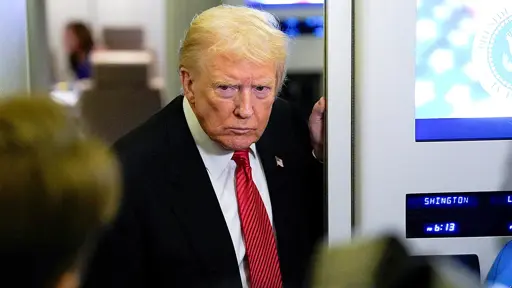
Iran’s response to the latest U.S. proposal represents more than just a partial rejection of Washington’s demands. Above all, it exposes the failure of the coercive strategy pursued by Donald Trump and leaves the White House trapped between two increasingly problematic options: escalating into a far more dangerous war or accepting negotiations far removed from the objectives proclaimed at the start of the conflict.
The reality is that, after months of war, bombings, sabotage, sanctions, and coordinated economic pressure between the United States and Israel, Tehran continues to negotiate without having capitulated, which completely transforms the strategic balance of forces.
The Islamic Republic has made it clear that it is willing to discuss limits, monitoring, and even temporary suspensions related to its nuclear program, but it will not accept the irreversible dismantling of its strategic capabilities. Nor is it willing to relinquish its main instruments of pressure — effective control over the Strait of Hormuz and its nuclear infrastructure — before obtaining concrete guarantees regarding a definitive end to the war, the lifting of sanctions, and the elimination of threats against the regime.
From the Iranian perspective, historical experience weighs too heavily to accept vague Western promises or unilateral commitments once again. Tehran vividly remembers what happened after the voluntary suspension of oil enrichment in 2003: a concession that ultimately led to increased pressure, new demands, and finally, international sanctions. The current Iranian logic stems precisely from that experience. Suspending strategic capabilities without solid guarantees, in their view, is tantamount to creating the conditions for future vulnerability.
The Iranian response reflects the perception of a regime that believes it has successfully withstood the combined pressure of the United States and Israel. Moreover, it believes that time is increasingly on its side.
This perception rests on several factors. First, the American inability to translate initial military successes into a decisive political victory. Washington and Israel destroyed infrastructure, eliminated commanders, and degraded Iranian capabilities, but they failed to break the regime’s strategic resolve or force it to accept the maximalist conditions demanded by Trump and Netanyahu.
Second, Iran learned that even limited attacks on energy infrastructure and shipping lanes were enough to generate enormous international economic tensions and force American caution. The Ras Laffan incident in Qatar highlighted just how vulnerable global energy stability remains. From then on, the Iranian threat to the Strait of Hormuz ceased to be an abstract hypothesis and became a concrete instrument of deterrence.
And third, Tehran correctly perceives the internal contradictions of the American position itself.
Trump repeatedly claimed that the Iranian nuclear program had been “annihilated.” He also declared that the war was virtually over and avoided fully assuming the domestic political cost of a protracted conflict. However, he now needs to maintain the military threat to try to obtain through diplomacy what he could not achieve by force.
This contradiction has become increasingly apparent. If Iran was truly defeated, why does Washington still require further concessions? And if Tehran still retains the capacity to blockade the Strait of Hormuz, attack regional energy infrastructure, and maintain a significant retaliatory capability, then it becomes clear that the proclaimed victory never truly existed.
Therein lies Trump’s true strategic dilemma.
The White House could continue to increase economic pressure, but even within Washington, there is a growing recognition that Iran possesses sufficient capacity to resist for months. It can attempt a new military escalation, although that would entail taking far greater risks than in the earlier phases of the conflict, without any real guarantees of altering Iranian calculations. Or it can accept, explicitly or implicitly, a settlement based on some of Tehran’s red lines, something politically difficult after having promised total victory.
Neither option is good.
The underlying problem for Washington is that the war ended up eroding precisely what it sought to reinforce: the credibility of the US capacity to unilaterally impose regional order. Iran did not merely survive. It demonstrated that it can still inflict significant costs on its adversaries and that it retains enough deterrent capability to force the United States to carefully consider every step.
This explains the growing anxiety among Washington’s regional allies. The United Arab Emirates maintains a harder line against Iran, but Saudi Arabia appears to be leaning increasingly toward the need for a swift negotiation that stabilizes the region. In the Gulf, the perception is growing that the United States can no longer single-handedly guarantee the regional security order as it did in the past.
Precisely for this reason, it is so significant that even figures historically associated with U.S. interventionism are beginning to acknowledge the magnitude of the problem. Robert Kagan — one of the foremost ideologues of American unipolarity and a proponent of multiple U.S. wars over the last few decades — now admits that the conflict with Iran could mark a strategic turning point for American hegemony.
His diagnosis is devastating. Its value lies precisely in its source: it does not come from an anti-American critic, but rather emerges from the very intellectual core of the American imperial establishment. In “Checkmate in Iran: Washington Can Neither Reverse Nor Control the Consequences of Losing This War” — published on May 10 in The Atlantic — Kagan argues that the United States has proven incapable of finishing what it started, and that the entire world is watching as just a few weeks of war against a regional power were enough to expose military, political, and economic limitations far deeper than anticipated.
The central issue is no longer merely Iran. It is the global perception that Washington faces mounting difficulties in imposing stable strategic outcomes, even after massive deployments of force.
Israel, too, faces complex consequences. Despite the significant military successes achieved during the war, it failed to resolve any of the major structural problems that had justified the offensive. The Iranian nuclear program remains intact. Tehran’s regional network of allies remains active. Gaza remains devastated and politically unresolved. And Israel’s international isolation continues to deepen.
The ultimate paradox for Trump is that the more he threatens further escalation, the more evident it becomes that the war failed to achieve its proclaimed objectives. And the longer the crisis drags on without resolution, the more visible becomes a reality that even segments of the U.S. establishment are beginning to acknowledge: the regional order can no longer be organized exclusively on Washington’s terms. The real problem for the United States is not solely the Iranian nuclear program. It is that, after all the destruction, economic pressure, and military superiority deployed, Iran remains defiant. And when an imperial power can no longer translate its military might into lasting political subordination, what enters into crisis is not merely a specific military operation, but the very credibility of its hegemony.
This article was originally published in Spanish on May 11 in La Izquierda Diario.
The post Iran’s Response to Ceasefire Negotiations Deepens Trump’s Strategic Dilemma appeared first on Left Voice.
From Left Voice via This RSS Feed.
I have no doubt that if we actually wanted to get into a full ground war we could destroy Iran. Problem is that’s not what we want and these fuckers never had a plan so this was always the outcome.