

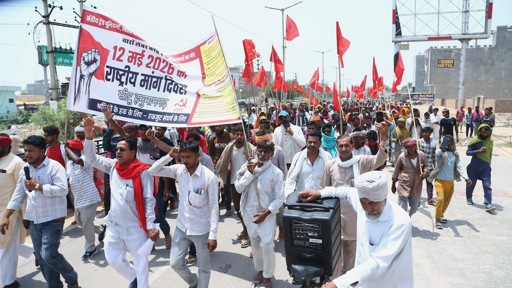
Hundreds of thousands of workers took to streets all across India on Tuesday, May 12, in solidarity with the unorganized workers facing state repression in various parts of the country, particularly in the National Capital Regions (NCR).
A joint platform made up of the Central Trade Unions (CTUs) and several independent sectoral federations made the call for the protest, calling May 12 “National Demands Day.”
The CTUs include all major left-leaning trade union federations in the country, such as the All India Trade Union Congress (AITUC), Hind Mazdoor Sabha (HMS), Centre for Indian Trade Unions (CITU), among others, with millions of members each.
The workers staged lunch-hour protests, sit-ins, and rallies at factory gates and industrial clusters across the country, carrying banners and posters and shouting chants against “inhuman exploitation”. Slogans focused particularly on contractual and non-regular workers.
The protesters condemned the brutal police repression of the striking workers in industrial manufacturing sectors in Noida, Manesar, Gurugram and Faridabad in the National Capital Region (NCR). Workers in these areas produce mobile phones, electronic components, garments, auto parts, and medicines.
The police from the right-wing-ruled states, such as Uttar Pradesh and Haryana, have launched “a direct assault on innocent workers and people, with the state machinery acting openly in the interests of the corporates,” a statement from the CTUs issued on May 6 says.
“Over 1,000 workers were arrested, with police using raids, repression, and surveillance to create a reign of terror.” They have arrested several “trade union leaders and wrongfully framed them” as “external” or “anti-national”. Some of these leaders and activists are still in prison.
The CTUs statement called the repression “nothing short of a state backed corporate offensive against the democratic rights of the workers.”
The CTUs claim that this “militant upsurge of workers’ resistance” is “against the inhuman exploitation of contractual industrial workers” and a “continuation of the momentum” built during the February 12 General Strike, in which over 300 million workers from all across the country participated, demanding the withdrawal of the four new labor codes.
Central demands
Though the agitation of workers has forced the respective state governments to hurriedly revise the wages, which they had failed to do for years, such revisions have largely been termed a sham by the CTUs. Even with the hikes announced, the “wages in Uttar Pradesh and Haryana remain far below those in Delhi despite identical living costs.”
Given the inadequacy of the wage revisions and continued state repression, the National Demands Day raised following demands;
- Inflation-adjusted minimum wages which should not be less than Rs 26,000 per month (approx 270 US dollars).
- Withdrawal of all cases against the agitating workers and immediate and unconditional release of all workers and activists.
- Immediate withdrawal of the four new anti-worker labor codes.
- Initiation of a tripartite dialogue with the trade unions and convening of Indian Labor Conference.
- Strict adherence to the 8-hour working day and double overtime wages
- Equal pay and end of contractual work.
More agitation is coming
The CTUs have claimed that India has seen a phenomenal rise in contractual employment, with around 42% of all employees in the manufacturing sector working on contracts in 2023-24. Most of these workers do not have any protection and are often forced to work beyond the stipulated working hours with no substantial wages.
The workers also face discrimination based on the nature of their employment and their gender, with women workers often paid less than their male counterparts and often subjected to workplace harassment.
In workplace and wage-related agitations, the governments in most of the Indian states have, instead of engaging in dialogue with the workers to provide relief, adopted the path of repression and taken the side of the management.
The state’s use of repression and smear campaigns, branding the agitating workers and their leaders as “external” or “anti-national” is a means to delegitimize the genuine struggles, CTUs statement says.
It warned that the failure of the state to listen to workers’ demands and unleashing acts of repression and smear campaigns will make it impossible for India to have any “lasting industrial peace.”
The government of India however, despite consistent protest and warnings by millions of workers for months now, has refused to listen to their concerns. On May 8 it went ahead and notified the final rules of the four labor codes.
This has prompted the trade unions to burn the copies of the act and issue calls for further agitation in the coming days.
The post Indian trade unions mobilize in solidarity with low-wage workers appeared first on Peoples Dispatch.
From Peoples Dispatch via This RSS Feed.