

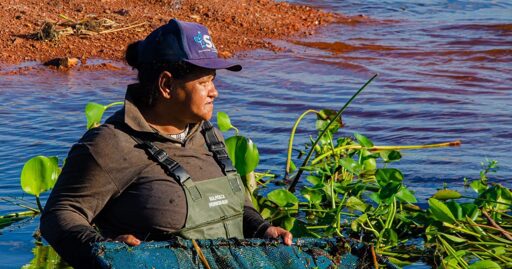
CORUMBÁ, Brazil — “Lord, go ahead of me and clear my paths, removing every beast, every wild animal, everything that does not come from you; let they be driven away, and may the Lord bless my work. I am in your hands. Walk with me, Father.” It is 3 a.m. on Baguari Island when Roseli Oliveira says her daily prayers before entering the dark waters of the Pantanal here in Brazil’s Mato Grosso do Sul state. With her flashlight off so as not to scare away the bait, she submerges up to her waist — sometimes up to her chest — surrounded by caimans, anacondas and stingrays. She has 12 hours of work ahead of her, with the dirty water penetrating her worn-out overalls. But she has no choice: no bait means no income. She is 48 and she has been doing this work for 36 years. Oliveira is not alone. In riverine communities scattered throughout the Pantanal, the world’s largest tropical wetland, dozens of women work gathering live bait for fishing. Armed with flashlights and fine-meshed dip nets known as puçás, they catch crabs and small fish such as tuviras (Gymnotus spp.) on riverbanks and bays. It is manual labor, invisible and dangerous, but also essential to an economy that moves millions and sustains fishing tourism in the region — an industry that rarely acknowledges these female hands. Free people, invisible work For the most part, small-scale fishers are distinguished from other workers by their autonomy. They are “free…This article was originally published on Mongabay
From Conservation news via This RSS Feed.