

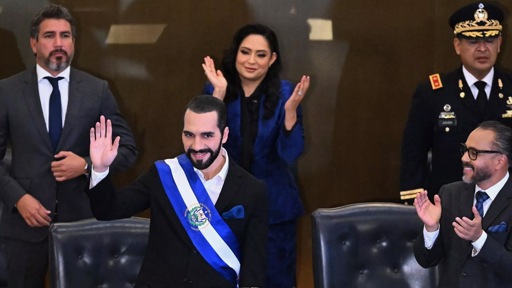
Last week, the online newspaper El Faro reported that the government of right-wing Salvadoran President Nayib Bukele froze the bank account and a property belonging to two partners of Trípode S.A., the company that founded and supports El Faro. According to the Ministry of Finance, the measure functions as collateral for alleged debts related to tax evasion.
However, the media outlet’s partners and journalists assert that this is yet another attempt to intimidate the press that has been critical of the Bukele administration and that, at its core, seeks to silence those who expose the right-wing government’s alleged acts of corruption.
The online newspaper El Faro has reported on numerous occasions that the government of right-wing President Nayib Bukele has launched several attacks against its journalists. It all began in 2020, when the president himself announced at a press conference that an investigation into the media outlet for money laundering would be launched.
Following that, the government conducted four audits to examine the source of the media outlet’s funding. Once it could not be proven that the funds were of illicit origin, the government pivoted to investigating the outlet for alleged tax evasion.
Carlos Dada, director of El Faro, told El País: “None of those audits has reached a final ruling; all are currently being litigated. We do not evade taxes. The taxes have been paid, and we have proven it.”
The allegations of deals between Bukele and the gangs
El Farobegan facing increased pressure after it revealed alleged pacts between powerful Salvadoran gangs and various governments, including Bukele’s.
In May 2025, several leaders of the Barrio 18 gang claimed that their organization had engaged in negotiations with Bukele before he became president – that is, while he was mayor of San Salvador.
The recent attempt to financially strangle El Faro coincides with the release of a documentary titled “The Deal,” produced in collaboration with the US network PBS, which reconstructs the alleged agreements between the Bukele administration and the MS-13 and Barrio 18 gangs. This documentary has garnered hundreds of thousands of views in less than a month.
“Clearly, this is another step in the escalation we’ve been facing since 2020. Not only through legal channels, but also through economic strangulation, political attacks, false accusations, espionage, and the interception of our communications,” Dada told El País.
In 2023, after several years of investigations, threats of criminal trials, and audits that have proven nothing, the administrative structure was forced to relocate to Costa Rica. In 2022, the newspaper also reported that 22 of its staff members had been subjected to nearly 226 attempts to hack into their electronic devices using the Pegasus spyware.
“We conclude that at least 35 individuals from the media organizations El Faro, GatoEncerrado, La Prensa Gráfica, Revista Digital Disruptiva, Diario El Mundo, El Diario de Hoy, and two independent journalists were hacked using Pegasus. We also identified hacking against civil society organizations in El Salvador, including Fundación DTJ, Cristosal, and another NGO,” Citizen Lab states in a report on the spying on journalists and activists in El Salvador
According to a recent report by the Association of Journalists of El Salvador (APES), nearly 50 journalists and reporters have been forced into exile in 2025 for fear of being imprisoned by the Bukele administration, including the entire main editorial staff of El Faro. In addition, there have been more than 400 attacks against journalists by a government that appears to have no moral qualms about confronting the press with the force of the state.
In this regard, El Faro states in an article: “The government continues to criminalize journalists and media outlets that defy its propaganda. It is using the state apparatus, which is under the control of the Bukele family, to persecute critical voices.” A year after the forced exile of our staff from El Salvador, we have continued to practice journalism and investigate the government, through the publication of monthly magazines, weekly podcasts, international collaborations, and more gatherings of journalists, such as the Central American Journalism Forum.”
Finally, the newspaper stated: “We will continue to practice journalism with the commitment and rigor that has characterized us since 1998. But also with the certainty that, as long as we don’t stop, they won’t stop either.”
The post Bukele escalates crackdown on independent media after documentary exposes his alleged gang deals appeared first on Peoples Dispatch.
From Peoples Dispatch via This RSS Feed.