


As top arms companies BAE Systems and Rheinmetall announce record sales, civilians in Yemen have faced a setback in their pursuit of international justice yet again.
After more than 6 years of preliminary examinations, the Office of the Prosecutor of the International Criminal Court (ICC) has confirmed that it will not open an investigation into the legal responsibility of European governments and arms companies in alleged war crimes in Yemen.
Radya Almutawakel, chairperson Mwatana for Human Rights, said:
The entrenchment of impunity over a decade of conflict has not only deepened the humanitarian catastrophe but has also fueled the persistence and escalation of hostilities.
The absence of international accountability has effectively granted a ‘green light’ to all parties, including the Ansar Allah armed group (Houthis), to persist in committing grave violations that exacerbate human suffering and undermine any prospects for stability in Yemen.
The ICC decision comes in response to a joint article 15 Communication requesting that the ICC investigate if European corporate and government actors aided and abetted alleged war crimes committed by Saudi Arabia and the UAE in Yemen through the sale of arms.
It was submitted in 2019 by:
- The European Centre for Constitutional and Human Rights (ECCHR).
- Mwatana for Human Rights.
- Amnesty International.
- Campaign Against Arms Trade.
- Centre Delàs.
- Rete Italiana Pace Disarmo.
Arms trade accountability
The 350-page Communication was the first of its kind to call for the ICC to address the issue of arms trade accountability.
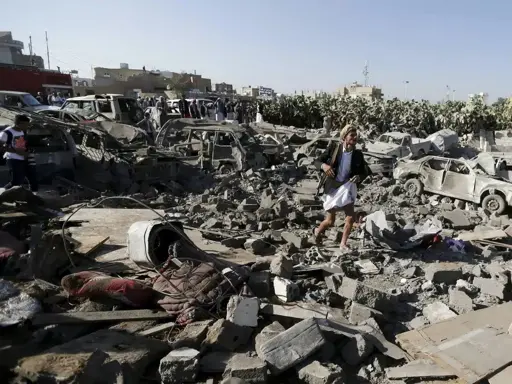
It details factual information on 26 airstrikes by the Saudi-UAE coalition, which may amount to war crimes under the Rome Statute. These included attacks on residential buildings, schools, hospitals, a museum and world heritage sites.
Despite clearly documented instances of indiscriminate and disproportionate attacks, arms companies from Germany, France, the UK, Italy and Spain continued to supply the coalition members with weapons, ammunition and logistical support. Government ministers and officials facilitated these exports by granting export licenses.
The Office of the Prosecutor did not provide any specific legal reasoning for its decision not to open a preliminary investigation. This is despite increasing calls for the international community to hold arms companies to account, where arms sales enable the commission of international crimes.
The cycle of impunity remains, perpetuated by the failure of the international justice system to hold powerful defence industry actors to account. Efforts to seek accountability have continued through strategic litigation at the national level against the actors named in the Communication.
Cases in Italy and the UK did not result in findings of liability. But a criminal complaint against arms traders is pending in France. And there are two submissions before the European Court of Human Rights.
Chloé Bailey, senior legal advisor ECCHR, said:
We regret the decision from the ICC not to examine the complicity of European arms companies in violations of international humanitarian law during the conflict in Yemen. In the face of ongoing geopolitical instability and conflicts fuelled by the arms trade, the ICC has an essential role to play in seeking the accountability of all conflict actors, including corporations.
Sam Perlo-Freeman, research coordinator at Campaign Against Arms Trade, explained:
European arms companies like BAE Systems and Rheinmetall, and government ministers including Boris Johnson, actively enabled and supported the brutal Saudi-led war in Yemen through the supply of arms and ongoing support and maintenance.
The Yemeni people deserve justice and accountability for these crimes, as well as those of the warring parties themselves. This ICC decision is yet another failure, maintaining the wall of impunity for western actors supporting war crimes.
Amnesty International’s Patrick Wilcken added:
While the ICC has failed to take this case forward, the principles outlined in the Communication still hold: both state officials and company executives bear responsibility when knowingly supplying arms used to commit war crimes.
And campaigns coordinator at Rete Italiana Pace Disarmo Francesco Vignarca said:
Even though the Italian criminal complaint started by civil society groups over bombs sold to Saudi Arabia used to kill civilians in Yemen did not result in a trial, the preliminary Judge’s decision to archive the case nonetheless acknowledged a violation of the Arms Trade Treaty.
That is why we pursued a Communication to the European Court of Human Rights in Strasbourg and why an ICC action would have been essential.
Victims and their families deserve justice, and arms sales that endanger innocent civilian lives must be stopped.
Featured image via the Canary
By The Canary
From Canary via This RSS Feed.