

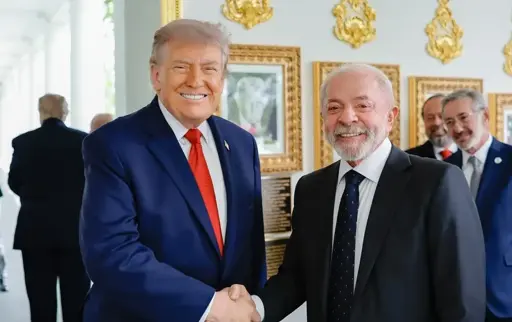
On May 7, Donald Trump and Lula met at the White House, where Trump gave Lula a warm welcome, praising him as “very dynamic” and rolling out the red carpet for the Brazilian president. He described the meeting as “very good.” This positive reception clearly indicated Trump’s intentions toward Lula, who since 2025 has celebrated the “good chemistry” with Trump, now declaring it “love at first sight.” Lula has, however, responded cautiously to the United States’ neocolonial offensive in Venezuela and the escalating criminal blockade against Cuba.
After speaking with Trump — one of the most interventionist leaders in global politics — Lula claimed he had “reasons to believe” that the U.S. will not interfere in Brazilian elections. This staggering statement fosters illusions about the role of U.S. imperialism, especially from a government that has historically sponsored coups, sanctions, economic blackmail, and destabilization efforts throughout Latin America. The notion of “love at first sight” between Lula and Trump does not reflect a commitment to national sovereignty; rather, it signifies an adaptation to U.S. pressure and an attempt to maintain stable relations with a segment of the international Far Right that poses a tangible threat to workers and oppressed peoples.
What Was Discussed?
No details have been made public about the leaders’ trade negotiations. According to Trump, tariffs were a key topic, although the U.S.’s interest primarily lies in Brazil’s rare earths and strategic minerals. Lula had already signaled his willingness to cooperate during the preparatory phase of the meeting by allowing the sale of the Serra Verde mining company to U.S. Rare Earths, a company linked to the U.S. government. Serra Verde is one of the world’s largest rare earth explorers and the only company outside Asia capable of supplying the four main magnetic rare earth elements: neodymium, praseodymium, dysprosium, and terbium.
At a press conference, Lula portrayed this concession as a “defense of sovereignty.” The central policy underpinning this handover is Bill 2780/2024, which establishes the National Policy on Critical and Strategic Minerals (PNMCE) and was approved by the Chamber of Deputies on May 6, 2026. Lula thanked right-wing politician Hugo Motta, asserting that the bill would facilitate a new phase of the country’s “industrialization.” By opening Brazilian natural resources to both the U.S. and China, Lula claims that the endeavor will not be solely extractive but will also involve refining and creating national jobs. In reality, this bill favors large mining companies, relaxes environmental regulations, and accelerates the exploitation of Brazil’s natural resources under the guise of “energy transition” and U.S. “national security.” While posturing as a leader who “brings investment to Brazil,” Lula has positioned the country within the strategic competition between Washington and Beijing as a territory to be expropriated.
Lula aims to present himself as a statesman capable of negotiating with far-right politicians like Trump. But these negotiations often devolve into capitulation. What is “modern” about placing strategic resources at the disposal of U.S. interests? What constitutes “progressive statesmanship” when it allows for increased environmental destruction and the bolstering of private mining companies, while the working population still lacks access to basic rights?
This subordinate stance reinforces elements of capitulation first articulated by the Far Right and fails to address the needs of working and poor populations. Their interests are intrinsically linked to the enjoyment of common natural resources, which should not be treated as commodities subject to the global market.
A Moment of Difficulty
The meeting between Trump and Lula occurred during a period of political challenges for both leaders, each facing the weight of domestic defeats.
The international landscape is undoubtedly marked by the weakening of Trump and U.S. imperialism, following military setbacks in their war against Iran. With strong internal opposition to the war and an economy strained by inflation and rising unemployment, Trump is bracing for disappointing midterm election results. His challenges are further reflected in the terrain of class struggle and social mobilizations that challenge the Republican domestic agenda. He was forced to make a partial retreat in response to resistance in Minneapolis, along with the historic scale of the recent “No Kings” demonstrations — highlighting a climate of mass polarization and contestation that limits his room for maneuver and deepening political instability in the United States.
For his part, Lula has also faced setbacks, including the rejection of Jorge Messias’s nomination to the Supreme Federal Court (STF) and the overturning of presidential vetoes related to reducing sentences for those convicted on January 8, 2023. Additionally, recent polls indicate a challenging electoral landscape for Lula, with surveys showing Flávio Bolsonaro leading him in certain second-round scenarios, reflecting the political strain on the government, thanks to a policy of conciliation that ultimately strengthens the Far Right.
More importantly, this meeting took place against the backdrop of an aggressive U.S. policy toward Latin America, characterized by attempts to reaffirm U.S. hegemony in the so-called Western Hemisphere in response to China’s advances in infrastructure, energy, and strategic minerals.
On the “Chemistry” between Lula and Trump
In mid-2025 U.S.-Brazil relations were altered by the episode involving 50 percent tariffs on Brazilian exports. Lula, having faced significant defeats in Congress, saw a sudden increase in his government’s approval ratings for resisting Trump’s “Liberation Day” demands. Later, Trump himself encountered a judicial setback in the United States when federal courts ruled parts of his tariff package illegal, indirectly benefiting the Brazilian government. Shortly thereafter, a meeting at the UN solidified what Trump described as “great chemistry” with Lula, who has celebrated the relationship ever since. At that time, Trump shared a photo with Lula, stating, “It is a great honor to be with the president of Brazil. … We have always had a good relationship — and we will continue to have one.”
This time around, Trump followed the same script. The red-carpet reception included praise for Lula’s dynamism, and Trump affirmed that new meetings would be held. Indications suggest that Trump continues to seek accommodation with the Brazilian government in light of the new U.S. offensive in Latin America, preferring diplomacy over the aggression he has previously shown in Venezuela and now in Cuba. Trump remarked that he would simply seize Cuba once the aircraft carriers deployed against Iran returned to the Atlantic. In this conciliatory posture, Lula aims to avoid Trump’s negative interference in Brazil’s national elections. The chemistry between the two does not necessarily imply an effective resolution to Washington’s pressures on Brazil; rather, it seems to be an attempt to manage them politically. Even after Trump’s judicial setbacks regarding tariffs, Brazil remains the target of a “Section 301” trade investigation conducted by the United States Trade Representative, which keeps open the possibility of new tariffs and economic pressure measures against the country.
Silence on Venezuela
Lula did not address Venezuela at the press conference. Regarding Cuba, he said that “Trump will not invade,” attempting to quell indignation against U.S. political and military pressure, and he did not voice opposition to the blockade of the island. This is symptomatic. Accompanied by a political and military hardening of U.S. actions in the region, Trump seeks to pressure Latin American governments and reconfigure imperialist ventures. By coordinating with right-wing and far-right puppet governments in Latin America, Trump has been strengthening mechanisms of cooperation in security, intelligence, and migration repression while framing criminal organizations and cartels as “terrorist threats.” This movement expands the legal and political space for interventions, blockades, military operations, and increased U.S. presence in the Caribbean and South America.
Venezuela has become an emblematic case of this regional imperialist orientation. The capture of Nicolás Maduro in January 2026, presented by the White House as an operation against “narco-terrorism,” was a milestone in the U.S. escalation of interventionism. The classification of groups linked to drug trafficking and even sectors of the Venezuelan state as terrorist organizations reinforced a hemispheric securitization logic that intertwines economic disputes, military intervention, and control of natural resources.
Lula took great care not to irritate Trump, which meant refraining from any mention of Venezuela. He has already stated that the “return of Maduro and [his wife] Cilia is not the main concern,” but rather “improving the lives of the Venezuelan people” — an affront to a country besieged by colonialist interventions through bombings and kidnappings.
This issue is connected to that of rare earths and strategic minerals, since the U.S. advance on Caracas implies the theft not only of oil but also of minerals from the Orinoco Basin and Mineral Arc, a region rich in coltan, copper, nickel, and other minerals used in military, technology, and artificial intelligence industries. This represents a policy of geopolitical pressure and a reorganization of U.S. influence over Latin America, which will be felt more acutely in Brazil thanks to Lula’s conciliatory approach.
An Attempt to Contain China
The meeting also served as an opportunity for Trump to pressure Brazil on its relations with China. Brazil’s structural dependence on China’s economy, particularly in agribusiness, challenges Washington’s efforts to regain influence. Brazilian exports to China in 2025 reached a record US$100 billion, a 6 percent increase over 2024, solidifying China as Brazil’s largest trading partner. In contrast, the partnership with the U.S. amounted to only US$37.7 billion in 2025, a 6.6 percent decline compared to 2024, marking the largest drop in five years.
Chinese investments in Brazil surged by 45 percent last year compared to 2024, reaching US$6.1 billion — the highest amount since 2017 — according to the annual survey of the Brazil-China Business Council. Furthermore, Brazil was the main destination for Chinese overseas investments in 2025, reflecting not only China’s growing presence in Brazil’s economy but also its intention to establish the country as a “red line” against U.S. ambitions. To this end, the Brazil-China Cultural Year was inaugurated in 2026, an agreement aimed at consolidating international cooperation beyond trade and politics.
China’s rising capitalism, characterized by a voracious pursuit of global resources, also increases Brazil’s dependence on foreign capital. Submission to the “double dependence” on both the U.S. and China has become Lula’s fate as a “statesman.”
Against Conciliation, an Anti-imperialist Policy Is Fundamental
Trump’s policy, which updates historical elements of the Monroe Doctrine under new geopolitical conditions marked by rivalry with China, seeks privileged access to and control over production chains and strategic resources, especially rare earths and critical minerals essential for the military industry, artificial intelligence, semiconductors, and energy transition technologies. In this context, Latin American bourgeoisies appear deeply subordinated to imperialism, albeit through different paths. On one side, far-right sectors act openly as lackeys of U.S. interests, advocating for automatic alignment, privatizations, and the unrestricted opening of the region’s strategic resources. On the other, governments and bourgeois factions aim to preserve extremely limited margins of negotiation between the U.S. and China, attempting to leverage great-power rivalry to expand investments and bargaining power without breaking the dependent, export-oriented condition of Latin American economies.
The dispute over rare earths encompasses not only trade but also control over technological supply chains, the military industry, and strategic resources essential for the productive reorganization of the great powers.
Lula aims to negotiate trade conditions while maintaining a degree of diplomatic autonomy, all without deviating from the export-dependent framework of Brazil’s economy. Confronted with evident political fatigue, defeats, and the rise of far-right initiatives domestically — highlighting the limitations of class-conciliation politics — Lula seeks to present himself to Washington as a more stable and effective interlocutor for foreign capital interests in Brazil, whether from the U.S. or China.
It is necessary to break this recurring cycle of double dependence. There can be no independence or national sovereignty in the politics of surrender agreements with Trump or Xi Jinping.
It is necessary to overturn the rare earths bill, which serves the interests of the U.S., large mining companies, and environmental destruction, by immediately nationalizing Serra Verde and the entire strategic rare earths sector, without compensation to large private entities. Workers, in collaboration with scientists, Indigenous peoples, affected communities, and environmentalists, must take control of the exploitation and planning of these shared natural resources. All of the country’s trade agreements must be reassessed to ensure that national resources benefit the poor and working population rather than the great powers.
Moreover, Lula’s “statesmanship” relies on maintaining good relations with an imperialist regime that is, alongside Netanyahu, responsible for genocide in Palestine, the destruction of Lebanon, and the imperialist war against the Iranian people. It is essential to sever ties with Zionism in all aspects and to immediately halt the delivery of oil to Israel’s genocidal regime, redirecting it instead to the Cuban people, who are being strangled by Trump’s policies. The unification of Latin America against imperialism and the major capitalist powers can be achieved only through a program of class independence that is inherently anti-capitalist — something that is unattainable with Lula’s politics.
The post Lula-Trump Meeting: “Love at First Sight” in Submission, Dependence, and the Surrender of Natural Resources appeared first on Left Voice.
From Left Voice via This RSS Feed.