

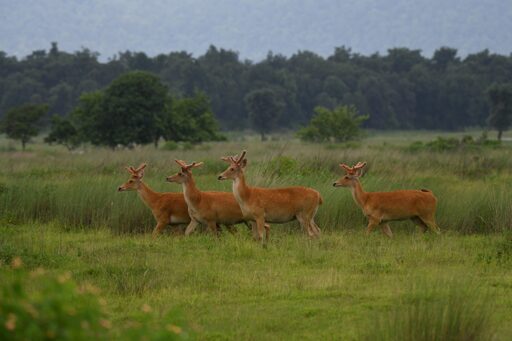
Forest authorities in central India have successfully helped establish a new breeding population of the vulnerable hard-ground swamp deer, an animal previously restricted to just one protected area, reports contributor Sneha Mahale for Mongabay India. Once widespread in India, the hard-ground swamp deer (Rucervus duvaucelii branderi) was until recently reduced to a single, isolated population of around 1,100 individuals, restricted to Kanha Tiger Reserve in central India’s Madhya Pradesh state. The hard-ground swamp deer is the only subspecies of the swamp deer — or barasingha, meaning “12-horned” in Hindi — that’s adapted to solid grassland. The two other subspecies live in swampy grassland habitats in other parts of the country. “Confining the entire subspecies to Kanha effectively created a single point of failure,” Neha Awasthi, a member of the Deer Specialist Group at the IUCN, the global wildlife conservation authority, told Mongabay India. She said small isolated populations face risks from fluctuations in population, gene patterns and inbreeding, as well as external threats including disease outbreaks or large-scale environmental disturbances. To help the deer survive future catastrophes, the Madhya Pradesh forest department translocated 98 deer from Kanha to Satpura Tiger Reserve, also in Madhya Pradesh, between 2015 and 2023. The deer were first transferred into a 50-hectare (124-acre) predator-proof enclosure to allow for acclimatization, before being released into open grassland. Awasthi is a co-author of a recently published study that found that the hard-ground swamp deer population had increased from the original 98 to 172 individuals by 2023.…This article was originally published on Mongabay
From Conservation news via This RSS Feed.