

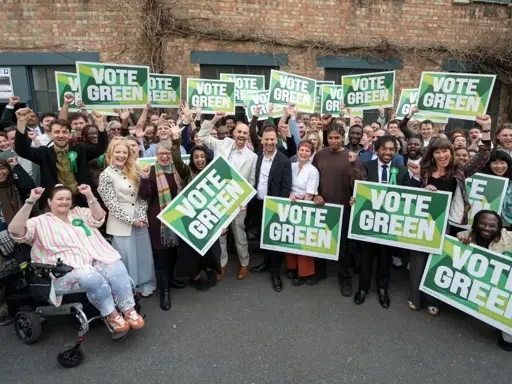

When the local election votes were being counted on Thursday night, the story was one of a huge Reform win on seats, collapse of Labour and Conservative, and moderate gains for Greens and Lib Dems. Naturally, the BBC and others talked up the Reform win and gave only a brief mention to the Greens doing well.
What this picture misses, though, is that – according to the BBC’s own projected national share – if the whole country had voted in the local elections, the Green Party would have secured 18% of the vote. This places the Greens in second place behind Reform UK’s projected 26% – and crucially, ahead of all three main establishment parties.
The Conservatives and Labour would both have been left with just 17% each, representing a record low. Even the Liberal Democrats, who typically perform better in local elections than general elections, would have trailed behind with only 16%.
The BBC have not wanted to highlight this, and poor old John Curtice had a terrible time trying to describe the vote share graph without using the word ‘second’.

The Green Revolution: From Third Force to Leader of the Left
The Green Party’s performance marks a watershed moment in British politics. The 18% vote share represents a 7% increase and places them firmly as Britain’s third most popular party nationally, surpassing both Labour and the Conservatives in terms of public support.
The Greens have particularly excelled in key urban areas, winning 56% of the seats in Manchester, despite securing only 37% of the vote. But overall, the seat tally has been disappointing in relation to their vote share. Incumbent parties with a more concentrated vote have been able to hold the line to some degree, but with another couple of per cent and better vote management, the Green surge will become a landslide.
Reform’s Decline: From 30% to 26% in Just One Year
While the Greens have been on the rise, the headlines about seats are hiding the fact that Reform UK peaked in last year’s local elections and are now on a downward path.
The party’s projected 26% vote share is a drop from 30% just one year ago. It turns out that being chaotic and hateful does have its limits after all, even when you get on Question Time almost every week and the media and the other parties give you an easy time on your £5 million donations.
The balloon hasn’t popped yet, but it’s like one of those birthday helium ones that’s still in the corner of the kitchen a week later for some unknown reason.
Reactionary Unionism is losing to Progressive Nationalism
From 2025 to 2026, if you count Conservative and Reform together, we find that the combined right-wing vote has fallen from 45% to 43%.
Now, we accept it’s a bit of a laugh to have to call Labour left-wing at this stage, but it’s still true that many of the few people who still vote Labour probably think they are backing a left-wing party. So, following through on the exercise, the combined Green, Labour and Liberal Democrat vote actually rose from 48% to 51%. On the BBC’s Projected National Share table, this is the highest it has been since 2012.
Making this even more powerful is the fact that the majority of the ‘other’ 6% are obviously SNP and Plaid Cymru, and are highly concentrated geographically. That puts us in the territory of 55% to 45% for where the British public are at, if we look at the figures in simple left/right terms. Not fun reading for Reform or the Conservatives, really.
First-Past-the-Post: It’s Backfiring on the Establishment
First-past-the-post, which has traditionally favoured the Conservatives and Labour by making it difficult for small parties to win seats, is now working against them.
Reform won a majority in a number of councils, despite winning less than half the vote in them. In the BBC’s sample of detailed voting results, there are eight councils where Reform won more than half the seats, despite receiving less than half the vote.
In councils where Reform won more than half the seats, they secured just 36% of the vote on average – yet this was enough to give them as much as 67% of the seats.
That’s grim for both Labour and the Conservatives, but not necessarily bad news for anyone to the left of them, who aren’t owned by corporate lobbyists and are willing to listen to the public.
Liberal Democrats: Winning by Losing Less
Jammy dodgers of the election, the Liberal Democrats managed to make big seat gains, despite their vote share falling. The party’s support was down on average by four points compared with four years ago, yet they still made a net gain of over 150 seats.
This happened because both Conservative and Labour support was falling even more heavily, allowing the Lib Dems to benefit from the collapse of the traditional two-party system.
As Professor John Curtice notes:
first-past-the-post even means that a party that is losing support at the ballot box can still make significant gains in terms of seats if its principal opponents are losing votes even more heavily.
The Future is Green
We can suggest a few key takeaways. The first is that the crazy smears against the Green Party and Zack Polanski in the past few weeks haven’t worked.
Please take note, Zack. Pointing out that our police should not kick an incapacitated, unarmed man repeatedly in the head is nothing to apologise for. And when they come with weak and risible stuff about the Red Cross, stop even acknowledging the nonsense from the paid shill pundits. Just attack them back and accuse them of desperation, bias and antisemitism. They are not your friend!
It also should be said that standing by while faceless goons within the party machine suspend members, such as Mark Adderley and Tony Greenstein, is something to apologise for, and to sort out sharpish.
Mark is an amazing advocate for Palestinian rights, a standard bearer for progressive politics, and an altogether top bloke who was deservedly elected last Thursday.
Tony is a Jewish man – the son of a Rabbi and a published author of some distinction. Aggressively targeting Jews for expulsion and then crowing about it is a Labour Together trick, which should have no place in the Green Party.
But to end on a positive note, there is a lot to be hopeful about after last week’s elections. The Green Party’s emergence as Britain’s second most popular party, Reform’s falling popularity, the collapse of Labour and Conservative support, and the solidity of the progressive vote in Scotland and Wales, all suggest that we are heading in the right direction.
Featured image via the Canary
By The Canary
From Canary via This RSS Feed.
You must log in or # to comment.