

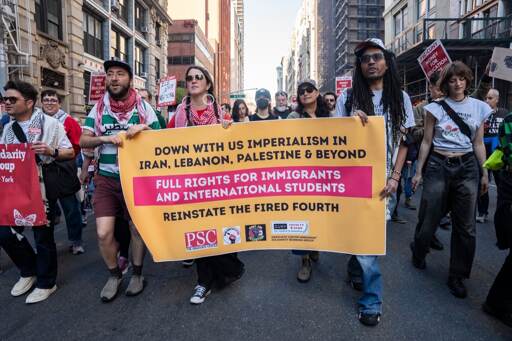
On May Day, thousands of workers across the country took to the streets in more than 5,000 mobilizations nationwide. In New York City, one of the largest contingents was PSC-CUNY, the union representing faculty, staff, and graduate assistants at the City University of New York. It mobilized 700 people for the march and engaged over 1,000 people in May Day activities over the course of the week.
Early May Day morning, the PSC organized a court-watch delegation in solidarity with immigrants and later helped organize a rally against cuts to higher education, bringing together higher education unions from across the city, including workers at The New School — who are facing major cuts — the St. John’s University faculty union — which the administration is seeking to de-certify — and others.
As marchers gathered in Washington Square Park, Ege Ozen, a political science professor at the College of Staten Island, spoke on behalf of the PSC, highlighting the union’s work for immigrants’ rights and speaking against cuts to higher education.
The PSC contingent included PSC-printed signs reading “Tax the Rich” and “End the War on Universities.” The PSC contingent was a sea of red, with the exception of those wearing “Reinstate the CUNY Fired Four” t-shirts, highlighting the ongoing campaign to reinstate the fourth Brooklyn College adjunct fired for Palestine activism.
The Graduate Center PSC chapter organized a contingent around three key demands. First, it highlighted the demand for full rights for immigrants and international students, rejecting the second-class status imposed on immigrants and international students and demanding full and equal rights at CUNY and beyond. Second, it emphasized the need for labor to take a strong stand against the imperialist war in Iran, which, despite a temporary ceasefire, threatens to erupt again at any moment, fueling further destruction in Lebanon and the ongoing genocide in Gaza. Lastly, the contingent demanded the reinstatement of the Fired Fourth. The contingent was co-sponsored by the Graduate Center Immigrant Solidarity Working Group, as well as CUNY4Palestine, Faculty and Staff for Justice in Palestine, and Rank and File Action.
May Day reflected a growing and increasingly mobilized PSC that is taking the streets and organizing solidarity with immigrants and in repudiation of Trump — a national sentiment that is certainly touching the hearts and minds of the PSC rank and file.
As the economy teeters on the edge, President Trump’s brutal imperialist policies continue to threaten Iran, Lebanon, Palestine, Cuba, and Venezuela, wreaking havoc on those countries as well as on the global economy. In this context, May Day and the mobilizations surrounding it are part of building working-class power to fight back.
In that context, where should the PSC go from here?
Unleash the Creativity of the Rank and File
First, we need spaces for democratic discussion and decision-making from below. That means organizing discussions on every campus to debrief May Day and collectively discuss, decide, and vote on next steps. How will the PSC organize against Trump’s threats against Iran and other imperialist aggression? How will we respond to deportations in New York City or ICE surges around the country? How will we organize against cuts to higher education? These democratic spaces should also discuss the next steps in the campaign to reinstate the “Fired Fourth.”
As we prepare for contract negotiations, with the current contract expiring just a year from now, we also need to discuss a contract that fights McCarthyism, defends immigrant and international students, and wins significant raises, especially for the lowest-paid members of the union. We must fight back against the “adjunctification” of the university, as well as against the abysmally low stipends for graduate students, which have a disproportionate effect on international and low income students.
These spaces of discussion are not the same as brainstorming sessions or informational town halls. The PSC often organizes town halls, which are important for sharing information, and union meetings are often used to generate ideas. But we also need spaces where members can collectively discuss that information, put forward proposals, and democratically vote on resolutions. If we are serious about mobilizing more of the rank and file and organizing to meet the moment, we urgently need to unleash members’ creativity to decide the path forward.
Full Rights for Immigrants
One of the strongest aspects of the PSC’s work in the recent period has been its support for immigrants through weekly court support efforts, as well as a new push for establishing immigrant student success centers with two full time staff members on each campus. Every campus now has an immigrant solidarity working group, and rapid-response networks have been organized across campuses. This has placed the PSC among the most militant unions in the country on the issue of immigrant rights.
Tom Homan has recently threatened to escalate ICE operations in New York City. How should we respond? UAW Local 2325 voted to hold an emergency membership meeting and strike vote in case Trump escalates ICE operations in New York. This is an important step forward and an example PSC should follow.
At the same time, it is essential not only to wage a defensive struggle, but also to articulate a broader political perspective. As the Graduate Center Immigrant Solidarity Working Group, has argued, we cannot remain confined to defending the limited rights immigrants and international students currently possess, rights that are rapidly being eroded. We must clearly state that immigrants and international students deserve the same full rights as everyone else in society, both at CUNY and beyond.
Left Voice has been organizing behind this demand for full rights for immigrants, highlighting that “When workers — immigrant and non-immigrant alike — stand together to demand the abolition of ICE, an end to deportations, and full rights for all, including the right to citizenship, they challenge the system that keeps the working class fragmented and weak.” The PSC must be a champion for unity and equal rights for all.
Unite with Students!
It is also crucial for the PSC to organize with students. This was perhaps one of the biggest weaknesses of both the PSC contingent and the broader preparation for May Day — the lack of a student presence. Students have played a central role in key campus struggles, particularly in the movement for Palestine, and were instrumental in the reinstatement of three of the Fired Four. On May Day, Brooklyn College students were organizing to demand that they be allowed to walk at graduation (which they won!), students at the College of Staten Island and CUNY Law are fighting for student commencement speakers, and the day before May Day, a joint march commemorated the Columbia and City College encampments and continued the struggle for Palestine. Organizing by faculty, staff, and graduate workers must connect with, support, and build alongside these student initiatives.
It is equally essential to organize alongside students for immigrant rights. This is already happening to some extent on campuses where PSC members in immigrant solidarity working groups collaborate with student organizations such as YDSA and the CUNY Internationalist Club. But the union as a whole generally does not organize systematically with students, and student involvement remains limited beyond these groups.
Our goal cannot only be to defend immigrant students, but to fight alongside students, seeing our students as political subjects with their own agency. Organizing alongside immigrant and international students in the fight for their own rights is therefore essential. Student-worker unity is key to building collective power.
Unite Across Campuses
We also need more opportunities for democratic discussion and coordination across campuses — spaces where rank-and-file members from different colleges can meet, discuss, propose resolutions, and organize common struggles together.
For example, the AAUP and PSC could organize a conference against cuts to higher education or against political repression on campuses, where workers and students from different universities could share experiences and collectively debate strategy and proposals for action — similar to the Higher Education Labor United (HELU) coalition, but for rank-and-file members, rather than union leaders.
At CUNY, union leadership has often organized solidarity with struggles across the city, which is important. But how do we mobilize the broader rank and file for these efforts? And how do we ensure that members themselves are involved in decision-making processes? These are essential questions for building a stronger and more democratic union.
The Fight Is Up to Us
As higher education, immigrants, the Palestine movement, and workers face escalating attacks under the Trump administration, it is increasingly clear that the only path forward is active struggle, in the streets and in our workplaces. Having Zohran Mamdani in office has not stopped the attacks on higher education, on immigrants, or on free speech. Voting Democrats in the midterms will also not stop these attacks.
But we have a beautiful example of how to fight Trump in Minneapolis, which has forced Trump to retreat after mass action and the call for a general strike.
May Day should therefore be seen not as an endpoint, but as a step toward building stronger organization from below — organization capable of preparing mass collective action and strikes powerful enough to meet the challenges ahead.
The post What’s Next for PSC-CUNY after May Day? appeared first on Left Voice.
From Left Voice via This RSS Feed.