

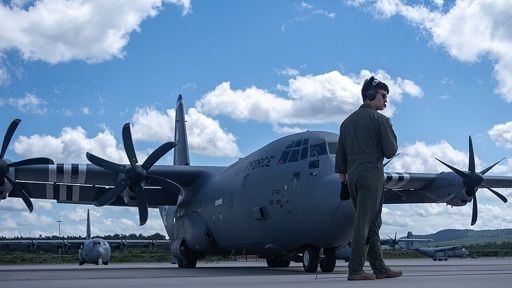
A recent announcement by the Trump administration that it plans to withdraw at least 5,000 US troops from Germany and halt the planned deployment of long-range US missiles has triggered contradictory reactions in the European country.
For decades, anti-war groups had demanded the withdrawal of US troops and nuclear-capable systems from German territory, while denouncing the planned stationing of Tomahawk cruise missiles, SM-6 systems, and Dark Eagle hypersonic weapons in Germany as a major escalation directed against Russia. The cancellation of these deployments therefore appears, at first glance, as a victory. Reuters reported that the Pentagon plans to reduce troop numbers over the next 6-12 months, bringing US deployments in Europe roughly back to pre-2022 levels.
Read more: Students and teachers in Italy strike against right-wing reforms and militarization
Taking a closer look, however, one sees that Germany currently hosts around 35,000 to 39,000 US soldiers and remains the central logistical hub of US military operations on the continent. It continues to host Ramstein Air Base, Landstuhl Regional Medical Center, and key NATO command infrastructure crucial for US operations in Europe, West Asia and Africa. Therefore, the real strategic significance of the announcement does not lie in the reduction of personnel itself.
Instead, sections of the US military establishment criticized the withdrawal plans because Germany remains central to the projection of US military power, and senior Republican lawmakers warned the move could weaken deterrence and send the “wrong signal” to Russia.
For the German ruling class, the apparent cancellation (or at least suspension) of the planned deployment of US weapons is devastating for the very same reason: they were viewed as an important element of deterrence against Russia. Now, European states are already developing plans to “fill the gap” themselves, according to Reuters. The North Atlantic Treaty Organization (NATO) framed the withdrawal in almost identical terms, arguing that the decision “underscores the need for Europe to continue to invest more in defense.” The political message is clear: sections of the German and European bourgeoisie interpret the US move not as an opportunity for de-escalation, but as an argument for acting more aggressively on their own.
This process predates this latest announcement, especially in the context of the escalation of the NATO-Russia conflict after 2022. Since then, Germany has undergone the most rapid militarization in the history of the Republic. Military expenditure has risen dramatically – from USD 35 billion in 2014 to USD 114 billion in 2025 – while austerity has been hitting the German working class in the last months: social, education and healthcare cuts, attacks on pensions, and the introduction of a compulsory military examination have intensified simultaneously.
Withdrawal of US troops does not equal demilitarization
An article from the German anti-war movement summarized the dynamic succinctly: the withdrawal of US systems does not represent a break with militarization, but rather shifts responsibility for escalation onto German and European capital.
The initiative “No more war – lay down your arms!” (“Nie wieder Krieg – Die Waffen nieder!”) argued in a public statement that the German government and military circles are already using the US announcement to intensify calls for independent European rearmament. The organization welcomed the fact that US first-strike capable systems would not be stationed in Germany, but simultaneously rejected attempts to replace them with German or European systems, arguing that Germany was already planning to develop European long-range missile systems with ranges exceeding 2,000 kilometers.
The statement explicitly rejected the transformation of the Bundeswehr into what Defense Minister Boris Pistorius has repeatedly called “the strongest conventional army in Europe.” As Jörg Kronauer argues in junge Welt, the cancellation of the US deployment offers only limited reason for celebration because the US missiles had always been conceived as a temporary arrangement until European systems became operational. He warns that the absence of US Tomahawks could actually accelerate European military autonomy and rearmament.
Read more: Peter Mertens: “We have to restore people’s confidence in collective strength”
The German Communist Party (DKP) similarly noted that widely-known politicians and media rapidly revived narratives about a supposed “Russian threat” and the need for an indigenous European “counter-threat.” Anti-imperialist initiatives argue that the leadership of the German Trade Union Confederation (DGB) has largely adapted itself to the militarization agenda: the Communist Organization (Kommunistische Organisation, KO) accused the union confederation of subordinating workers’ interests to the strategic goals of German capital and promoting the illusion that militarization could occur with stable jobs and without social devastation – which is not true.
Rising numbers of objectors show that resistance in Germany against these developments is growing: more than 2,600 young people refused military service in the first quarter of 2026 alone. School student strikes against conscription and anti-militarist youth mobilizations have also expanded massively in the last year.
Read more: Second school strike takes place in Germany: “The rich want war, the youth want a future”
Meanwhile, liberal and conservative politicians frame the US announcement as proof that Europe must become militarily independent from Washington. Even politicians who previously emphasized transatlantic cooperation now argue that Europe requires autonomous offensive capabilities. This reflects the sharpening contradictions within the Western imperialist bloc itself: Trump’s erratic approach to alliances and military commitments has destabilized long-standing assumptions inside Europe, but this does not automatically lead to demilitarization.
Instead, powerful sections of European capital seek to use the crisis to construct a military apparatus capable of defending European imperial interests independently of the US. Additionally, the attempt to appease Trump no longer seems to be an option: tariff disputes (tolerated because the German auto industry is unable to compete with China) only encouraged Trump to impose tariffs on the entire EU – rules which even the US itself does not adhere to. American capital and German-European capital are now openly fighting over markets, Kronauer emphasizes.
This scenario shows that the demand for “US bases out of Europe” cannot remain isolated from opposition to European rearmament itself. The removal of US troops, if carried out within a framework of accelerated German militarization, could mark a transition toward a more independent and more aggressive European military bloc, therefore emphasizing the necessity of connecting international resistance to war to NATO escalation to the opposition to German rearmament and defense of social rights.
As anti-war organizers repeatedly emphasized, the question is not whether Europe should militarize independently from the US, but how to prevent the ruling classes on both sides of the Atlantic from driving the continents toward permanent confrontation and war.
The post Trump administration ponders withdrawing 5,000 troops from Germany: a reason for celebration? appeared first on Peoples Dispatch.
From Peoples Dispatch via This RSS Feed.