

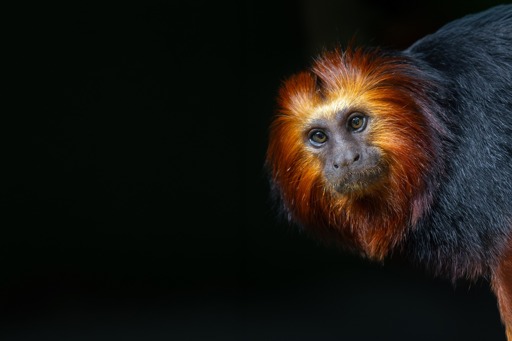
The golden-headed lion tamarin, captured in the photo above, is a small primate species found only in the northeastern Brazilian state of Bahia. The tamarins, Leontopithecus chrysomelas, have bright reddish-golden manes, and similarly colored paws and tails. They live among tree branches, eating fruit and the occasional bird egg or small vertebrate. They sleep huddled together with their extended family units in tree holes. Flávia Zagury, a biologist and photographer, photographed a family of tamarins at the Primatology Center of Rio de Janeiro, a state research center with a mission to preserve Brazil’s primate heritage. “I was so impressed by this creature, their colors are incredible,” Zagury told Mongabay in an audio message. “[The tamarins] were vocalizing a lot … I sensed a lot of curiosity coming from them.” These tamarins are among Brazil’s most threatened primates, having faced a nearly 60% population decline in just three decades. From 1992 to 2024, agricultural and urban expansion took over more than 40% of their habitat. Now, they have just 13,000 square kilometers (5,000 square miles) of available forest, and much of it is fragmented. A large part of the existing range of the tamarins is made up of cacao agroforestry farms called cabrucas, where the crop is grown underneath a canopy of native trees. Luckily, cacao is also one of their favorite fruits. In recent years, soy monocultures and livestock pastures have taken over many cacao farms, adding to the primate’s extinction risk. Locals have been working to better protect them:…This article was originally published on Mongabay
From Conservation news via This RSS Feed.