

Bullets:
China is the world’s largest importer of crude oil, with energy supply chains that run through countries under heavy sanctions by Western governments.
This year, military actions in Venezuela and in the Persian Gulf were believed to shut off China’s supplies of discounted crude, and that shortages would result in China, with lower prices in North America.
But the opposite happened. China’s economy continues to operate with high levels of crude surplus, while Western markets are seeing severe shortages and sharp price increases.
Over the past decade, China has invested hundreds of billions of dollars into new energy projects across the world, via the Belt and Road Initiative. Those projects, and the associated logistics and transport systems, are now mature, and today supply China with massive volumes of energy, minerals, metals, and food.
The BRI investments have also forged a powerful economic and diplomatic bloc of countries who are immune from Western sanctions and even military threats, while their intra-bloc trade grows at double-digit rates every year.
Inside China / Business is a reader-supported publication. To receive new posts and support my work, consider becoming a free or paid subscriber.
Report:
Good morning.
We now are seeing in real time the results of a decade of Chinese Belt and Road Investments across the world. As a result, China’s economy and industrial sectors are far less vulnerable to the supply shocks that are hitting the rest of the world today, and very strong economic and diplomatic ties have formed between China and the Global Majority countries.
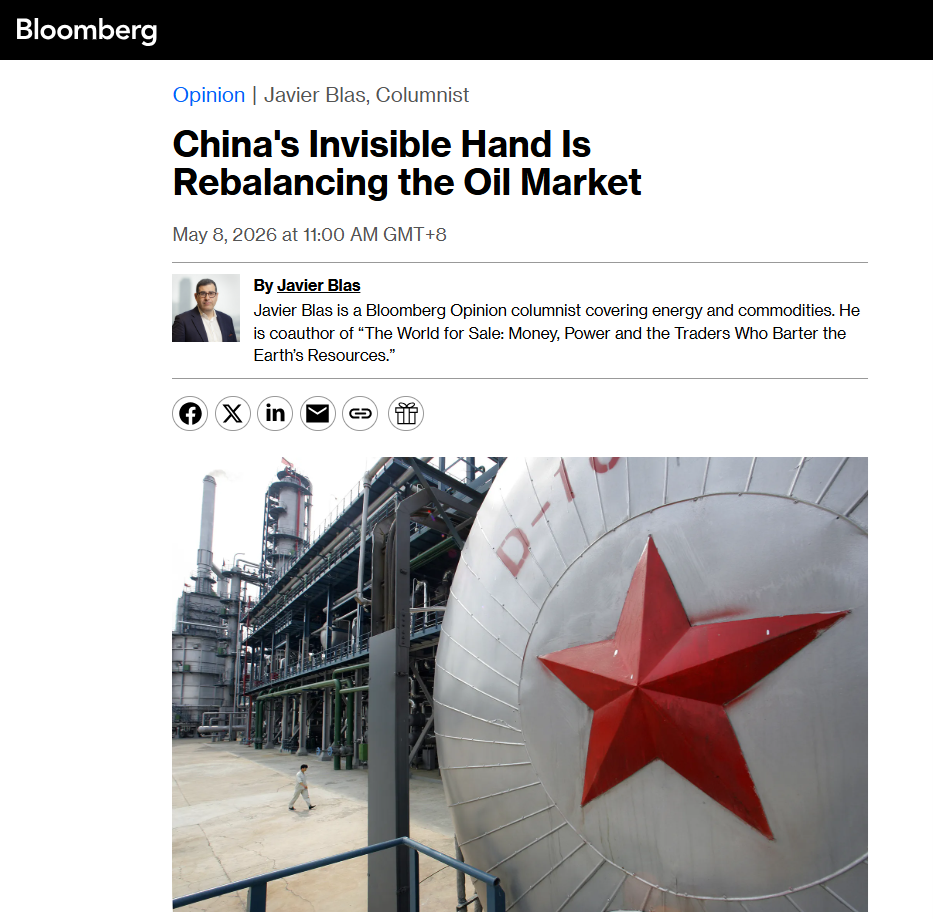
None of this was supposed to happen, that right there, and oil industry insiders are trying to understand how China, which is the world’s largest importer of energy, is running at operational surpluses for crude oil. Countries everywhere are racing around for new supplies now that the Hormuz is closed, and energy prices are rising, fast, which is destroying demand. But Chinese policymakers have not made radical moves to slash consumption, which is in stark contrast to other economies here in Asia, Australia, and in Europe.
The Chinese oil industry is not transparent, and Western analysts are just making educated guesses, and they admit as much. They study satellite photos, talk to people here, and make some assumptions. For example, only Russia and China really know, how much oil trade they’re doing.
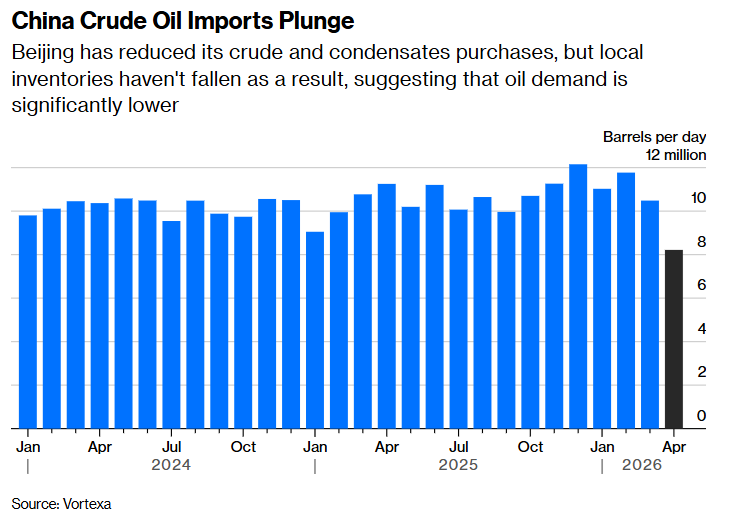
Analysts suspect that China’s imports of crude oil overall have fallen, perhaps by 25% since before the War on Iran. That alone would be sufficient to make a lot more oil available in markets everywhere else. But analysts also believe that Chinese inventories of oil have not changed either—stocks aren’t being drawn down, so they wonder if Chinese oil demand is significantly lower than thought, and why that might be.
It gets even more confusing, when we learn that Chinese oil majors are net sellers of crude in European and Asian markets. That means that China would be in surplus, while the rest of the world is running severe shortages. That would explain why the world is not yet at $150 or $200 on benchmark oil prices, like many of these analysts assumed we would be by now.
If Chinese imports have dropped by 3.5 million bpd, that would equal Japan’s total oil demand, and twice the supply now going through the pipelines around the blockades in the Strait of Hormuz.
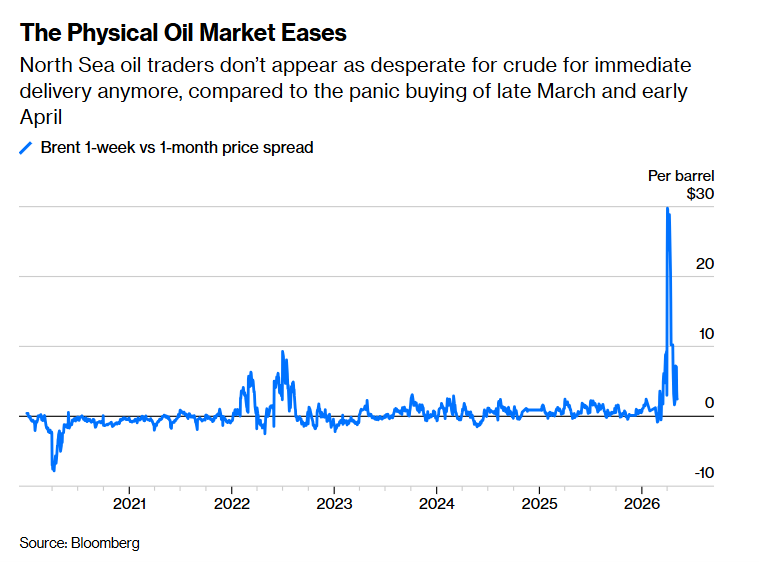
So that alone would be a huge factor in rebalancing the global market, and helps to explain how the big premiums that oil trading companies were getting when the war began, have since dropped to almost zero. In other words, China’s oil industry surpluses are wiping out the arbitrage opportunities for commodities traders:
China has a lot of crude oil in storage. Last year China was buying a million barrels per day to put into storage. That buying at the time kept oil prices higher than they would have been otherwise. Now it’s the opposite—the Chinese crude surpluses could keep a lid on prices by drawing down from their reserves of over a billion barrels.
But here the analysts are confused again, because Chinese commercial inventories are not falling; they are somehow still growing. China is not drawing down its stockpiles of strategic reserves. Beijing briefly banned exports of jet fuel and other refined products, but now they are selling again, so the only conclusion is that China’s domestic markets are fully supplied.
None of that that was supposed to happen, and oil traders are trying to figure out how we got here.
Because this is the second time, in a short time, that the analysts have been proven very wrong about China’s oil supply and demand profiles. After the US’s lightning raid in Venezuela, it was just conventional wisdom that it would be a huge problem for China’s energy security:
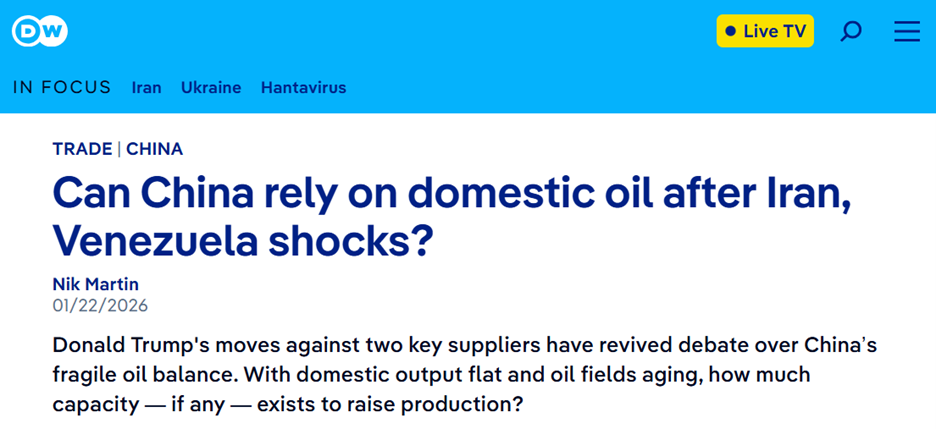
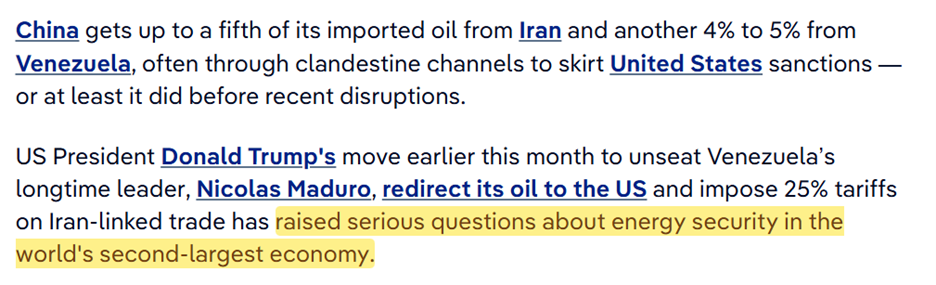
Fortunately for Beijing, the thinking went, they could shift their buys to Iran. Venezuela was gone, and China’s refineries were then dependent on Iran. “It would be extremely difficult for China to replace the 1.3 million bpd of Iranian crude.”
Quick point here, that only Iran and China have any idea how much Iranian oil China is still getting; it may actually be higher today than before the war started.
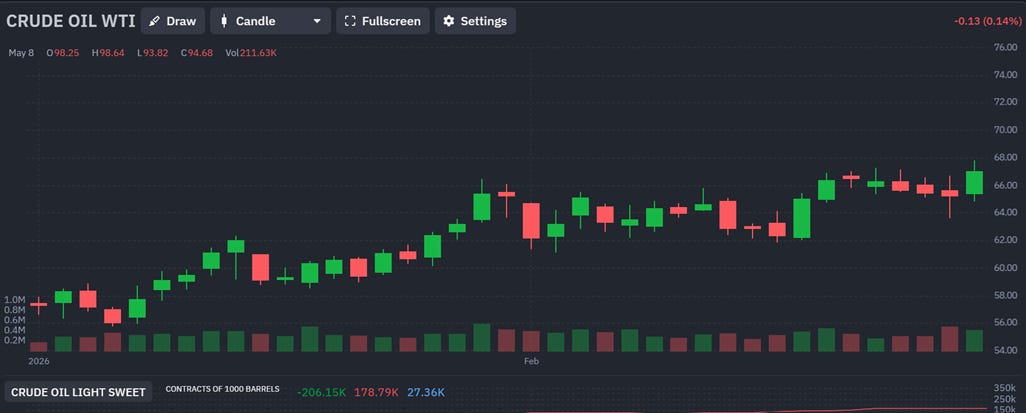
But taking stock of things we know, just so far: Venezuelan oil would be going to be refined in the US, or at least through US trading firms, and that would raise the oil price in China, who previously was getting discounted oil from Venezuela. But it was in the United States that oil prices rose, after the raid. Crude prices rose over 20% in US markets in the two months after the capture of Maduro:
And immediately after the war on Iran started, prices went up everywhere except here. The United States up big. Europe up big. And those prices would be far higher were it not from drawdowns from stockpiles there. At least 10 million barrels per day of supply are gone from the market, and in order to keep planes in the air and trucks and cars on the road, countries are hitting their stockpiles, again everywhere except here. 500 million barrels of strategic reserves worldwide burned through already.
And even were the war to end right now, countries will prioritize building those reserves back up again. Australia is 80% reliant on energy imports and will spend over $7 billion on stockpiles after the war ends. The EU is also looking to overhaul their policies for reserves. Here is another big assumption, from Goldman Sachs: assuming oil cargoes are glowing again at normal levels in two or three weeks, the world will have lost about a quarter of its oil inventories. If it’s later, the reserve situation gets worse.
So we’re back to the question, as to why the rest of the world is running short of crude today, and why the rest of the world is draining their energy stocks today, and why China is not – even though nobody is more dependent on imports than China, on a volume basis, and even though China’s supply chains through Venezuela and Iran are turned off.
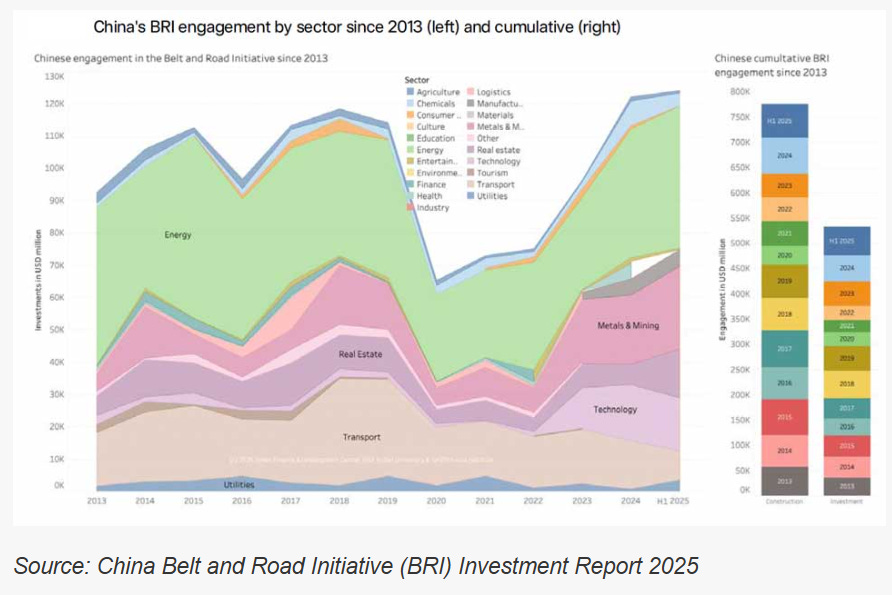
And we’re also back to China’s Belt and Road Initiative Investments, which began in 2013, and how those are paying off today. The green part of that chart is energy, and every year China’s global investments in energy projects have been larger than in any other category. That chart is helpful in another way—transport has declined on a percentage basis, as seaports and railroad projects were completed and came online.
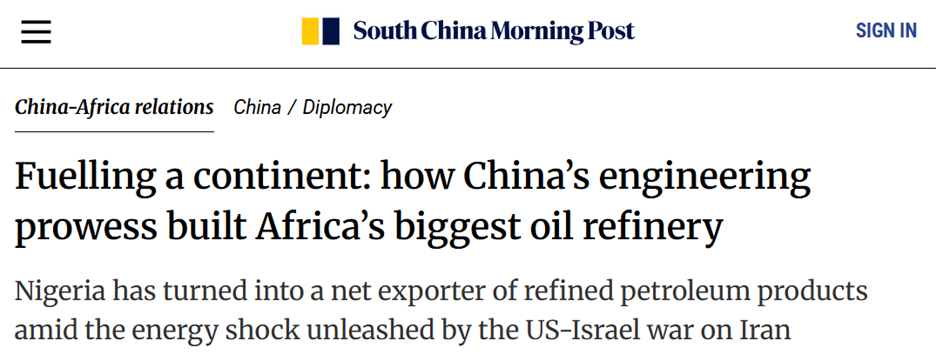
For energy, we’ll look just at two countries, and how China’s BRI investments in energy have quietly overhauled global oil markets. Nigeria has been a crude exporter for a long time, but now is also a major player in refined fuels, which are much higher-margin, which allows Nigeria to retain more of the energy value chain in their own economy. The biggest refinery there was a $20 billion project, primarily from Chinese engineers and contractors. There is another refinery expansion coming.
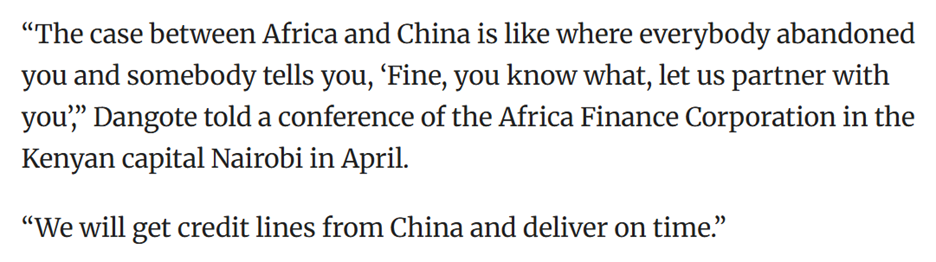
For years, Nigeria was looking for investors, and only China stepped up. China offers credit lines, and gets projects done on time and on budget:
Next up is Brazil, which is the biggest oil producer in South and Central America. The war in the Persian Gulf has been a boon to Venezuela, who in April exported 1.23 million barrels a day in April, the highest in seven years. Iran, by the way, produces around 3 million barrels a day.
But Brazil’s crude oil production is over 4 million bpd, which is about as much as Venezuela and Iran combined. Brazil’s oil exports in April hit a record high. And China gets about half of everything coming out of the ground in Brazil. China’s imports of Brazil crude are up five times in 10 years.
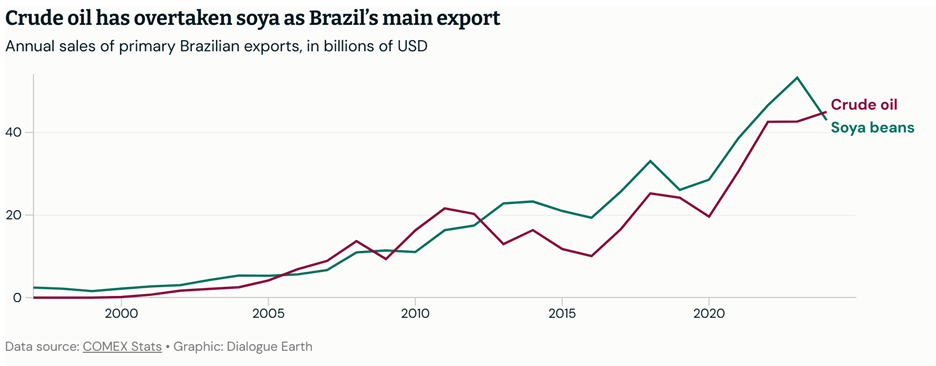
Brazil’s soybean farmers have already famously put the American soybean industry out of business, but meanwhile Brazil has also become a key supplier for crude. Chinese cumulative investment in Brazil is over $78 billion, and last year another $6 billion went over. Brazil is far removed from the Caribbean and the Persian Gulf, trade between Brazil and China is booming, both countries are in BRICS, and the implications for international relations are obvious.
In Nigeria, it’s the same story. Nigeria is the biggest country in Africa. The population is around 250 million, and when the Nigerians wanted to move up the value chain in petrochemicals and refined fuels, nobody would invest there except China. Cumulatively, China invested $28 billion in energy projects in Nigeria, along with other large investments in the Nigerian mining sector. Now those investments are paying off, for both sides.
Nigeria-China Bilateral Trade: Nigerian Imports v Exports
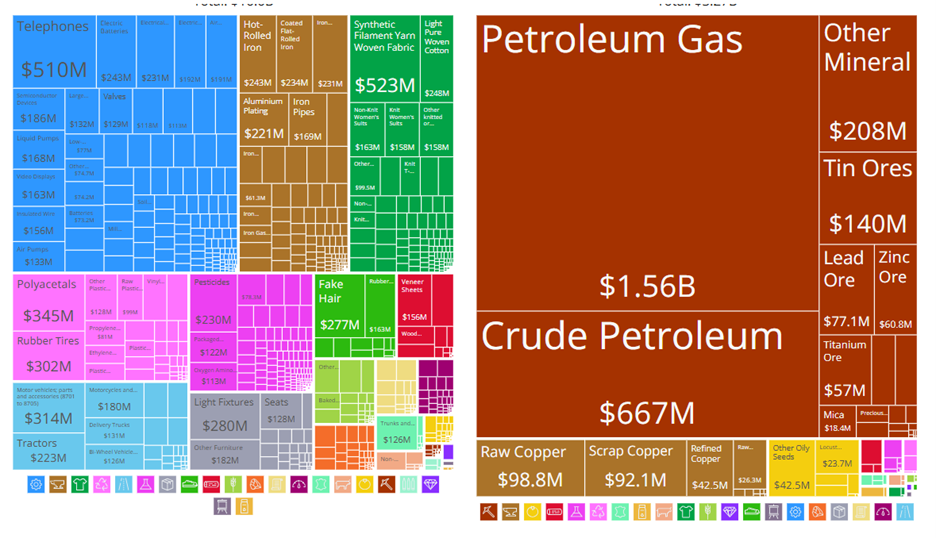
Bilateral trade is growing at double-digit rates—Nigeria exports raw materials and energy to China, and imports manufactured products in over 200 industrial categories, all growing at fast rates. Nigeria is also a BRICS country. And there is no need to even bother asking, who Nigeria is more friendly with, today—the Western bloc or the new BRICS economic bloc.
These massive investments, over time. Hundreds and hundreds of billions of dollars, into developing the economies in countries that Western investors didn’t want to touch, have yielded gigantic surpluses for China, enormous stockpiles of metals and energy and everything else China’s factory sectors need to keep that trade going.
But the investments have also yielded for China a lot of good will across the world. There’s no easy way to put a number on how much that is worth, but it is a big number.
Be good.
Resources and links:
Fueling a continent: how China’s engineering prowess built Africa’s biggest oil refinery
https://www.scmp.com/news/china/diplomacy/article/3352256/fuelling-continent-how-chinas-engineering-prowess-built-africas-biggest-oil-refinery
Chinese oil imports boom, with giant volumes going to strategic reserves. How much? Nobody knows.
New Map of the Belt and Road Initiative
https://www.clingendael.org/publication/new-map-belt-and-road-initiative
Latin America’s Largest Economy Sets Export Record on Oil Price Surge
https://www.bloomberg.com/news/articles/2026-05-07/latin-america-s-largest-economy-sets-export-record
Oil supply shock to worsen as inventories fall further even if conflict ends
https://www.reuters.com/business/energy/oil-supply-shock-worsen-inventories-fall-further-even-if-conflict-ends-2026-05-06
After Venezuela blow, Iran supply risks test China’s oil strategy
https://www.aa.com.tr/en/energy/general/after-venezuela-blow-iran-supply-risks-test-china-s-oil-strategy/55314
China’s Invisible Hand Is Rebalancing the Oil Market
https://www.bloomberg.com/opinion/articles/2026-05-08/iran-war-china-s-invisible-hand-is-rebalancing-the-oil-market
US Action Threatens Venezuela-China Oil Flows, Debt Repayment, and Investments
https://www.energypolicy.columbia.edu/venezuela-china-oil-ties-severely-impacted-by-us-action/
Can China rely on domestic oil after Iran, Venezuela shocks?
https://www.dw.com/en/can-china-rely-on-domestic-oil-after-iran-venezuela-shocks/a-75516569
Brazil’s oil exports and exploration cast a shadow on its green ambitions
https://dialogue.earth/en/business/brazils-oil-exports-and-exploration-cast-a-shadow-on-its-green-ambitions/
China – Nigeria Bilateral Trade Profile
https://oec.world/en/profile/bilateral-country/chn/partner/nga
Chinese BRI Investments and Construction Contracts Smash New Records in the First Half of 2025
https://chinaglobalsouth.com/2025/07/21/china-bri-2025-investment-surge/
Iran crude oil production
https://tradingeconomics.com/iran/crude-oil-production
Venezuela Lands Billions in Oil Deals as Industry Rushes Back
https://oilprice.com/Energy/Crude-Oil/Venezuela-Lands-Billions-in-Oil-Deals-as-Industry-Rushes-Back.html
Inside China / Business is a reader-supported publication. To receive new posts and support my work, consider becoming a free or paid subscriber.
From Inside China / Business via This RSS Feed.