

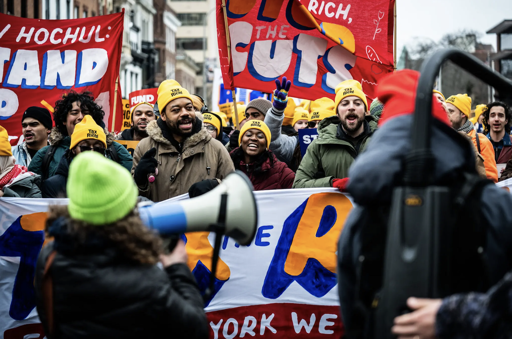
According to everyone from Bhaskar Sunkara to Eric Blanc, Our Time was supposed to be the best way to capture and channel the power of the more than 100,000 volunteers who helped elect Mayor Zohran Mamdani last November. Now, less than six months later, the organization has been reduced to just one staff member and the board says it is reassessing its strategy to “meet the moment.”
In other words, it’s looking increasingly likely that Our Time, like so many other organizations of its kind, is already a big flop.
This should come as no surprise to anyone who follows national politics or who was paying attention to the Mamdani campaign. Mamdani drew tens of thousands of dedicated volunteers (104,000 by some estimates) because he was unashamed and unafraid to openly declare his politics and the problems with capitalism. He embraced the label of socialist with honor, proudly declared his membership in the Democratic Socialists of America (DSA), and was vocal about his support for the people of Palestine.
Yes, his idea of socialism, like that of Bernie Sanders, is really little more than a glorified form of social democracy. And yes, he has already jettisoned many of the political principles he espoused on the campaign trail. But nonetheless, it was his self-proclaimed socialism, his critique of capitalism, and his promise to materially improve the lives of the millions of New Yorkers scrambling to make ends meet, that propelled him into Gracie Mansion and made him a national figure practically overnight.
Our Time was meant to build on that momentum, to harness the enthusiasm and anger of those who volunteered to help elect Mamdani and use it to win the affordability agenda that he had promised. But that strategy was doomed from the start. First of all, there were those who rightly asked why anyone who supported Mamdani would want to organize with a brand new non-profit rather than just join the DSA, of which Mamdani himself is a member. After all, the barriers to entry are not that high — joining the DSA requires little more than signing up online and attending a chapter meeting or study group. And indeed, several thousand volunteers have joined the New York City chapter since Mamdani’s victory, but this is largely despite, not because of, Our Time.
The biggest problem with Our Time, however, was its central strategy, which, in essence, amounted to the exact opposite approach that Mamdani took in his campaign. Rather than offering an inspiring and motivating socialist politics of class struggle grounded in self-organization, Our Time embraced a top-down lobbying strategy and pressure campaign based on a political slogan that would appeal to the lowest common denominator: “Tax the Rich.”
Meanwhile, as even Blanc himself admits, Mamdani has done nothing since taking office to help build Our Time or the kind of independent working-class power needed to win his agenda. Instead he has chosen to go it alone with a so-called “common-sense” strategy of compromise, fiscal sleights of hand, and back-room deals with Albany, in which his supporters, and even the DSA, have become little more than passive observers. His willingness to play the role of the good Democrat and his endorsements of Kathy Hochul and Hakeem Jeffries are part of this politics of compromise.
Understanding why such organizations and strategies are an inevitable and demobilizing dead-end and how to build real working-class power is essential for the construction of a bold socialist movement in New York City and beyond.
Working People Are Ready to Fight
Behind the strategy of Our Time was an idea — pervasive among professional organizers and their academic apologists like Blanc — that the vast majority of workers are not ready for class struggle or willing to participate in any kind of politics that is more than a step ahead of voting or writing a letter to their representatives. They believe socialism is too divisive a word, and that participating in political strikes like those in Minneapolis are just too risky for most people. In order to get more working people into the movements, they argue, we have to provide “easier on-ramps.”
In theory this sounds reasonable, but when such on-ramps are not grounded in the right ideas and the right tactics, when they are not part of an actual strategy for building working-class power, they inevitably lead to apathy, retreat, or, most often, cooptation. Asking volunteers to do little more than phone bank for candidates and lobby for legislation to tax the rich — instead of organizing for neighborhood assemblies, strikes, and mass demonstrations — is a perfect example of the wrong strategy.
But even if such tactics did help get some working people more active and engaged, they are grounded in two fundamentally flawed premises. First, they view working people not as a force for themselves, but merely as a mass of maneuver; a reserve army that can be called upon to act at the direction of a particular candidate or campaign when needed and demobilized when not. This treats the working class as a mere pawn of politicians rather than the engine of revolutionary change that it is. In this sense, such tactics ignore the importance of self-organization and limit the ability of working people to collectively take up the struggle as a class that is independent of the interests of the bourgeoisie. Indeed, the kinds of appeals to power that are indicative of non-profits like Our Time, such as letter writing campaigns and lobbying Albany, only reinforce the legitimacy of the state and the Democratic Party.
These kinds of tactics also undercut our true potential to take advantage of this political moment. The election of Mamdani and the uprisings against Trump and ICE across the country, as well as the massive No Kings demonstrations and May Day rallies, have shown us clearly that working people are both ready for socialism and more and more ready to take up the banner of the political strike and class struggle to defeat Trump. Pretending that we need to pander to some presumed ideological immaturity is not only backward and insulting to workers, but counterproductive to achieving even the most modest reforms. This is especially true at a time when polls show that capitalism is less popular than ever, and 39 percent of Americans now have a positive view of socialism.
Instead of lowering the bar and watering down our politics, the Left needs to boldly embrace a thoroughgoing anti-capitalism and socialism that goes beyond new taxes and small reforms. A truly ambitious program for New York City, grounded in building the power of working people and directly confronting the capitalist class as well as the state with working class methods of struggle, is the best and only way to grow the kind of movement we need to win any of our demands.
The Limits of Mamdani’s Sewer Socialism
Unfortunately such bold demands, working-class organization, and confrontation with the state are not part of Mamdani’s agenda and never were. Instead, he has pursued what his supporters have described as a strategy of sewer socialism based on the legacy of so-called progressive mayors like Fiorella LaGuardia. Like LaGuardia, who was a shrewd manager of working-class anger at a time when the U.S. was on the brink of popular revolt, Mamdani has cast himself as a pragmatic progressive able to channel the rising discontent over the affordability crisis into a program of practical, but very limited, reforms.
Extending the already-existing system of universal pre-K to children under three; making local buses — but not the subway — free; and increasing city housing subsidies for those experiencing homelessness were all part of Mamdani’s campaign promises. And while these reforms, if enacted, would certainly help a small number of working people and the oppressed, they are mostly little more than extensions of programs implemented by previous mayors like Bill DeBlasio, hardly a socialist, who was responsible for launching the universal pre-K program during his first year in office in 2014. Furthermore, and perhaps most importantly, Mamdani’s proposed reforms would do little to nothing to advance the power of the working class more broadly or increase their share of the surplus value they produce.
Unfortunately, thanks to a massive budget deficit, it’s looking increasingly unlikely that any of these programs will receive the kind of funding they need to be fully implemented. Even if the proposed, extremely modest plan to tax second homes passes the state legislature, Mamdani still needs to fill a $5 billion budget gap before even thinking about funding the programs he proposed on the campaign trail. But rather than using his bully pulpit to encourage working people to organize and take to the streets, he is instead already talking about cuts. These include, ironically, postponing a state mandate to reduce class sizes at public schools (to presumably help pay for universal pre-K) and to slash funding for the very same housing assistance program he promised to increase.
Mamdani’s supporters and the DSA have avoided criticizing him for these cuts (as if he had no choice), choosing to pin the blame instead on Hochul’s failure to support greater tax increases on the wealthy. But it is precisely Mamdani’s business-as-usual approach to this budget crisis and every other aspect of city politics — including his failure to rein in the police, which have continued to arrest and oppress working people, unionists, and the Left (even on May Day) — that is the real problem.
Indeed, since taking office, he has killed his own momentum, and that of Our Time, by acting just like every other politician in all the ways that really count. He may be more charming and charismatic and more social-media-savvy. He may occasionally speak from a more radical perspective (though Chicago Mayor Brandon Johnson seems to have him beat even on that score). But he has made it abundantly clear to everyone who has ears to listen that he has no intentions of challenging the status quo of New York City or New York state politics. He is happily playing the same budget games and making the same kinds of deals his predecessors made. Is it any surprise that his tens of thousands of volunteers are now less enthusiastic than they were in November?
A Real Program for New York City
Since its founding, Our Time had two interconnected goals. First, it wanted to use the momentum of Mamdani’s historic victory to build a mass of maneuver to win some limited reforms in the hopes that such small victories might act as a banner for electing further social democrats like Mamdani. Second, it wanted to build an organization that could act as an activist base for such campaigns in the upcoming midterm election and maybe a recruiting tool for DSA. The irony is that pursuing such a strategy is anathema to building the kind of class struggle necessary for its success. By focusing exclusively on the pursuit of narrow, near-term legislative goals, and by redoubling efforts to elect social democratic candidates like Mamdani — in some vain attempt to build a left wing of the Democratic Party in New York — it does nothing to actually build the kind of independent working-class struggle necessary to win even the smallest demands.
If Mamdani and Our Time were serious about materially improving the lives of working people; if they were serious about making the rich pay and building a city that works for the millions who make it run, they would be asking for a hell of a lot more than a few minor reforms and a pied-à-terre tax. Instead of phone banking, they would be using the Mayor’s bullhorn to champion a real socialist program for the city that would actually put the wealth of the city back in the hands of the working class. This would include, as a start, the expropriation of corporate landlords and private for-profit hospitals, a massive expansion of affordable public housing, free public transportation, free higher education; colleges, universities, hospitals, and transportation systems run by students, faculty and workers; the elimination of the Taylor Law and a path to unionization for every worker in the city with the right to strike guaranteed to all.
And if they were serious about winning such a program, they would not be making back-room deals with politicians in Albany and City Council. Instead, they would be organizing with the people in the streets. Like congresspersons Myriam Bregman and Nicolas Del Cano, members of our sister organization in Argentina, they would be fighting to radicalize the labor movement, building strikes, calling for massive neighborhood and workplace assemblies to strategize and debate the way forward, marching at the front of the picket lines, and confronting the police. Rather than endorsing class enemies like Jeffries and Hochul, and standing for photo-ops with monsters like Trump, they would be offering a ruthless criticism of the entire bipartisan political structure that has miserably failed to deliver for the working people of the city.
And rather than channel the power of the class back into the Democratic Party, they would be raising the banner of an independent working-class party for socialism grounded in class struggle, which is ultimately the only path toward revolutionary change.
The post What Happened to Our Time? appeared first on Left Voice.
From Left Voice via This RSS Feed.