

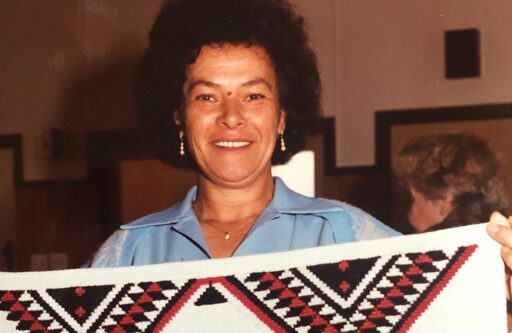

Mary Nu, as she was known in Ahipara, in 1977, around the time that Tainui first met her. (Photo supplied)
An unveiling is one of the most important hui in the Māori world, writes Tainui Stephens. To bless a headstone for our dead is a big step in our acceptance of their absence.
Many Māori homes have a “dead wall”. A place for photographs of beloveds who have passed on. No one living should be seen up there. On our wall, there’s a small, framed picture of a smiling Māori woman holding up a tāniko panel. That’s Mary Williams. She passed away in 2014, at the age of 79.
At the end of last year, my sister Māmari and I got an invitation to attend Mary’s unveiling. We were thrilled to go together to pay our respects to a truly important person in our lives.
In terms of whakapapa, she’s actually a cousin to us, but we called her “Aunty”. Everyone loved Mary. She was the loving aunty. Not the grumpy aunty or the party aunty. She was the one everyone ran away to, because you felt safe in her arms. In Ahipara, she was also known as Mary (or Mere) Nu. Nu was her husband Paul Manuka’s nickname.
In 1977, Mary Nu lived in a pink house at the end of Wainui Church Road. There were few buildings on that dodgy dirt road. My grandfather’s house was at the beginning of it. Next door was the dilapidated Moetonga hall that used to be the hapū marae. Further up was our hapū cemetery and the vestry remains of a church destroyed by a storm in the 1960s.
Decades earlier, a busy community had lived at Wainui. Not any more. There were scattered farms and paddocks with a few horses and cows. The surrounding low hills were covered in gorse. The fencing was optimistic.
I first met Mary that Christmas. I was new to Ahipara and staying with my grandfather, Bobby Roberts. He’d suggested I walk up to the Ngātotoiti cemetery to check out the headstones. It was a way to see how I fitted in with all the other family names I was discovering. As I walked around the small cemetery, a voice called out. “Hello!” A woman had come out of the pink house and waved at me. I was keen to know the people in the district and walked over to say kia ora.
Mary and I talked easily. She was so friendly and whisked me inside to her kitchen table for fried bread and tea. I filled her in on my family connections. She’d already heard about Uncle Bobby’s Pākehā mokopuna turning up. She knew all my family and could explain connections and personalities and stories in truly forensic detail.
She spoke fluent Māori, and not in a formal way. It was roots reo. A pure record of the way the old people in her youth spoke. She was a natural language teacher. She’d observed people all her life and understood how the Māori language worked on earth, and upstairs with her Lord.
Mary had been a widow for a couple of years. At the end of our first chat, she invited me to the cemetery for a midnight karakia on New Year’s Eve. She said the local tikanga was to be with the dead at that time. I felt honoured to be asked. I was hungry for any Te Rarawa reo and tikanga, and I knew right away that Mary would guide me on that journey. Along with some of her whānau, we stood at her husband’s grave and shared karakia. It was a moment where I expressed my gratitude to Nu and Mary for the connection. Tears all around, stirred by memory.
Mary and I became forever friends.

“Everyone loved Mary. She was the loving aunty. Not the grumpy aunty or the party aunty. She was the one everyone ran away to, because you felt safe in her arms.” Pictured: Tainui and Māmari with Mary. (Photo supplied)
Māmari met Mary when she was just seven years old. My little sis had come up from Christchurch to stay with me and our grandfather for a week, but the experience wasn’t a happy one for her. She was a bit intimidated by Bobby. He wasn’t a guy who talked much, partly because his bad asthma made him wheeze all the time. His physical weakness frustrated him.
My sister was also tormented by a small cousin who lived there. A girl who had no problem swiping at Māmari in ways designed to cause maximum pain. Sis couldn’t wait to escape what she saw as hell. One day, she gapped it and ran up the road. She ended up in Mary’s pink house and got one of those big, warm, motherly hugs. Sis has remained in Mary’s embrace ever since.
After her husband’s passing, Mary had felt trapped by her solitude, even with her adult and teenage children coming and going. Her lovely pink house was new and was to have been their dream home, before his fatal heart attack at Roma marae.
In those years, I got around the country a lot by hitchhiking. No problem to hit the road. And never a problem if you stood somewhere where a driver had time to assess you and could safely stop. I said to Mary: “Haere tahi tāua!” Let’s go together! So we did. We hitchhiked all over the place. We’d visit relations or her “merry widow” mates. Or we’d head off into Kaitāia for housie or functions at the Yugoslav Club hall.
Like any small town, there are no degrees of separation and a lot of gossip. Whenever Mary and I caught up, she couldn’t wait to unleash the stories about the doings of the locals, and who might have been born on “the other side of the blanket”. If someone had suffered or got into trouble, she’d say: “Aī, te aroha noki” Aw, we all need love. If someone had redeemed themselves, she’d say: “Mahi tika ana.” They did what was right.
Mary was an attractive single woman, and in the opinion of some, she was ripe for rescue by a man. Over the years, many gave it a go, but Mary was the boss of her home and her life. Sometimes, hitchhiking back to Wainui, we’d see a hopeful chap’s car, truck or tractor parked up, waiting for her to come home. Some of the men (single or married) seemed to think they were being romantic by letting Mary cook for them. We’d head off the other way.
For a short time, we were the objects of gossip ourselves. I didn’t know about it until after we’d visited a well-known kaumātua for a cup of tea. As we got up to leave, his wife, who was seated on the ground weaving, said quietly to my cousin: “Praise the Lord, Mary.” She never lifted her eyes from her busy fingers. When we got outside, Mary told me that the kuia’s words were code for: “You better not be doing the dirty deed with that boy!” We laughed, and didn’t care. Eventually, no one else did either.
Mary and I established a simple pattern in our relationship. We just enjoyed being in each other’s company. I was her sounding board for what was happening in her life. She loved hearing about mine. I got to know her boys, Sid, Peter, and Hector, and the girls, Linda and Gayle. For most of my life, I would travel up that road to Mary’s place. Often with my own family.
Kai, comfy couches, and kōrero were what we did. All the time. After the house went to sleep, I loved to sit on the porch and have a quiet ciggie. There were no streetlights or close neighbours. The nights were so very dark. Within that peace, I imagined the history of my whakapapa being lived out on those lands.

Mary and Tainui on the set of It’s In The Bag, Kaitāia 2012. (Photo supplied)
For my anxious seven-year-old sister, that first encounter with Aunty Mary’s big warm hug was a loving introduction to our iwi. She hung out with Mary’s children. She remembers looking for inanga in the local stream with Linda and Gayle. They laughed at her dorky city ways, but she felt included in the joke. Peter took her for a horse ride on the beach. Before long, they were galloping, and she was holding on tight. She has a vivid memory of sand flying from thundering hooves and feeling that any minute she might die. But she also felt safe, and this was one of the most thrilling things she’d ever done.
Māmari found warmth and acceptance at Mary’s home. She felt she belonged there. It was the home base for her expanding connection to our Te Rarawa people. Later, as a teenager, she would return to the pink house. As she became an adult and had her own family, they would all return time and again to be with Aunty Mary and whoever from the family was there.
Mary was such a loving person because she had no choice. She’d had a tough life and had known the common violence of an earlier era. She had little money but used it wisely to raise her family. She worked hard and loved her garden. She contributed to the community. Some would take advantage of her generous soul and humble ways, but her strong Christian faith enabled her to face any challenge and brought her peace. Mary truly lived with Jesus in her life. It radiated in her smile.
The unveiling was held on a sunny Friday in March, Mary’s birthday. As Māmari and I drove up the familiar old road, it was wonderful to see that much had changed. The Moetonga marae is new, attractive, and well cared for. A community of whānau homes has sprung up. The white Tokotoru Tapu church stands proudly at the entrance to the expanding wāhi tapu.
A big family crowd had turned up. The hui was a triumph of fundraising and organisation. It wasn’t just Mary’s headstone — there were five others to be unveiled: all were her children or mokopuna. Cars were everywhere, people were hugging and yarning, and kids were running about. The marquee was up, and kai was being prepared by the workers.
At the appointed hour, Mary’s nephew Sonny led a moving karakia in the church. We then moved to the cemetery and went through the process of unveiling each headstone and reading the engraved words aloud. Whānau then shared stories about Mary, Charlotte, Michael, Peter, Hawaiki, and Te Aroha.
It had been nearly half a century since I first stood with Mary in that cemetery, and at that spot by her husband. It was nice to speak to them both again. This time, I had no tears. An unveiling is a final physical responsibility to our dead. We then move on with life, with a greater acceptance of their absence.

“An unveiling is one of the most important hui in the Māori world. To bless a headstone for our dead is a big step in our acceptance of their absence.” Pictured: Tainui, Māmari and Mary’s daughter Linda at the unveiling. (Photo supplied)
Māmari spent time with Mary’s daughter, Linda, and told her how much her mother’s home meant to her. When Mary died, Māmari felt her connection to the land was lost. Linda quickly reassured her: “You can come back to this house. I’m here now. You come here anytime. You go inside now.” Māmari did just that and was amazed to see that much of the inside hadn’t changed at all.
The big living room was still the same as always, with its beds, couches and cushions. The same Christian hangings, school photos, and kids’ artwork were on the walls. The same chart of New Zealand seafood was pinned inside the toilet door. The same floorboards creaked. Māmari felt those parts of the house had been preserved out of respect for Mary. A comforting embrace still lives in that home.
Mary’s headstone says simply that she was a beloved wife, a loving daughter, a treasured great-granddaughter, cherished by her children and moko, and dearly missed by whānau and friends. The type of person she was is also in the words: “I will go in the strength of the Lord God.”
Everyone lives their own unique story. When that story ends, and we depart the place of its telling, all that we leave behind is how others see us. The words on a headstone or a moment captured in a photograph are clues to what your story was about — and who was paying attention.
Tainui Stephens, of Te Rarawa, has been fully engaged in the film and television industry since 1984, working with a range of genres and content. He is particularly attracted to compelling Indigenous stories that critique and celebrate the human condition. Tainui lives in Ōtaki with his wife and fellow filmmaker Libby Hakaraia. Together, they and a small whānau team run the Māoriland Film Festival.
The post A stone for Mary Nu appeared first on E-Tangata.
From E-Tangata via This RSS Feed.