

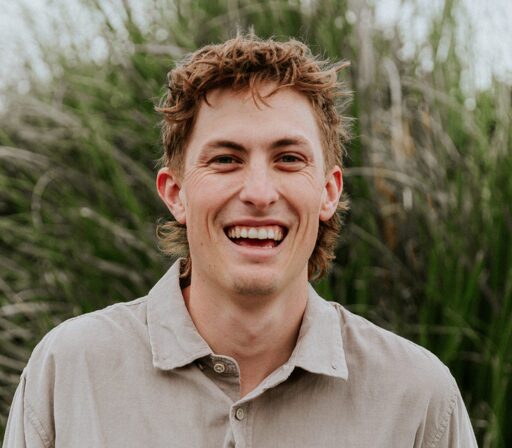

“Someone said to me that the show I’m doing will be Māori because I’m Māori. In that sense, when I do jokes about my experience in Māoridom, it’s about me. But I also think, if anyone can make fun of Māori, it’s us.” Kipling DC, 2026 Billy T nominee. (Photo supplied)
Last week, Dale talked to Opeti Vaka, one of five nominees for this year’s Billy T Award, to be announced on the final day of the Comedy Festival, running in Wellington and Auckland till May 24.
This week, he’s talking to another nominee, 27-year-old comedian Kipling DC (Ngāpuhi), whose 2026 Comedy Festival show is Skuxx Cowboys get lonely sometimes too.
Tēnā koe, Kipling. I wonder if you could tell us about your names and your whānau. Give us an overview of where you grew up and who was around when you were a kid.
Kipling Davies-Colley is my proper name. I grew up in Porotī, which is about 20 minutes west of Whangārei.
In a way, my name is a gift from my grandfather, whose favourite poet was Rudyard Kipling, and his favourite poem was “If”. My parents had only a girl’s name decided on before I was born, and when I came out as a tāne, they were like: “Oh!” They needed something, and “Kipling” felt natural and right.
I come from Ngāpuhi and Te Hikutū, originally from Hikurangi, and I went to an incredibly small primary school, an area school, in Mangakāhia, where I was the whitest Māori in the whole school. It wasn’t kura kaupapa or bilingual, but it was something like that. I didn’t realise that the rest of the country didn’t have that experience of growing up among a village of people, the way I did.
I was fortunate that my te reo teacher at Mangakāhia was Whaea Palmer, who was really more like family. Her mana in the school and across the whole community was phenomenal, and she never made me feel like I wasn’t allowed in that space.
It was later, as I grew up and went to Whangārei Intermediate School and then Whangārei Boys’ High School, that I felt more disconnected — and even more so after I moved away from Porotī to Wellington. I’ve been here for the last 10 years, and it’s probably only in the last five that I’ve managed to find my people again, who’ve allowed me to feel Māori again in these spaces.
I like that you say you’re from Porotī, not Whangārei, because that means you’ve grown up with a strong sense of community, which can be a source of great pride and great mirth.
Tell us a little bit more about your grandfather, the Kipling fan. What sort of character was he?
His name was Richard Davies-Colley, and he was a boy from the north, through and through. He was a farmer and one of the pioneers of farm forestry in Aotearoa. He was always pushing for knowledge, and he passed it on to us by sitting us down one-on-one and having this kōrero about the things we needed to learn. We used to call it “getting trapped by Granddad”, and now I think about how much I miss that.
He passed about 10 years ago, and it’s been an interesting time coming to terms with one of the first really close losses that I’ve had. I think a lot about him.
I have high regard for people who make others laugh. It’s a real skill. And, of course, people think that because you’re a comedian, you’re supposed to be funny all the time. But a lot of comedians, as we know, aren’t like that. It’s performance. How did it develop within you? When did you sense that you had the confidence to stand and deliver, as the saying goes?
I’ve always been a performer. Growing up, I was involved in kapa haka, and then the choir at high school. And then I did a lot of theatre with some awesome people at the Northland Youth Theatre and the Company of Giants. People ask me: “Were you the class clown?” And I was a bit, but I was also someone who was really interested in my studies and focused quite hard.
When I left high school, I auditioned for Toi Whakaari (New Zealand Drama School), but I didn’t get in, so I did a design degree instead, at Massey University in Wellington.
When I was about 21, I was joking with friends and family, making people laugh, and they said: “Have you thought about doing stand-up?” So I went to watch an open mic at the Fringe Bar in Wellington and sort of got hooked on it.
But the roots of it go back a lot further. When I was about seven, Jan Maree came to Mangakāhia, and she’d just won the Billy T James Award. She came to talk to us at school, and that was really cool. And when I was about 12, I got to see Ben Hurley, Vaughan King, and Ewen Gilmore out on the Tūtūkākā Coast, and it was awesome. And now I’ve performed with Ben quite a few times.
One thing that’s been cool for me is that Billy T James went to Whangārei Boys. He was on our honours wall, but he seemed a bit out of place, because right next to him are your All Blacks legends and your war veterans and politicians.

Kipling studied design when he couldn’t get into Toi Whakaari, and graduated from Massey University with a Bachelor of Design (First Class Honours) in Spatial Design in 2022.
There’s a confidence that you need to carry on stage as a comic. I’ve spoken with others who work in this space about the timing and the rehearsal. I mean, it looks very natural, but it’s not. It’s quite refined. The confidence that you derived from kapa haka and choral work no doubt serves you well when it comes to stand-up work. Because it’s just you, a microphone, and an audience.
In a sense, you’re naked. You have the microphone and you and your voice, but you’re not performing a song or a play, where the artwork itself is what’s being judged. In stand-up, it’s you that’s being judged. I was terrified when I started doing it. I was almost frozen on the spot. It took me a while to feel relaxed and high-energy on stage.
There’s heaps of thought and crafting that goes into it, and you’re always listening and looking for things that are funny and interesting, and going: How can I turn that into something that brings joy and laughter into this space? How can I uplift people for the hour that they’ve come to see me in the show?
I’ve been fortunate to have come into comedy at the same time as some awesome people. I started around the same time as Hoani Hotene, and we’ve been good mates down here. People assume that he’s a person who’d stand up in a room and take up the space, but he’s incredibly reserved.
There are times when people assume that I’m very extroverted and outgoing all the time — and I can be when I need to switch it on. But oftentimes, I actually need time to myself to reflect. And people are surprised that I can be quite introverted.
Can you touch on rhythm and intonation and inflection, all of these nuances which I use, too, because I’m a broadcaster. They can impact how you utilise the time on stage. I once spoke with Mike King, and he said that he’d spend ages in his garage practising with a hairbrush in front of a mirror, to get the timing of the gag just how he wanted it. He said that you’re trying to build an idea and then get a click or a chortle every 30 seconds or a minute, and it’s quite rhythmic. Can you touch on this for a moment?
I like to think of a stand-up comedy set as an opera. It will have moments of big grandeur and small pacing. Quiet moments might elevate into larger points, and that might be over the span of an entire show. How you warm people up and introduce them to your comedy is important.
I used to be so fast. I wanted to tell 50 jokes in the span of six minutes, because I wanted people to think I’m so, so funny all the time. But jokes are like conversation, even though it can feel one-sided with stand-up. I’m telling you something, but the people in the audience have their own history and experience with the words that I’m saying. Some jokes they get right away, but others take time.
My favourite jokes are when I can tap into your whole knowledge and past and being, and you start to pick up and go: “Oh, wow, he’s connected this all the way around to that!”
I grew up watching a lot of UK comedies, like Blackadder and Monty Python. And I heard a lot of storytellers around me as well. I’m always super impressed by the guy that you meet in the pub who’s telling you about the crazy thing that just happened in his day, and he might have rehearsed it or whatever in his head, but he can just rhythmically bang it out. And that’s a skill that I think I’ve gotten better at over the years. But they’re the people I learn the most from — how they hold your attention and suspense. I aspire to be like that.

“In a sense, you’re naked. You have the microphone and you and your voice, but you’re not performing a song or a play, where the artwork itself is what’s being judged. In stand-up, it’s you that’s being judged.” (Photo: Garth Bradley)
Are there any no-go zones for you? I mean, we need to be able to laugh at ourselves, but for a long time our people bristled at some of the comedy portraying us in certain ways. Have we grown out of that, or are there some areas that you avoid? How do you go with creating Māori-focused gags? Do you think you need to?
Recently, when I was wanting to do more content about being Māori, I had that exact fear and worry, like whether it was a space for me. Someone said to me that the show I’m doing will be Māori because I’m Māori. In that sense, when I do jokes about my experience in Māoridom, it’s about me.
But I also think, if anyone can make fun of Māori, it’s us. That’s what we do off the stage, when we’re with our mates and our family. We’re constantly ribbing each other and playing around, but there is a safety to it.
I tell audiences that I’m Māori, right out of the gate, because in Wellington people can be noticeably afraid to laugh. Even about things that are very mild, or jokes about my experience, because they’re worried about offending people. And I’m like: “I’m giving you permission.”
We did an improv show last year called Kōrero Paki, which was all Māori and Pasifika improvisers, and it was awesome because the audience was, for the most part, Māori and Pasifika. We could do our content for them, and that was really awesome to do, because very rarely do I perform in rooms with sizeable Māori audiences.
When Mike was in his heyday, it was very X-rated, about whacking his missus, and a lot of sexual innuendo. And I get it. We’ve all seen Eddie Murphy doing similar material. How do you go with that stuff? Is anything out of bounds for you?
I don’t think there’s necessarily a line on any jokes. Some jokes are better told by certain people, because everyone has their own experience with it, but I think everything can be funny. The number one rule of comedy is that it needs to come from a place of being funny. If it’s coming from a place that’s harmful, why are we doing that? I want people to come to my show, get a break for an hour, and just laugh about dumb stuff and be silly within it.
An hour-long programme can be bloody hard to pull together. People probably don’t appreciate the amount of work and careful consideration that goes into creating an hour of stand-up. That’s a hell of a challenge.
Yeah, I’m feeling it. I did my first hour last year, and now I’m writing two different ones back-to-back. This year, it’s been a lot easier because I’ve brought on one of my good mates, Mamaeroa Munn, to direct the show, and she’s a machine. She did two different hours last year and has created a whole new project with her husband this year for the Comedy Fest. Just having her to help motivate me and hear the material is great. You can do it on your own, but having someone to ask if something is funny or a good idea has made it so much easier.
Who are some of your inspirations, Kipling?
There are so many. Probably the first guy that I, as a stand-up, really enjoyed was Rhys Darby. His performance style of just being raw, silly, and a bit childish, really inspired me. The Humourbeast guys, Taika and Jemaine Clement, Flight of the Conchords, they’ve all been massive in the way that they’ve inspired me.
But then I also get inspiration from panel shows. There are people on there that always made me laugh, like Josh Thompson, the way he can just rattle off a bit, but also have that cadence of voice.
God, who else is really good? I mean, the international acts, people like James Acaster, Bo Burnham were really massive. Back here, I really loved people like Oscar Kightley, the Bro’Town guys and Laughing Sāmoans.
We’re living in a time that seems burdensome, with a lot of pressure on families. You must be warmed by the audience reaction when you can see that the things you’re doing are giving people some respite, at least for an hour. What’s the most uplifting aspect of the work you do in a stand-up routine?
There’s something really special when you do a gig, and it might only be 100 people in a small room, but it’s packed out, and it’s raucous, and full of laughter. A hundred might sound like a lot of people, but in that space, it feels like you’ve got this connection with everyone in the room.
And then people come up to me afterwards and say: “I loved when you talked about being rural and coming from these super small towns,” or “I love when you talked about dinosaurs, because I’ve got a kid who’s super into dinosaurs.” There have been cool moments where I’ve met people a year or so later, and they’ve been like: “Oh man, I saw you, and you did this one bit.” And it feels like I’m having a real connection with people, and that’s really cool.
Can we talk about improv as a tool for your work? Improvisation in its own right is amazing. We see it musically, but when you’re with a collection of guys of similar mindsets and you start improvising, it can be outrageously interesting. How do you describe the ability to improvise, and how important is it as a tool in your kete?
Improvisation has helped in my day-to-day life. It’s taught me how to talk to people and how to engage with them and get them talking about the stuff they really enjoy. Because improvising is about listening. It’s about seeing what your partners on stage are doing, and then kind of going: “Okay, what can I now say or do and offer you to get more out of you?” And they’re thinking the same thing about me: How can they make me funnier, and where can we take this?

“People assume that I’m very extroverted and outgoing all the time — and I can be when I need to switch it on. But oftentimes, I actually need time to myself to reflect.” (Photo supplied)
They say that comedians, almost without exception, are melancholy.
Yeah, there’s a sense of melancholy in what we do.
Yeah, well, you can’t be the funny guy all the time, and nor would you want to be. But, as far as a craft, it’s certainly something that our Māori and Pasifika peoples are well attuned to. I can’t help but think of the laughter that emanates out of Pasifika gatherings. And we know that often people are living on struggle street, but this laughter is freely given and shared. And it’s a wonderful trademark of our peoples.
I think it’s honestly one of the most healing and important things there is. If you share laughter with someone, you’re gonna connect with them. Even with a stranger, you’re gonna immediately feel closer to that person, far more than any other way.
Laughter is free. I mean, I’ve turned it into a job. But when we’re off stage, and things are tight, it’s important to have those moments and be positive. Even in our darkest moments, when we lose our loved ones, laughter is the joy in the moments we remember. It’s the easiest way to remember and connect with people, and with that nostalgia and happiness.
What’s on the cards for you, Kipling?
We’ve got Comedy Fest this month, so that’s a big focus at the moment. But after that, I don’t really know. I stopped doing my office day job a few months ago for health reasons and to focus on comedy, and now I’ve got the Billy T coming up. Regardless of whether I win or lose, I think I want to be in that space more.
I want to see what the future holds for me, so I’m trying to put myself in the right places. I hope people see what I do and then keep an ear out for me.
We know that comedy can be a great icebreaker to talk with people about really serious topics. Do you sense that there’s room to take comedy into places where it’s not traditionally used — in schools, for instance, talking about serious issues with young people?
Actually, I’m weirdly informed on this. I used to work for the Education Review Office in the research centre, and you hear this all the time. The two biggest things are making sure that we can get kids into school, and when they’re there, that they’re engaged. You can’t just sit a kid in a classroom and then not meet them at their level. And oftentimes, you do that through laughter.
I said before that when I didn’t get into Toi Whakaari, I ended up doing design. And for my Spatial Design Honours, I focused on using laughter in the design of public spaces. Seeing if we can make people laugh in public spaces that normally would make us feel not so great. And asking: How can laughter change our perceptions?
It’s something I think about all the time. How can we bring joy and excitement into our everyday lives — and how can that lift us up?
(This interview has been edited for length and clarity.)
Kipling’s showSkuxx Cowboys get lonely sometimes toois on at BATS Theatre, Wellington, from May 12-16, and at Basement in Auckland, from May 19-23.
The five 2026 Billy T Award nominees are performing one-hour solo shows during this year’s Comedy Festival, culminating in their final performance atLast Laughson Sunday, May 24, at SkyCity Theatre, where one comedian will take home the yellow towel and be crowned the 2026 Billy T Award winner.
The post Kipling DC: Permission to laugh appeared first on E-Tangata.
From E-Tangata via This RSS Feed.