

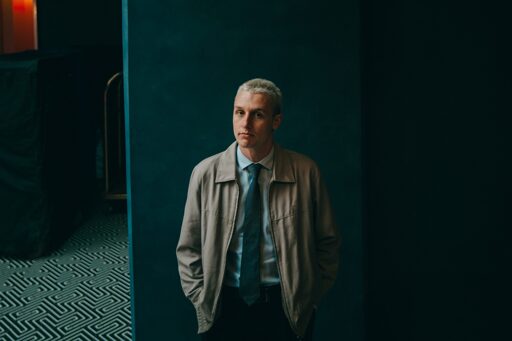

Asher Emanuel is the author of The Valley: Crime and Punishment in a New Zealand City, published by Bridget Williams Books. The book is the product of more than two years of field research and hundreds of hours of interviews. (Photo: Ebony Lamb)
Wellington-based lawyer and writer Asher Emanuel spent more than two years following three Hutt Valley men through courtrooms, prison, hospital, rehab, boarding houses and welfare offices.
The result is a new book out this week, The Valley*, which one reviewer has described as a “once-in-a-generation contribution to New Zealand writing about justice, class and wider society”.*
This extract follows one of the men, *Rikihana Wallace, from late January to February 2022.
(*All names have been changed, including Rikihana Wallace, his legal aid lawyer, Lewis Skerrett, his landlord, Ken, and Esther, a staff member at the Salvation Army.)
Rikihana left the boarding house at noon on a Wednesday in January, dressed sharply for his probation meeting in tan pants, a checked shirt and red canvas shoes. He had slicked back his bleached-blond hair, now tidily cut, and carried his bail paperwork in a shoulder bag.
He felt very lucky to be free. This time yesterday, he had been in the bail cells at the Hutt Valley court, with another shoplifting offence charged as burglary and a charge of resisting arrest from a night when he had been convinced to go drinking with his friend Kimberly. He was already on his final warning when Judge Booth let him out in late December on the 9-to-6 daytime curfew.
Lewis was worried they would need to apply for an ankle bracelet, which could take weeks, and Rikihana was worried he was about to lose his room and all his possessions. As soon as Work and Income were notified that he had been admitted to Rimutaka Prison on Friday, they had cut off his benefit. Moreover, if he lost the room, there would be nowhere to go with an ankle bracelet, so no EM bail, no community-based sentence. The only option would be prison.
But he had been given another chance. “I’m going to grant you bail,” Judge Logan had said, “probably against my better judgement.”
He got another warning, too — the judge said it would be prison next. “And I agree with Mr Skerrett that prison is not going to help you.”
Now he was on a 24-hour, seven-days-a-week curfew with a brief window on Wednesday afternoons to visit probation and get food. Other than during that window, police could visit at any time, day or night, to check he was there. He had just paid some debts and had only $12 in his bank account, so with an hour spare before his probation meeting, he decided to visit the Salvation Army about a food parcel.
It was a hot day and the sun was in his eyes as he descended the steps in front of the boarding house, past the empty swimming pool. He had visions of sunbathing and listening to music, people visiting, him passing out drinks to women beside the pool. He had been trying to persuade Ken to let him paint the pool and fix it up, but Ken just said, “No, no, no.”
He was taking no more chances with his bail and had Blu-Tacked a sign, written in red felt tip, to the window by the front door:
- Hello. ‘Curfew Check.’
- My Window 2 my Room
- is on the top floor @
- the back ov the House
- Could you ‘Please’ yell
- my name out by my
- window… It would be
- easier for me too be
- able to hear you’s Knock
- My rooms pretty far Away.
- And People may be asleep
- Thank You, R. Wallace.
On the day he was released, he had stayed up all night in case police did a bail check, just to be extra sure. The other residents were asleep at night because most of them worked — one was in construction, another a hairdresser.
He felt pretty confident about the 24-hour curfew. He had a plan to make some money. As soon as he could get his tablet back from a house in Taitā, he would be able to get online. There were websites where he could earn money for playing games and watching videos. He’d already had seven dollars sent to his PayPal account and he planned to keep going until he had hundreds of thousands of dollars.
His main worry was that his cravings might overwhelm him and that he’d then leave Ken’s to buy drugs and get caught breaching his bail. Withdrawals put him in a mental state where he just didn’t care. His mind would come up with crazy ideas — it felt like they weren’t even his thoughts, that there was an invisible junkie sitting next to him.
On his most recent stay in prison, he spent it hanging, forced to withdraw from opioids with no more than Panadol, food and water. Hot and sweaty in the isolation cells with the other suspected Covid cases, he took six showers a day but otherwise just lay in bed. It was the longest four days ever.
Friday.
Saturday.
Sunday.
Monday.
Fuck man, he had thought to himself. This is bad. I can’t be doing this all the time. I’ve gotta give this shit up.
*
When he arrived at the counter of the Salvation Army’s Lower Hutt building, the woman behind the counter greeted him with a smile. He asked if they did food parcels and she said they did, but they were closed that afternoon.
Rikihana gave her an apologetic look. “Today’s the only day I can come out. I’ll show you.” He got his bail bond from his bag and unfolded it on the counter. “I’ve got paperwork from court saying that I can only come out from 12 to 3.30.”
The woman inspected the paper and agreed to help. Rikihana thanked her and sat down in the waiting area. After a time, another woman brought out a clipboard with a form and a ballpoint pen.
“I’m Esther,” she said. “Nice to meet you. We should tell the police we close at 11.30 so they don’t do curfews from 12.”
Rikihana smiled at her and took the clipboard and Esther left him alone, disappearing out back. The form was three pages long, with questions about his living situation, what support he was getting for mental health, his Work and Income client number and what benefit he was on, and whether he needed help. He murmured to himself while he filled it out.
He returned the form to the counter and sat looking at carvings on the waiting room wall — three panels depicting ocean-going waka, navigation by starlight. He liked the carvings. At home, he had been drawing and painting watercolours. He had been working on character designs for a comic strip about his life story — being abandoned while growing up, being in and out of jail. Because it was a comic, it needed to have a happy ending, and so it would also be about positivity, and have information about the law and how to get out of trouble. He wanted to leave it for his children so that when he died they would understand his life.
He inspected a world map tacked to the wall near the carvings. He wanted to travel, to Japan and America, though he had not yet been as far as Auckland. Even the outback of Australia, he thought. In one of those jeeps. It would be hot as and he’d need plenty of water and petrol. His half-brother was married and lived in Australia. Rikihana had never been to a wedding, though he had been to a lot of funerals.
The woman called Esther re-emerged and led him down a corridor to a small room with a table, three chairs and a variety of toys and picture books. “We’ve had a bit of a busy morning,” she said, and thanked him for filling the form. “I know it’s a lot of paperwork.”
Rikihana smiled. “That’s all right, that’s all right.”
“You’re flatting at the moment?”
“Boarding, boarding house. About eight people.”
“Okay — so no one else you need to look after in terms of food?” She flicked through the form. “So you’re on the Jobseekers and it’s a bit tough financially at the moment?”
“Yeah.”
Esther gave him a big smile. “All righty, I’ll see what we can pick for you today. So — do you remember what’s in a food parcel? Has there been anything in the past that you’re like, Oh, I don’t like that, I don’t want to have that?”
Rikihana shook his head. “No.”
“Okay. And would you like us to pack any toiletries? The main things we can offer are soap, toothpaste, toilet paper, maybe washing powder.”
“Oh yes, please!” Rikihana nodded enthusiastically. “Yeah, that would be good.”
“Do you have normal cooking facilities? Would you like flour?”
Rikihana frowned as he thought. “Ahh—”
Esther smiled. “You can make pancakes?”
Rikihana laughed. “Oh, yeah. Yeah!”
She laughed too. “And cooking oil.”
“Yes, please.”
She asked about allergies but he had none. Did he need anything else?
“Umm, do yous have milk or butter or anything?”
Esther told Rikihana the parcel would have margarine and peanut butter and long-life or powdered milk and he was happy to hear that. Carrying his box outside, he stopped at the bottom of the steps where trays of old bread were left out and picked up three bags of buns and two baguettes. This would have to last him until next Wednesday.
Rikihana was 10 minutes late to his probation meeting, but it didn’t seem to matter. The woman behind the counter at the Community Corrections office mistook him for someone else and ushered him straight into a meeting space. The room contained two lime-green plastic chairs and a white desk with a computer terminal and two bottles of hand sanitiser. The door closed with a snick behind him as he sat down.
“Okay,” the woman said, settling into her chair and resting her arms on the desk. She wore a diamond ring and a small dress watch. “So I have — obviously — I had the meeting with your partner, and she was happy to consent to everything. She is more than happy for you to continue to reside there. Obviously—”
Rikihana realised there had been a mistake. He shook his head. “Aw, um, nah, I live at Hill Road. I only just got released from prison yesterday.”
“Sorry?”
“I’ll show you my paperwork,” he said, and unzipped his shoulder bag. He explained who he was, taking the woman through his bail documents.
She took the documents and read the curfew conditions back to him. He was not to enter various shops and supermarkets, she noted. It was important he show up to court next time. And was there anything he didn’t understand? “That’s pretty much it!”
She smiled as if to say the appointment was over, then recalled that he needed to be scheduled for a pre-sentence report. She turned to the computer terminal, asking for his date of birth. Once she’d looked him up, she apologised for the confusion. She had mixed him up with someone with a similar name. “Your photo looks different,” she said with a frown. “You’ve both got the same name, and you’ve both got pre-sentence reports!”
When the probation officer excused herself to find some paperwork, Rikihana’s mind wandered. He had only a short time left before curfew but he’d probably just go home. Maybe he would get a four-pack of seven percenters on the way, he thought. It would only be $10 and he could drink them at home, a few in the afternoon and one before bed. He’d have to go to the liquor store in Alicetown, 20 minutes’ walk away — he sometimes had trouble buying from the shops in the city.
The woman returned with a pad of appointment forms, to book Rikihana for an interview ahead of the pre-sentence report the judge had ordered. “It just gives you the opportunity of saying what was going on at the time of the offending,” she said as she filled out the form and tore off a carbon copy for Rikihana. “It just humanises the report we complete.”
*
On his curfew release afternoon a week later, Rikihana stopped in at Work and Income to check on his benefit — it was being reconnected, the staff told him — then hurried the few blocks to the Community Corrections building. It was raining on and off, and the air was muggy, but Rikihana wore two hoodies despite the heat.
He was looking forward to seeing Jean Wells, whom he hadn’t seen in ages, but when he got to the counter, he learned that she was on leave and he would be meeting with another probation officer, Mel.
“Okay,” Rikihana said, quietly.
Mel emerged from the back office and led him to a meeting room. “We have met before, very briefly, as I recall,” she said cheerfully as they settled into their chairs. She was middle-aged and spoke with an English accent, but it wasn’t posh. “How’s your week been?”
“Ah, it’s been okay.”
“Alcohol use?”
“Umm, nah,” Rikihana said easily.
The truth was, he had been drinking, but not a lot.
“Nothing at all?” She gave him a sympathetic look. “Are you doing okay with that?”
“Yep, I’m doing good,” he said and smiled. He always told probation officers positive stuff, because he knew they would repeat it to the judge in court. It was important to think ahead.
Mel nodded. “So, your offending. Is that around your drink?”
“Yeah,” Rikihana said, and sighed. “I make real impaired decisions when I drink — yes.” He thought for a moment. “I think everything’s easy and it’s okay, and it’s not.”
“Okay. It’s an escape, eh? A self-medication.”
“Yeah.”
She said he needed to think about how he wanted to deal with his drinking ahead of the interview for his pre-sentence report. “Because it seems quite clear to me — and I’m sure it probably seems a little bit clearer to you when you’ve not had a drink — that until you get a handle on your alcohol and what causes you to drink, this is just going to be repetitive.”
Rikihana nodded.
In an ideal world, she asked, what would he be doing? What would he like to do?
He gave her the answer he knew she wanted. “Oh, just be sober and have a job.”
Currently, what Rikihana wanted was his benefit reconnected and his debts paid. The Friday before, when a week after his benefit had been cut off the money hadn’t shown up, he’d gone out to WINZ at Ken’s insistence, in breach of his curfew, to try to sort it out. They told him to come back Monday, which he couldn’t. Now, five days later, Ken was complaining that the rent money still hadn’t arrived, and Rikihana also needed to clear his tab with his dealer, with whom he’d left his payment card as security on an advance.
Mel nodded enthusiastically at Rikihana’s answer. “Okay, so the getting sober — at the moment you’re sober. Are you going to any AA meetings, or having any counselling?”
Rikihana shook his head.
“Do you think you would benefit from those things?”
“I’ve been to quite a few. I do all the steps and stuff.”
Rikihana thought his life had been going downhill ever since he’d first gone to prison. On his first lag, he saw someone stabbed up in his cell. That was when he realised prison was serious. He learned a lot, that first time. How to do tattoos. How the screws are called screws because they screw you over. How to push the feelings away.
He had a mental breakdown and was sent to the At-Risk Unit where he sang songs and talked to himself and got really good at art. He’d felt some kind of support there, something invisible, and he thought about his Māoritanga from his upbringing and how it was like he had his spiritual ancestors there, helping him. He also thought a lot about God and Christianity to keep positive.
Not everyone got through. On his second lag, a fellow prisoner died of a suspected suicide. What’d you do that for? Rikihana wondered — he hadn’t even been far from getting out. Not long after, one of the other bros tried to kill himself but didn’t manage it and ended up badly injured.
Mel asked if residential rehab would be a good idea and Rikihana explained that he had been once before but left early. Mel said he was allowed to try again. “Quite a few people, it can be two or three times. You almost have to hit your rock bottom before you can really see exactly what’s going on. And it may be this time, you have hit your rock bottom,” Mel continued. She shrugged. “I don’t know. And you probably don’t know, really. Whichever way you look at this — you will always be an alcoholic. So you’ll always be recovering. You will always need support.”
On one hand, he did want to get sober in the long term and he thought it would be easy to do. But he also believed that the problem wasn’t drinking per se — it was drinking too much, or drinking with the wrong people. It was okay if he was in a good mood, but if things were ugly, drinking just made it worse.
“Are you pleading guilty?”
“I’m probably going to, yeah,” he said quietly.
He believed that all his problems were just from being negative and feeling down. That was why he used downers because he felt they perked him up. But he had noticed lately that his drug habit had started to change him. He used to be able to enjoy things — playing games, going for walks, days at the beach. Now he’d be doing something and all of a sudden things didn’t feel right and he didn’t feel good and he’d need to use.
Mel gave him a big smile. “Look, you’ve been clean for a couple of weeks. You’re doing really, really well. So, good on you.”
Rikihana smiled back. “Yeah.”
Everyone else thought that he needed to go out and get a job, but he wasn’t that type of person, he thought. There were other ways to make money fast — legitly, and smartly. He had been learning about Bitcoin and investment on YouTube — all he needed was a computer and a few bank accounts and a proper rerouter so no one could hack his shit.
“And I know it’s not easy. You know, things get you down. It could be the easiest thing in the world to go back to old ways. But you’re doing really, really well, so well done.” Jean wouldn’t be back next week, either, she said. He would be seeing someone called Glennis. “Anything you want to ask me?”
Rikihana was going to get some money, get a car and get out of Ken’s place. Get out of the worried zone. Ken was cool, but when he got worried, he made a face like he was going to faint or have a heart attack and it made Rikihana worry for him. He hated feeling like that.
“Um, nah.” Rikihana sighed slightly and gave Mel another smile. “I’m good.”

Extract from The Valley: Crime and Punishment in a New Zealand City by Asher Emanuel (BWB, $39.99).
Asher Emanuel is a writer and lawyer based in Wellington. He has worked in various legal and investigative roles, and his writing on justice and policy issues has been published in mainstream and specialist publications. The Valleyis his first book. Asher now works as a legal aid lawyer focusing on public law and human rights cases. He grew up in Auckland before moving to Wellington, where he studied law and English literature.
The post The easiest thing in the world appeared first on E-Tangata.
From E-Tangata via This RSS Feed.