

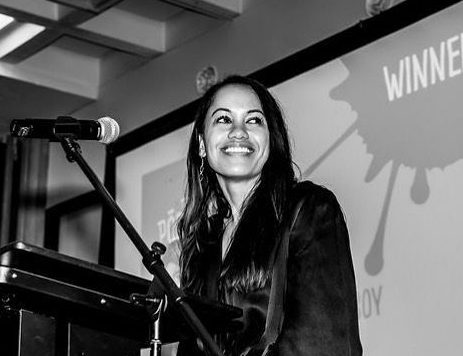

Shilo Kino (Image supplied)
Author Shilo Kino rethinks her criticism of the Auckland Writers Festival, as she gets involved in this year’s kaupapa Māori and Indigenous programme.
Last year, during the heightened national conversation around the proposed Treaty principles bill, I messaged Auckland Writers Festival director Lyndsey Fineran and asked if I could facilitate a panel around the bill and Te Tiriti o Waitangi. More than ever, it felt urgent to arm people with knowledge, and create a space where these conversations could happen openly and in-person, especially when the bill’s creator relied heavily on ignorance and the public misunderstanding that is generated online.
Lyndsey said yes, and when the day came, I was in awe. Around 85,000 people came through the festival doors that year, and our tangata Tiriti panel with Kirsty Fong, Max Harris, and Avril Bell was packed, if not sold out. There was a real vibrancy in the room, a buzz, and I saw older, everyday New Zealanders, mostly Pākehā, who genuinely wanted to learn and understand.
After the panel, an older Pākehā male approached me and asked if I could write down “Matike Mai” so he could spell it correctly and then go home and learn about constitutional transformation. It made me realise that people are actively looking for resources, but often don’t know where to go. As Kirsty said, we are ignorant by design, but there is a growing hunger to break that cycle.

David A. Robertson (a member of Norway House Cree Nation) joins Hēmi Kelly and Louise Erdrich at this year’s festival to talk language, identity, and storytelling. (Image supplied)
The Auckland Writers Festival is a major event that brings together some of the most important voices in writing and thinking, both locally and globally. Now that I’m an author, festivals are part of my world, but I didn’t even know they existed before I published my first book. When I first attended one in 2021, I wrote a pretty damning critique. Looking back, I can see I was trying to make sense of how different it felt from te ao Māori, and where I could fit in without having to change myself or conform.
The truth is, writers’ festivals are not Indigenous spaces. Our learning has always happened in the doing, on the marae, in the māra, in te taiao, through kōrero (as my aunty once told me, if I really want to learn my whakapapa, go and mow the lawns at the marae).
Literary spaces have largely been Pākehā, but things are shifting, and to me, literature and storytelling are deeply connected to the wider work of decolonising and indigenising our spaces.
The work of the father-and-daughter duo Michael and Matariki Bennett, led by Lyndsey, has been part of that shift, bringing te ao Māori into literary spaces in meaningful ways.
Last year’s programme blew me away. Indigenous voices were brought into the festival — from sessions in te reo Māori to spoken word, performances, and across almost every creative expression of art.

Jessica Hutchings, is in conversation at this year’s festival about her work growing kai and restoring soil as acts of tino rangatiratanga. (Image supplied)
So when I was invited to help guest curate the Auckland Writers Festival, I thought about the people and spaces that inspire me. I wanted to bring together voices, both young and old, those who have been doing this work for years and those emerging into it now. Rangatira in community, committed to transformation. Dreamers, believers, and doers.
Events are unfolding around us, here and across the world. It’s easy to feel despair in the face of war, rising costs of living, and political decisions that attack not only our culture, but also our most vulnerable communities. (The irony is not lost on me that while writing this, the government is in the process of removing clauses from the Treaty, quietly, across 23 pieces of legislation.)
I kept returning to an Indigenous principle often spoken about by Moana Jackson: the idea of looking seven generations ahead. What does it mean to be a good ancestor? What legacy are we leaving behind?
My tīpuna played significant roles in He Wakaputanga and Te Tiriti o Waitangi, and they came seven generations before me and my generation today. I think about how He Wakaputanga, in particular, was not a historical document, but a living entity that was written for us today, for me today, seven generations ahead.
Our tīpuna had the foresight and vision to know that our culture, our language, our lands, and our way of being were under threat. After all, He Whakaputanga translates to a declaration of our own independence, of sovereignty, that we can hold on to for generations beyond our own.
This programme is grounded in that same whakaaro. It invites us to look beyond our own lifetime, asking us to think beyond the present and consider the long arc of our decisions and their impact.
The panel “How to Be a Good Ancestor”, came together naturally, bringing in trailblazers Tame Iti, Margaret Mutu, and Richard Shaw, in conversation with rangatahi lawyer Gabriella Brayne. Tame Iti and Margaret Mutu have lived through movements, smashing down doors so we could walk through them. Richard Shaw has written two of my favourite books, and a new one, Good Settler, where he comes to grips with the truth of his family’s “pioneer stories” and how to live well with the past, the present, and the future.
The second panel centres on te taiao, and the idea that we are the land and the land is us. Anyone who works in māra and kai sovereignty will know Jessica Hutchings, a trailblazer in the movement. To have her in conversation alongside Tame Malcolm, who lives and breathes te taiao, and Rikki Solomon, who brings deep knowledge of maramataka and lunar cycles, is an honour.

Tame Malcolm, on left, will join Jessica Hutchings and Rikki Solomon to talk about living on the whenua in accordance with te ao Māori principles. (Image supplied)
And, of course, language is central. Hēmi Kelly, who has helped so many reclaim te reo Māori, joins Louise Erdrich (a member of the Turtle Mountain Band of Chippewa) and Canada’s David A Robertson (member of Norway House Cree Nation) in what promises to be a powerful conversation about language, identity, and storytelling.
Moana Jackson once said that one of the most devastating impacts of colonisation is that it has suppressed our ability to dream. May we all have the ability to imagine again, to dream beyond our own lifetimes.
This programme is an invitation to do exactly that.
We have two tickets to Ko au te whenua on Sunday Sun, 17 May at 4pm at the Aotea Centre to give away to E-Tangata readers. Just drop us a note at editor@e-tangata.co.nz to go in the draw — subject line “Tickets”.

Louise Erdrich, a member of the Turtle Mountain Band of Chippewa, and Pulitzer prize-winning author of novels, short stories and children’s books. (Photo: Paul Emmel)
Shilo Kino is an author from Ngāpuhi, Ngāti Maniapoto and Ngāti Te Ata. Her debut novel,The Pōrangi Boy, won the Young Adult Fiction Award at the 2021 New Zealand Book Awards. Her second book,All That We Know, took the number one spot in the NZ Fiction bestsellers list. Shilo lives in Tāmaki Makaurau and has recently completed a master’s degree in Indigenous studies at Waipapa Taumata Rau or the University of Auckland.
The post Shilo Kino: Indigenising writers’ festivals appeared first on E-Tangata.
From E-Tangata via This RSS Feed.