

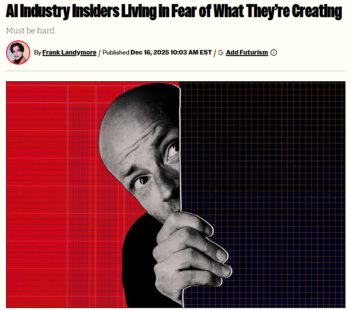
Futurism (12/16/26): “At NeurIPS, one of the big AI research conferences…visions of AI doom were clearly on the mind of many scientists in attendance.”
You ever wonder why people who make AI talk about how AI might destroy humanity—but still keep making AI? Brian Phillips of the Ringer (5/6/26) has a plausible explanation.
Writing about Anthropic’s announcement that it wasn’t going to release a new product, Claude Mythos, to the public because it was too dangerous, Phillips notes:
The AI industry has been driven from the beginning by wildly overwrought claims, many of them pertaining to the destructive potential of its products. Too dangerous to release to the public is a move the industry has pulled before….
It may seem like a strange tactic for companies to scaremonger about their own products. When Ford rolls out a new pickup truck, the CEO generally doesn’t go around giving keynote addresses about how much more lethal it will make American highways. But the AI industry is selling a narrative—a mythos, if you will—as much as it’s selling a product, and that narrative is one of revolutionary, transformational power. “Our product can make your life a bit easier, although there are still a lot of kinks to iron out” is not a trillion-dollar sales pitch; “we’ve invented something so powerful that it has the potential to destroy humanity” is.
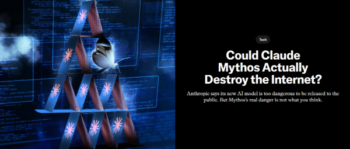
Brian Phillips (Ringer, 5/6/26): “The decision to portray the new model as too dangerous to release into the wild suggests an attempt to answer a follow-up question: ‘And how can we maximize the attention we get for it?’”
In this read, apocalyptic narratives about AI are largely if not entirely designed to justify more investment in a technology that has already sucked up so much money that analysts wonder if it will ever show a profit:
Think about the way the industry talks about itself. AI isn’t just another tech gizmo. It’s bigger than the internet. It’s bigger than the smartphone. It’s going to reshape human society. It’s going to put millions out of work. It’s going to eliminate money. It’s going to surpass human intelligence. It’s going to replace humans altogether. It’s going to kill all humans. It’s going to be profitable beyond your wildest dreams, at least at some point, although definitely not today.

The artificial-intelligence boom has ushered in one of the costliest building sprees in world history,” reports the Wall Street Journal (9/25/25). “No one is sure how they will get their investment back—or when.”
This serves, says Philips,
to distract from the fact that their products thus far have been largely underwhelming. If the integration of AI into Google Search had been rolled out quietly and evaluated on its merits, it would have gone down as one of the most disastrous tech launches of all time. Your only job is to give me accurate information; you did a decent job of it yesterday, and today you’re telling me to put glue on pizza? But when the same rollout comes slathered in hype—when I’ve been conditioned to experience it as part of a narrative about civilizationally transformative technological innovation—I’m less likely to judge it on its merits, because even its shortcomings can be reframed as marks of the disruptive nature of progress.
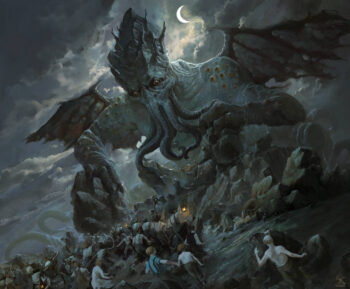
Harris Cameron (Medium, 4/27/20): H.P. Lovecraft, creator of the Cthulhu Mythos, “has come to be a kind of mascot to the very geek culture which dominates Silicon Valley and, by extension, much of our media landscape.” (Creative Commons 3.0 image by Sanskarans.)
And this is why it makes sense for Anthropic to talk about how their latest creation could destroy the internet: If it’s that powerful, maybe it’s worth giving its creators $1 trillion (which is what it’s hoping to raise in an IPO), in hopes that you’ll own a piece of that power:
The tendency of AI companies to talk about the dangers of their products may make people hate the industry (and people really hate the industry). But it also keeps people from saying, “This is kind of neat, I guess? But it’s super buggy and not all that useful.” The Mythos announcement can be understood in that light: It might make people leery of Anthropic, but it makes Mythos seem like a huge deal, which is ultimately what Anthropic wants.
Note that in the nerd culture that dominates Silicon Valley, the first association with the word “mythos” is the Cthulhu Mythos, a series of horror stories about an alien monster that will one day destroy humanity. That’s very on brand.
From FAIR via This RSS Feed.