

World War II ended in the final hours of May 8 and the first hours of May 9 in 1945. In an old military academy in the Karlshorst neighborhood of East Berlin, Nazi Germany’s top military brass declared their unconditional surrender to the Allies. Since then, May 8 has been celebrated as Liberation Day.
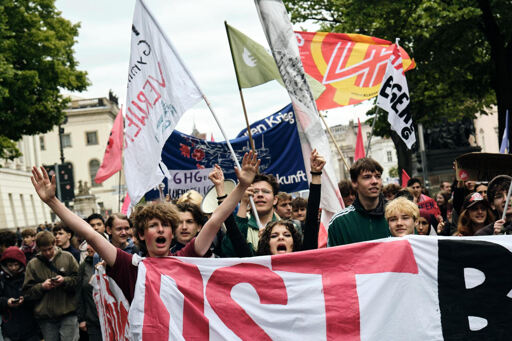
This year, May 8 was used for a different fight against German militarism. In over 150 cities, school students went on strike against the military service introduced by Friedrich Merz’s government at the beginning of this year. Organizers counted 45,000 young people on the streets.
In Berlin, several thousand kids gathered at the Brandenburg Gate and marched past the Soviet War Memorial. They swung around the Victory Column, a celebration of Prussian military might, before reaching the headquarters of Merz’s Christian Democratic Union.
Police were out in force and detained several young people for saying: “Merz, lick eggs!” (i.e. balls). This has turned into quite a meme since a youngster was arrested at the last school strike two months ago for a sign with this suggestion for the chancellor. This time, thousands were chanting together: “Merz leck Eier!” The police also took umbrage at the slogan: “Merz, you can die on the Eastern Front yourself.”
Authorities have used different repressive tools to silence anti-militarism: Students in Kiel reported being threatened by agents from the VS, the domestic intelligence service, and the BKA, Germany’s FBI. Propaganda for Germany’s army is everywhere, with recruitment officers prowling through schools and pressing charges against students who object. While Merz claims that a trillion-euro armaments program is necessary to protect “our freedoms,” militarism is going hand in hand with attacks on basic democratic rights like freedom of speech.
Since January 1, the German Bundeswehr has been sending questionnaires to everyone who turns 18. In the first five months of this year, the defense ministry sent out 200,000 letters. Only 72 percent of young men responded — despite facing a fine of €250. Among women and other genders, who are not required to answer, only 3 percent reacted.
Merz’s government wants to build the “strongest conventional army in Europe,” and is planning to spend €200 billion each year on new weapons. Their goal is to raise the troop strength to 270,000 within a decade. If they can’t do this with “voluntary” means, such as astoundingly high pay for young soldiers, they will begin conscripting people. While a majority of the public voices abstract support for increasing the military budget, the number of people who are willing to enlist is tiny.
After just one year in office, Merz is currently the world’s least popular head of government, with an approval rating of just 16 percent — the lowest value ever measured for a German chancellor. The massive militarization program is being financed with vicious cuts to education, health care, pensions, and unemployment benefits. Quite literally: Money is being taken out of workers’ pockets and handed over to weapons manufacturers like Rheinmetall. As Merz’s predecessors called this program, it’s “cannons instead of butter.”
In Berlin, the school strike was joined by a group of service workers from the Vivantes public hospitals. They have been on strike for three weeks demanding equal pay for equal work. Their solidarity showed that the school strike and the hospital strike are two sides of the same coin: young people want a future and healthcare workers want a decent life; both these demands are in conflict with the German bourgeoisie’s ambitions for new wars.
This incipient alliance between young people and workers shows how Merz can be defeated: students who want to stop conscription need to give full solidarity to the Vivantes strike. A victory by hospital workers would put a brake on Merz’s austerity plans for health care, and thus reduce the amount of funding available to prepare new wars. It’s no different than what we see in the U.S., where students and workers have gone on strike together against ICE and on May Day. Workers and students united in struggle — that gives us a rough outline how we can prepare new Liberation Days from German militarism.
The post Students in Germany Strike Against Conscription appeared first on Left Voice.
From Left Voice via This RSS Feed.
You must log in or # to comment.