

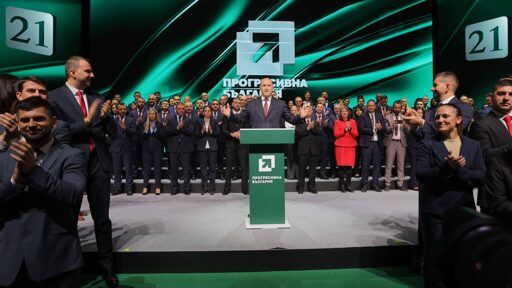
The recent emergence of former president and military pilot Rumen Radev as the winner of the snap election in Bulgaria signaled potential stabilization in parliamentary politics. The previous government collapsed at the end of 2025 – after approximately 11 months – continuing a cycle of instability that has persisted for years. While for some Radev and his Progressive Bulgaria’s majority bring hope this might change, it remains to be seen whether their program actually responds to the reasons behind the quick governmental turnover.
Radev stepped down from the presidency in January and announced he would run in the election, shortly after a wave of protests toppled the previous administration headed by the right-wing Citizens for European Development of Bulgaria (GERB). As researcher and political analyst Madlen Nikolova explains, the protests were sparked by the annual budget proposal but had much deeper roots. “The budget offered very little to working people, instead proposing increased social security contributions and some taxes,” she told Peoples Dispatch. “That angered many working class people: they could not tell where their money was going in the context of a constant stream of corruption scandals and schemes related to the then-ruling party and their cronies.”
While mainstream media was quick to classify the protests under the Gen Z mobilizations umbrella, Nikolova emphasizes they were actually based on social issues and cost of living concerns felt across generations. “In different surveys, people raised concerns rooted in the aspiration for a dignified old age for their parents, good education for their children, good healthcare, and so on,” she says. “None of them have seen progress in any of these spheres over the past 20-30 years.”
A potential moment of respite from corruption scandals
Governments led by GERB – supported by the populist There is Such A People and the Bulgarian Socialist Party at the time of the protests and enjoying the continuous backing of formations like the Movement for Rights and Freedoms (DPS) – fed this frustration by building a fine-knit clientelistic network at different levels of administration and legislative power, leaving most people conscious that no options are available unless one joins them. That’s why it was notable to see the protests expand outside Sofia, Nikolova points out. “Protesters were finally defying the clientelistic networks operated by GERB and DPS that were controlling public contracts and jobs in poorer regions,” she says. “This is more or less the context in which Radev’s party rose and received such a surprising wave of support.”
Contrary to earlier predictions that saw Progressive Bulgaria winning the election but needing coalition partners to form a government, Radev’s camp secured 131 of 240 seats on its own. This should give it ample room to implement its program, except for matters relating to promised judiciary reform – where additional parliamentary support will be required.
Read more: Orbán defeated, but right still victorious in Hungarian elections
The first announcements of Radev’s electoral success in the mainstream dubbed him as a pro-Russian and potential Eurosceptic: this took place around the same time it became apparent Viktor Orbán would leave the Hungarian premiership, with European institutions wary of new figures who could obstruct their planned support for the Ukraine war. Since the election in April, however, it seems Radev is unlikely to be this figure.
Instead, Nikolova points to a certain “ideological vagueness” – the benefit of not being associated with any of the parties that have let down people’s hopes over the past decades – that has ushered in Radev’s election. “His program does focus a lot on issues related to corruption and clientelist networks, but other than that, it offers boilerplate policies in all spheres, along with a strong focus on artificial intelligence (AI),” she says. “When it comes to working conditions, there’s no mention of improving them really. The only mention of workers’ rights and stable employment is exclusively in the context of military employment.”
In this regard, Progressive Bulgaria’s planned measures mirror EU guidebooks, emphasizing fiscal discipline, budget constraints, and a limited distributive role for the state. “The party is definitely not a vehicle for social change, but maybe it will provide respite from all the endless corruption scandals and allow for room to talk about other strategic policies for the country,” Nikolova says. This remains a hope despite clear neoliberal tendencies, she adds, as Progressive Bulgaria still appears as a kind of broad-tent party, with some representatives using language based on solidarity, justice, and reform.
Moving beyond anti-corruption rhetoric?
“The key challenge is to move beyond the anti-corruption rhetoric, which would mean turning widespread frustration into a more coherent political project rooted in people’s everyday material concerns,” Nikolova points out. With the Bulgarian Socialist Party out of parliament for the first time since the 1990s, its credibility among the people eroded after its participation in a number of right-wing governing coalitions, including the latest GERB-led administration, it is a big question who could assume the responsibility for building this political project.
Progressive Bulgaria is, again, unlikely to assume the role. While the prospect of tackling corruption and prioritizing national interests in foreign affairs could lead to improvements, caution is still in order, Nikolova says. “As Bulgaria is unlikely to become a major global player, it makes sense for its political class to focus more consistently on the concerns of its own voters. That said, those concerns don’t necessarily align with what Radev’s camp defines as the national interest.”
Read more: Peter Mertens: “We have to restore people’s confidence in collective strength”
“I believe Progressive Bulgaria’s stance mirrors wider developments across Europe. A growing push for military autonomy is unfolding, alongside deep internal tensions. Belgium has resisted seizing Russian assets despite pressures from the EU, but continues to cut welfare to fund its own rearmament. This has prompted large-scale mobilizations for over a year. In the context of economic slowdown in the country, Germany is struggling to justify moves towards conscription,” Nikolova adds. “It is obvious that Europe’s emerging ‘austerity for war’ agenda is already under strain from domestic pressures and fiscal constraints.”
“Radev and Progressive Bulgaria are already advocating for a significant increase in military spending up to 5% of GDP by 2035. The former president has called for – like many other European leaders – investments in unmanned aerial vehicles, drone defense systems, and the integration of AI technologies into the armed forces.”
“And he has explicitly emphasized closer interoperability between Bulgaria’s armed forces and NATO’s,” Nikolova concludes. “What will be left of NATO soon, I don’t know. But he’s definitely not questioning the logic of this military alliance – nor Bulgaria’s place in it or in the EU.”
The post Progressive Bulgaria promises to fight corruption but unlikely to stray from EU playbook appeared first on Peoples Dispatch.
From Peoples Dispatch via This RSS Feed.