

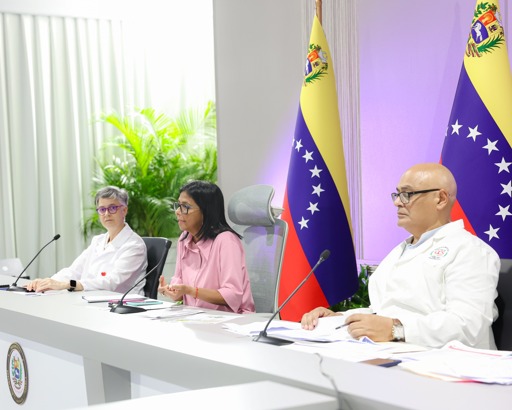
Venezuelan Acting President Delcy Rodríguez has reported that the nation has successfully distributed 47% of the medicines sent in recent months by the US empire, in accordance with existing healthcare agreements made between the nations. She pointed out that the supplies provided by the US represent only 4% of the monthly allocation that the Venezuelan government itself distributes to hospitals and health centers, amidst the severe blockade that US imperialism maintains against Venezuela.
The points made by the acting president this Wednesday, May 6, were intended to dismantle a campaign promoted by far-right sectors seeking to continue harming Venezuela by spreading lies and falsehoods, as she herself described in a presidential activity dedicated to the health sector.
In recent weeks, media outlets linked to far-right extremist groups, as well as the president of the Venezuelan Medical Federation (FMV), Douglas León Natera, and other spokespeople associated with these groups, have tried to sow doubts about the destination of the medical supplies sent by the US entity to Venezuela.
From Miraflores Palace in Caracas, Rodríguez explained that the medications Venezuela receives must comply with international verification protocols before being distributed to the population, a process carried out by the Rafael Rangel National Institute of Hygiene. The procedures the leader described were further elaborated on in a video published a few minutes after her speech during the presidential event.
“There are sectors that persist in harming Venezuela through falsehoods and lies,” she explained prior to the screening of the video. “I hope that the media outlets that have lent themselves so much, both nationally and internationally, to spreading lies, will embrace the truth.”
She detailed that Venezuela has not only received an allocation of medicines from the US, but also “a donation from the president of the UAE for equipment for a CDI (Comprehensive Diagnostic Center),” and a donation “from Brazil’s President Lula of medicines for cancer treatment.” She detailed that the US empire’s donation was the equivalent of $2 million in antibiotics, anti-inflammatories, steroids, vitamins, gauze, gloves, and masks.
A few days after the arrival of the former US chargé d’affaires to Caracas, Laura Dogu, on February 13, the US embassy launched a public relations campaign displaying medicines arriving to Venezuela. Days later, Chavista leaders explained that the medicines were not a donation but a medicine allocation within healthcare agreements signed between Venezuela and the US, for which Venezuela was paying for.
Before showing the video of the verification process carried out by the National Institute of Hygiene, she emphasized that the video is being presented to prevent the people from being deceived, so that they do not become “victims of the narrative of far-right sectors that persist in attacking the people of Venezuela.”
President Trump, end the blockade against VenezuelaThe acting head of state reiterated her request to US ruler Donald Trump to end the US-led illegal blockade against Venezuela. The unilateral coercive measures against the country began in March 2015, when former President Barack Obama declared the land of Simón Bolívar an “unusual and extraordinary threat.”
“I will insist to the president of the US, Donald Trump,” she demanded, “within the framework of these good relations we have been building, that he immediately cease the sanctions against Venezuela.” This direct appeal to the current White House tenant has been consistently repeated by the acting president in recent months.
“I have said that our role is that of justice seekers; to bring justice to Venezuela and correct inequalities in the face of all difficulties, the first of which is the economic blockade against the country. The entire country mobilized with a pilgrimage, demanding the end of the blockade against Venezuela,” she had commented previously, referring to the mass mobilizations that took place from April 19 to 30 that encompassed the entire nation.
US medicines went to the hospital network
In the video released by the acting president, it was explained that the distribution of the medicines sent by the US empire was destined for the hospital and outpatient network.
In May, the government directed ciprofloxacin (antibiotics) injectable solution and 0.9 sodium chloride (saline) solution to the hospital network, while medications such as folic acid (supplementaries), ciprofloxacin tablets, and some antihypertensive medications went to the outpatient network, CDIs, and popular clinics.
“There it is,” Rodríguez explained after the video was broadcast, “we have to comply with these international protocols so that safety can be ensured in the use of this medication.”
On February 14, the first vice president of the National Assembly (AN), Pedro Infante, explained that these were not donations, and that with its own unblocked money, Venezuela was buying medicine and medical equipment from the US, adding that “there are those who always try to distort and manipulate the truth.”
He thanked several countries for international support via social media:
• Brazil donated supplies to guarantee dialysis for Venezuelan patients for five months.
• The UAE donated three million dollars for hospital medical equipment.
• Venezuela purchased $945,000 worth of outpatient medicine for $140 million within the framework of the agreement between the nations for hospital medical equipment and medicine, using money unblocked in the binational cooperation agenda
Venezuela Welcomes More Repatriated Citizens; US SOUTHCOM Reaches 178 Extrajudicial Executions
Venezuelan money in the IMF will also go to health
Acting President Rodríguez further noted that Venezuelan resources that are blocked in the International Monetary Fund (IMF), once unblocked, will be used to finish housing solutions that the Great Housing Mission Venezuela (GMVV) is building, as well as to strengthen health centers.
“I hope that as we gradually continue to unlock the Venezuelan economy, Venezuelan hospitals will be the first beneficiaries in terms of supplies and equipment,” she explained. “We are already discussing this with the IMF, where Venezuela has frozen financial resources. We hope to unlock these resources to equip the hospitals.”
She explained that the government is already in the process of contacting international companies for hospital equipment.
When the IMF refused to recognize Venezuela’s constitutional government in 2019, it also stripped the country of its Special Drawing Rights (SDRs), a system created by the IMF in 1969 to provide liquidity to global economies and offer additional reserves to member countries in times of crisis. In 2020, as the world grappled with the beginning of the COVID-19 pandemic, the international organization prevented Venezuela from accessing $5 billion to which it was entitled, amidst the severe hardship caused by the virus. The IMF’s actions were repeatedly condemned by the constitutional president, Nicolás Maduro, before being kidnapped by the US empire in its brutal January 3 invasion of the country, when he was kidnapped and more than 100 people were massacred.
(Diario VEA) by Yuleidys Hernández Toledo with Orinoco Tribune content
Translation: Orinoco Tribune
OT/JRE/AU
From Orinoco Tribune via This RSS Feed.