

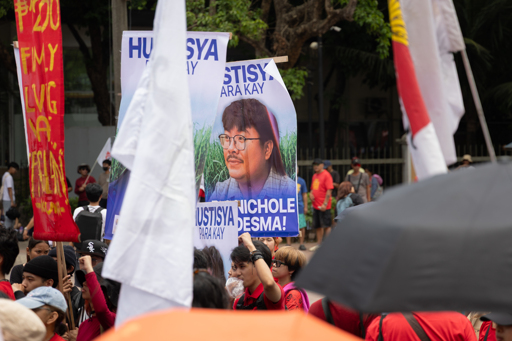
“RJ symbolizes the best of us in community journalism, but his life was cut short when the military killed him.”
MANILA – Community journalists like RJ Ledesma report at the center of conflicts— from sugar plantations, displaced communities, up to the blood-soaked sites of so-called “encounter”— rendering them vulnerable to two-folds of danger: state violence and the precarity of their conditions.
Ledesma was killed together with eight other civilians and 10 revolutionaries in a series of military operations by the Philippine Army on April 19. He spearheaded the operations of Paghimutad, a Negros-based news outfit, and acted as the regional coordinator of Altermidya.
Altermidya Network organized a tribute to honor his works and contribution to community journalism, while also strengthening their demands for justice for Ledesma and the rest of the slain individuals collectively known as “Toboso 19.”
“RJ symbolizes the best of us in community journalism, but his life was cut short when the military killed him,” Altermidya chairperson Raymund Villanueva said during the tribute. “Every journalist should be like RJ: heart close to the people.”
Ledesma’s work revolves in documenting the struggles of communities facing displacement due to large?scale renewable energy projects, reclamation projects, and the expansion of palm oil plantations. He also reported the dire conditions of sacadas or sugarcane workers in the Negros island – the “sugar bowl” of the Philippines.
Diosa Labiste, dean of the University of the Philippines Diliman College of Media and Communication, said that community journalists are the least protected in the country’s media ecosystem– lacking economic and institutional safeguards and being a subject of political vilification.
“The precarious situation of journalists exposes them to the risk of being able to write a story alone,” Labiste said in a tribute, highlighting that community journalists operate on a contract or freelance basis, without institutional and economic protections (e.g. social protection benefits, insurance) .
“Economic issues cannot be separated into political conditions. Where impunity, disinformation, and weak institutional protections converge, freelancers and community journalists like RJ become casualties of conflict and crisis they report on.”
She also added that the implications go beyond the welfare of journalists as news organizations often face attacks and delegitimization, weakening the journalism’s role to reflect the conditions of the society.
The National Union of Journalists of the Philippines (NUJP) released its annual report, emphasizing that state repression remains the biggest threat to the Philippine media. In more than 200 media freedom violations they recorded, 43 percent were perpetrated by government and state security forces.
“In the case of community journalist RJ Ledesma, the Philippine military lied through its teeth claiming that our colleague was a combatant in an attempt to justify the murder,” the union stated.
It is explicitly stated in the Rule 34 of the international humanitarian law (IHL) that journalists are protected from being targeted by military offensives, especially if they are engaged in “professional missions in areas of armed conflict.”
The Philippine government and the National Democratic Front of the Philippines also signed the Comprehensive Agreement on Respect for Human Rights and International Humanitarian Law.
Moreover, the International Committee of Red Cross (ICRC) stated that journalists are dying in record numbers in situations of armed conflict.
“The people and places that IHL is meant to protect are too often in the line of fire,” the ICRC noted. “Deliberate violations are far too common; and too little is done to prevent their recurrence and hold state and non-state perpetrators to account.”
The ICRC urged member-states like the Philippines to do more in training and sanctioning their own security forces, push others to comply, and empower the judiciary to prosecute and punish those who commit war crimes.
Making them the enemy
Branding journalists and activists as “combatants” – arrested, killed in the name of the government’s counterinsurgency program – is not new but the norm.
In fact the CHR released the results of its 2025 national inquiry, stating that red-tagging is a recurring pattern that disproportionately affects human rights defenders, journalists, humanitarian workers, labor leaders, youth, religious leaders, lawyers, and activists enabled within the government’s counterinsurgency program.
Read: Rights commission report affirms detrimental outcomes of red-tagging — groups
Frenchie Mae Cumpio, executive director of Tacloban-based alternative media outfit Eastern Vista remains in detention for more than six years, convicted on trumped up terrorism financing charges.
“The cases of RJ and Frenchie reflect the harsh reality of press freedom in the Philippines: it continues to be under grave threat, primarily from state forces that regard truth-telling as a crime and critical journalism as an enemy,” Altermidya said in a statement on World Press Freedom Day.
The CHR enumerated the human rights violations that transpired in the case of red-tagging: the right to life, liberty and security, the right to privacy, the right to freedom of expression and opinion, and the right to defend human rights.
“Several human rights defenders who were subjected to enforced disappearances, assassination attempts, or killings were identified. These cases demonstrate the real and concrete consequences of red-tagging, which constitute serious violations of the rights to life, liberty, and security,” the CHR noted in its report.
Center of violence
The Negros island is one of the hotbeds of state violence. Under the administration of Ferdinand Marcos Jr., human rights group Karapatan reported that the Negros region has the highest number of extrajudicial killings related to counterinsurgency at 52 cases.
It also has a large concentration of political prisoners in the country with 94 individuals, second to the highest following the Northern Mindanao Region at 103. There are also three cases of enforced disappearance in the region, according to Karapatan.
“Negros has witnessed a series of massacres, majority includes children,” said Negros veteran journalist Inday Espina-Varona in her tribute. “Most of those killed were also rights defenders to isolate the people, to create an environment of fear. For RJ to actually reinvigorate the movement there is a great contribution. I know he is not alone, but definitely, they are operating in a turbulent context.”
On June 14, 2023, a peasant family of four was killed near their home in Sitio Kangkiling, Barangay Buenavista, Himamaylan City, Negros Occidental. Spouses Roly and Emelda Fausto, 55 and 50 years old, respectively, were killed along with their two sons. Ben Fausto was 15 years old while Ravin Fausto was 12 years old.
The family reported illegal searches and seizures, surveillance, and red-tagging from the Philippine military prior to the killing. Until now, no one has been held accountable for the killings of the Fausto family.
Read: ‘Probe massacre of peasant family in Negros’ – rights group
On October 20, 2018, nine farmers – including two minors – were killed in Hacienda Nene in Purok Pine Tree Barangay Bulanon in Sagay City, where farmers are staging “bungkalan” or land cultivation of idle farm lands. All nine were members of the National Federation of Sugarcane Workers (NFSW).
Read: 9 farmers killed, 3 wounded in Sagay massacre
Human rights watchdogs observed that the killings of civilians have intensified since the implementation of Oplan Sauron or the Memorandum Order No. 32. Rev. Melvin Fajardo of Human Rights Advocates in Negros (HRAN) said that the memorandum was used to address criminality, but the implementation paints otherwise.
“In practice, it has enabled the increased deployment of units from the AFP and the Philippine National Police, deepening military presence in communities and heightening the risks faced by civilians, activists and journalists alike,” Fajardo said.
Read: ‘Why did the military kill a journalist?’
Documenting human rights violations
Moreover, Ledesma wore many hats as his colleagues emphasized. He was seventh nominee of progressive youth group Kabataan Party-list in the 2022 elections, worked with the local environmental network HAKSON, Inc., and contributed to Karapatan in documentation of human rights violations in the province.
“Whenever he reports about the situation in Negros, everyone is listening. He has interesting insights and contributions about designing campaigns,” said Cristina Palabay, secretary general of Karapatan.
Palabay said that their group documented a large number of human rights violations and IHL violations during their initial fact-finding mission on the killings of Toboso 19.
Journalists, activists, farmers, and civilians in general are not valid military objectives as explicitly stated by the IHL. Even revolutionaries who are considered out of combat (hors de combat) are not valid targets of conflict.
“The parties to the conflict must at all times distinguish between civilian objects and military objectives. Attacks may only be directed against military objectives. Attacks must not be directed against civilian objects,” IHL stated in its rule 7.
Children were guaranteed special respect protections under Article 135, but two of the identified civilians killed were minors. Since the issue went public, the Philippine Army has maintained that all those killed were combatants, but is heavily contested by human rights groups, watchdogs, and even the belligerent forces that the military is at war with – the Communist Party of the Philippines (CPP).
Karapatan concluded that the Philippine Army’s hostility towards Toboso 19 constituted war crimes. “Whether they are civilians or combatants, the sheer number of those killed triggers significant questions and conclusions on the conduct of the AFP operations,” Palabay said.
She added, “The military’s use of disproportionate and excessive force, the seeming failure to undertake measures to avoid or minimize deaths, the one-day media black-out, and varying reports on places of incidents and recovered firearms.” (RTS, RVO)
The post Attacks on community journalism meant to silence people’s issues appeared first on Bulatlat.
From Bulatlat via This RSS Feed.