

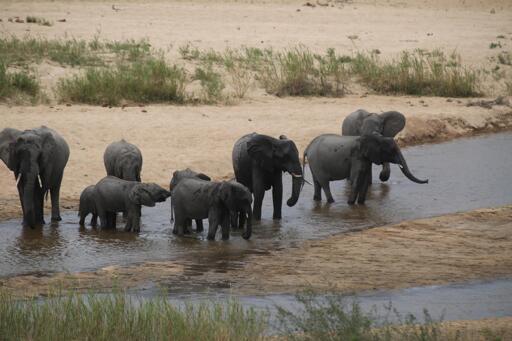
A continent-wide genomic study of both savanna and forest elephants in Africa has found that African elephants once roamed widely, both species exchanging genes throughout their range. However, as humans decimated elephant populations for their ivory and fragmented their habitats with farms and urban development, the effects of these disturbances appeared in the genomic patterns of both African elephant species. Forest elephants (Loxodonta cyclotis) and savanna elephants (Loxodonta africana) were considered one species until 2021, by when genetic studies confirmed they are two distinct evolutionary lineages that diverged 2 million to 5 million years ago. The recent study, which sequenced 232 genomes of savanna and forest elephants across 17 African countries, confirmed the deep divergence between the elephant species. The researchers also found that the two species have a history of hybridization, especially where forest and savanna habitats meet. In areas such as Garamba National Park in the Democratic Republic of Congo and Queen Elizabeth National Park in Uganda, the team found evidence of recent hybridization. Meanwhile, some savanna elephants far from forest habitats, such as those in northern Uganda, the Serengeti in Tanzania, and the Zambezi in Southern Africa, also have signs of forest elephant ancestry in their genomes, the study found. This suggests there was hybridization at some point in the deep past, the authors say. They link this to shifts in the extent of tropical forests in response to climate change over millions of years. The researchers also found signals of human impacts on some elephant genomes.…This article was originally published on Mongabay
From Conservation news via This RSS Feed.