

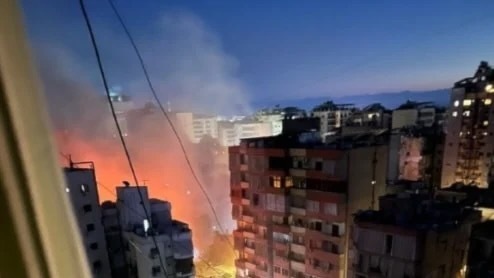
Israeli warplanes bombed Beirut’s southern suburb Dahiye on Wednesday, May 6, killing at least two people and injuring seven others in yet another clear violation of the ceasefire agreement announced last month.
The Israeli attack in the densely populated area also caused massive damage to residential buildings.
Israeli media later reported that the attack was carried out in coordination with the US and it was an assassination attempt targeting alleged Hezbollah fighters in the area, Al-Mayadeen reported.
Israeli Prime Minister Benjamin Netanyahu later confirmed the attack, claiming its forces assassinated Malek Balou, a commander of Hezbollah’s Radwan Forces.
Israel also claimed to have killed other Hezbollah officials in the attack. None of these claims have been confirmed by Hezbollah yet.
This was the first Israeli attack on Beirut since the ceasefire announced by US President Donald Trump came into effect on April 17 as a part of the Iranian demand of a comprehensive ceasefire in the region prior to talks.
However, this was not the first such violation of the ceasefire by Israel as it has regularly bombed Southern Lebanon and the western Beqaa region, killing hundreds of people.
On Wednesday alone, at least 13 Lebanese citizens were killed in different attacks including one in eastern Beqaa Valley, in which at least four people were killed.
Israel also issued fresh threats of attacks asking residents of dozens of towns and villages in Southern Lebanon to evacuate on both Wednesday and Thursday.
At least 2,700 Lebanese have been killed in Israeli attacks since March 2, which has also seen massive damage to the entire region and the complete derailment of all civilian activities there, forcing thousands into displacement.
However, despite Israeli aggression in Lebanon for the last two and half years, it has failed to damage Hezbollah’s capability to retaliate.
Hezbollah has been able to resist the Israeli land invasion in Southern Lebanon and cause substantial damages to the enemy forces as well as launch missile and drone attacks targeting various locations in Northern Israel.
Israeli ceasefire violations in Gaza
According to a report published by Drop Site News on Wednesday, Israel has carried out over 1,228 airstrikes and shelling attacks and over 1,060 live fire attacks across Gaza since “the ceasefire” in October last year.
Tuesday alone saw at least 10 ceasefire violations, including an attack in which at least three Palestinians were killed. One of the Palestinians killed was identified as 15-year-old Gaza City resident Mahmoud Sahwil.
On Thursday, Israel killed four more Palestinians in Gaza including a child. Azzam al-Hayya, son of Khalil al-Hayya, the Hamas political bureau member and top negotiator from Palestinian side, also died in a hospital after being attacked by Israeli forces on Tuesday.
Khalil al-Hayya condemned the Israeli violations of the ceasefire and claimed that due to Israel’s failures to honor its obligations, peace talks have failed to yield any results so far.
The ceasefire violations by the IOF on Tuesday include shelling, drone attacks, live fire by the IOF on civilians, moving tanks into civilian areas under the cover of live fire, bombings, attacks on camps, and explosive demolition near residential areas, among others.
Drop Site reports that the total number of Israeli violations of various ceasefire agreements in Gaza since 2023 has now reached over 2,741.
Since the October 2025 ceasefire, the IOF has killed over 837 Palestinians, including 216 children, in Gaza, violating the ceasefire. At least 2,381 Palestinians, more than half of them being children, have also been injured in these attacks.
Israeli forces also continue to occupy a large part of the land inside the so-called yellow line from which they had to withdraw, as per the “Peace Plan” presented by US President Donald Trump.
The presence of the IOF has prevented necessary repairs of basic civilian infrastructure such as water supply, electricity and sewage damaged during the Israeli war on Gaza.
The Israeli occupation has also maintained its severe restrictions on the supply of humanitarian aid and movement of people across the territory.
The IOF restrictions do not exempt movement related to medical or humanitarian needs either, causing additional suffering to Palestinians in need of urgent treatment.
According to the Drop Site report, Israel has allowed only around 37% of agreed humanitarian aid per day (224 trucks instead of 600 trucks) into the occupied territories. Its restrictions on the supply of fuel to the Palestinians is even more severe, with only around 15% of the total need allowed in.
The post Israel violates ceasefire in Lebanon in attack reportedly coordinated with the US appeared first on Peoples Dispatch.
From Peoples Dispatch via This RSS Feed.