

Drop Site is a reader-funded, independent news outlet. Without your support, we can’t operate. Please consider becoming a paid subscriber or making a 501©(3) tax-deductible donation today.
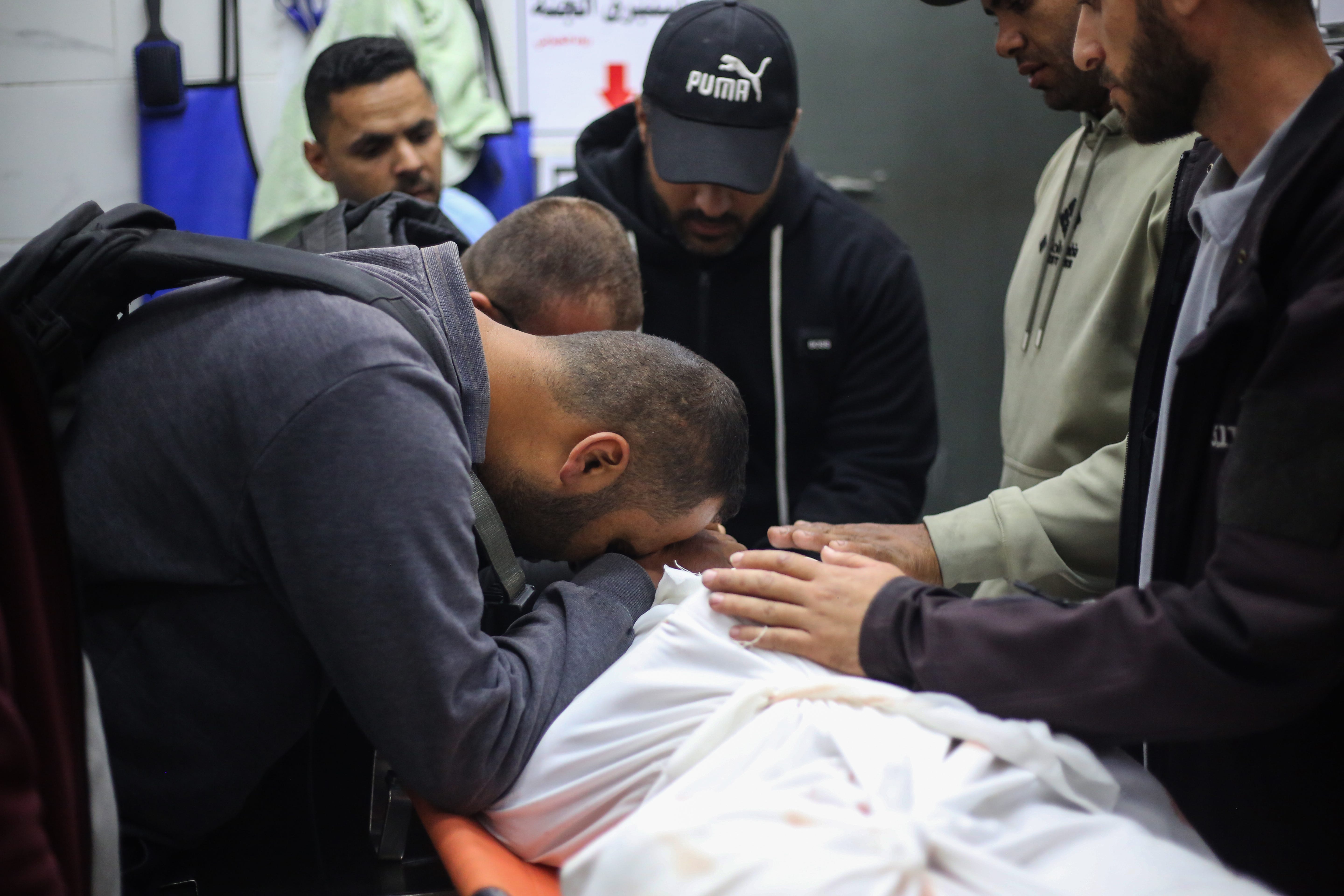
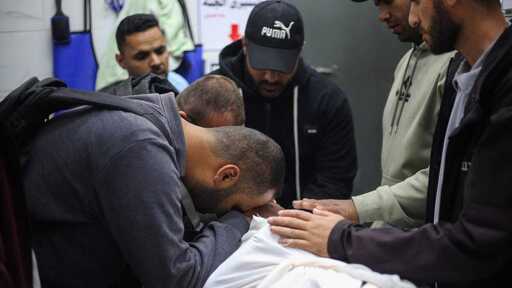
Family and friends mourn the death of Azzam al-Hayya, son of Hamas leader Khalil al-Hayya at Al-Shifa hospital on May 7, 2026 in Gaza City, Gaza. Photo by Ahmad Hasaballah/Getty Images.
GAZA CITY–Palestinian families wailed in grief outside the morgue of al-Shifa hospital in Gaza City in an all too familiar scene on Thursday as they waited to receive the bodies of their loved ones killed in Israeli strikes the day before. Among the dead was Azzam al-Hayya, the son of Hamas leader in Gaza Khalil al-Hayya.
Azzam al-Hayya was severely wounded in an Israeli airstrike on the eastern Gaza City neighborhood of Al-Daraj late Wednesday evening. He was taken to al-Shifa hospital for surgery but succumbed to his injuries Thursday morning. Azzam’s body emerged from al-Shifa morgue wrapped in a white shroud as crowds chanted his martyrdom and marched through the streets.
“He was at the mosque and on his way home, and they targeted him,” Abu Sharif al-Hayya, Khalil al-Hayya’s brother, told Drop Site News as he stood outside al-Shifa hospital on Thursday. “He is not the first one in the family, nor the last one in the family—nor the first nor the last of the Palestinian people; the entire Palestinian people have sacrificed.”
Mourners carry the body of Azzam al-Hayya through the streets of Gaza City on May 7, 2026. Video by Abdel Qader Sabbah.
Azzam al-Hayya is the fourth son of Khalil al-Hayya, who has seven children, to be killed by Israel. Khalil al-Hayya, who is the lead negotiator for Hamas, has survived multiple Israeli attempts on his life. Another son was killed in an Israeli strike in Doha, Qatar last year targeting Hamas leadership as they gathered for ceasefire talks. Israeli assassination attempts in Gaza killed two other sons in 2008 and 2014.
Two of Al-Hayya’s grandchildren, aged eight and two years old, were also killed in an April 2025 strike on a school sheltering displaced families in Gaza City that left more than 35 dead.
“These Zionists are targeting us because there is no deterrent for them. There is no deterrent for the Zionists. They do not respond to negotiations, nor do they respond to anything,” Abu Sharif al-Hayya, who lost three of his own children in Israeli attacks, said.
Azzam al-Hayya was one of nine Palestinians, including a child, killed Wednesday in multiple Israeli strikes across the enclave. Another three Palestinians, part of the civilian police force in Gaza, were killed Thursday in drone strikes as the Israeli military has escalated attacks across Gaza in recent weeks while the world’s attention has focused on the Iran war and Israel’s assault on Lebanon.
The aftermath of an Israeli attack on Thursday that killed three members of Gaza’s civilian police force. Video by Mohammed Ahmed.
Soon after learning of the strike, but before his son’s death was announced, Khalil al-Hayya told Al Jazeera, “Our sons are the sons of the Palestinian people. My son and the sons of others are all children of our people without distinction, and our feelings toward them are the same.”
More than 840 Palestinians have been killed and over 2,400 wounded in Gaza since Israel signed a ceasefire agreement on October 10, 2025, nearly seven months ago.
“The Zionist enemy has become accustomed to negotiating with Palestinians and non-Palestinians through fire,” Khalil al-Hayya said in remarks broadcast on Thursday. “This targeting that occurred yesterday was an extension of the Zionist enemy’s targeting that struck the negotiating delegation in Qatar last year, on September 9, and it comes in the same context.” He added, “We negotiate on behalf of our people and on behalf of our resistance in a way that achieves our people’s goals. If the Zionist enemy thinks that by targeting leaders, or targeting their children and families, it can extract from us what we do not want and achieve through killing and terrorism what it desires, then I say this is an illusion and impossible for it to achieve under these circumstances.”
The attacks came as leaders of Hamas and other Palestinian factions gathered this week in Cairo for talks with regional mediators and the High Representative of President Donald Trump’s Board of Peace, Nickolay Mladenov. Israel and the U.S. have been calling for the full and unilateral disarmament of Hamas as a supposed precondition for the ceasefire talks to proceed, with no guarantee or timetable for an Israeli withdrawal.
Following the agreement in October, Israeli troops withdrew to the “Yellow Line,” occupying over 50% of Gaza. In addition to Israeli troops’ gradual encroachment further east of the Yellow line, the Israeli military quietly issued new maps of Gaza in March, according to Reuters. The new Israeli maps indicate an additional “Orange Line” demarcating an expanded restricted area that make up an estimated 11% of Gaza’s territory beyond the Yellow Line, showing Israel effectively controlling nearly two-thirds of Gaza.
Despite Israel violating the ceasefire every day since the October 2025 agreement—with near daily attacks; heavy restrictions on aid, reconstruction materials and life essentials; and a severely limited opening of the Rafah border crossing—the Board of Peace has told Hamas it does not intend to hold Israel to the terms of the so-called ceasefire if Hamas does not accept its framework for disarmament.
“Failure by Hamas to accept the framework within a reasonable timeframe, as determined by the Board of Peace and after consultation with the parties, shall render such commitments null and void,” said a letter sent in April by Mladenov and Aryeh Lightstone, a State Department official appointed as a senior adviser to the Board of Peace, to Ali Shaath, the head of Palestinian technocratic committee, according to the Times of Israel.
Lightstone was a key figure in the 2020 Abraham Accords that normalized diplomatic, economic, and security relations between Israel and several Arab countries, most notably the United Arab Emirates. Lightstone also played a central role in advancing the Gaza Humanitarian Foundation, the U.S. and Israeli backed group that oversaw so-called aid distribution in Gaza last year, when over 2,600 Palestinians were killed as they were trying to get food from GHF distribution sites.
Hamas has consistently said that any discussion about the weapons held by the Palestinian resistance can only begin once the first phase of the deal is implemented. While Hamas has rejected calls to disarm unless a Palestinian armed force capable of defending the population is established, it has also said that it would respect the authority of a Palestinian governing body and would agree that no weapons should be on the streets except those authorized by that authority.
“The Zionist enemy’s failure to comply with the details of the first phase is what obstructs moving to the second phase,” Khalil al-Hayya said in an Al-Jazeera interview Wednesday. “We informed the mediators and informed Mladenov directly—we sat with him repeatedly—and told them: ‘implement the first phase, and we are ready to proceed to the second phase in every sense of the word.’”
In addition to the continuous Israeli attacks, Gaza is facing an unfolding “environmental and biological apocalypse,” driven by systemic infrastructure collapse as a result of the ongoing Israeli blockade, according to Eyad Amawi, an NGO coordinator with the Gaza Relief Committee. A recent report based on data from the UN and other humanitarian organizations shared by Amawi found that 97% of groundwater in Gaza is undrinkable, while water access has fallen to just 3–5 liters per person per day, fueling nearly half a million cases of acute diarrhea, many among children. Around 500,000 tons of garbage now blanket displacement sites, 80% of which are infested with disease-spreading rats; 71% of desalination plants and 80% of water infrastructure have been destroyed.
On Thursday, the Health Ministry warned of a severe shortage of medical supplies in Gaza, with stocks of some essential medicines and laboratory supplies falling to zero, as Israel continues to heavily restrict the entry of supplies to Gaza. According to the Ministry, 47% of essential medicines and 87% of laboratory testing materials are completely unavailable.
As he prepared to bury his nephew on Thursday, Abu Sharif al-Hayya struck a defiant tone. “We are steadfast in our land. Either death—martyrdom—or our homeland,” he said. “We will not surrender the homeland. Nor will we abandon it.”
Sami Vanderlip edited the video for this report.
From Drop Site News via This RSS Feed.