

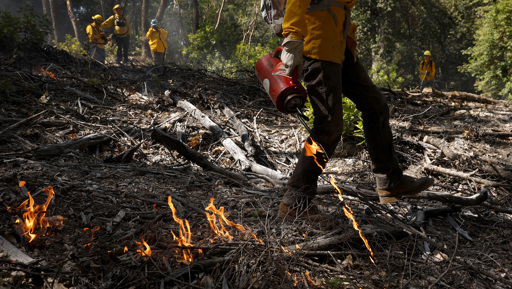
For decades, the U.S. Forest Service has actively managed public lands to reduce wildfire risks by clearing underbrush and trees, or employing prescribed burns — something Indigenous nations have practiced for centuries. Scientists have generally lauded the ecological benefits of what is also known as “fuel treatment.” Now, they say there’s another reason to support this approach: It saves money.
According to a study published today in the journal Science, every dollar that the agency spent on such tactics avoided $3.73 in smoke, property and emissions harm. “A lot of people have suggested that there could be potential economic benefits,” said Frederik Strabo, the lead author of the paper and an economist with University of California, Davis. “But it’s been a pretty understudied area.”
The study analyzed high-resolution data from 285 wildfires across 11 Western states between 2017 and 2023 that burned through areas where the Forest Service had reduced the fuel load. On average, the treatments decreased the total area burned by 36 percent and cut the amount of land burned at moderate to high severity by 26 percent. Researchers then modeled the economic benefits of those reductions.
The paper estimated that fuel treatments prevented $1.39 billion in health and workforce productivity losses tied to wildfire smoke, $895 million in structural damage, and $503 million in carbon dioxide emissions. Overall, that amounted to an average savings of about $3.73 for every dollar the government spent. The research also found that larger treatments — those covering more than 2,400 acres — were the most cost effective.
“It’s a significant number, but when you compare it to the total cost of wildfires it’s small,” caveated Strabo, noting that the cost of the worst disasters can reach hundreds of billions of dollars. But he also said the boon could be even greater than calculated. The research didn’t, for example, examine any savings or benefits for the multi-billion dollar outdoor recreation industry. “We’re only capturing a specific subset of benefits.”
Morgan Varner, the director of fire research at the conservation non-profit Tall Timbers, called the work “the missing link for a lot of fuels treatment research” and said that data like this can be extremely helpful in guiding decision makers. “Studies like this round out the story and provide more evidence for the benefits of these treatments.”
David Calkin, who until last year was a Forest Service research scientist, also applauded the analysis, calling it “novel.” But he does not find the math entirely convincing, and questions the notion that such an intangible public good can, or should, be assigned a monetary worth. “A lot of the values of fuel management are non-market,” said Calkin, who wasn’t involved in the study. Ecological benefits, for instance, can be hard to quantify, as can things like public recreation access.
“I’m not trying to reduce the importance of fuel management and the value of it. It’s just highly uncertain,” he said. “I worry about trying to monetize the value of treatments on public lands.”
One issue Calkin notes is that such work on federal lands may not significantly mitigate the costliest fires, which ignite near communities and destroy homes and buildings. “The best way to protect a structure is at the structure itself,” he explained. That means the study could be over-estimating the amount of property damage that clearing and prescribed burns avoid.
Strabo disagrees, saying that an unpublished portion of the analysis found that fires which interacted with fuel treatments accounted for a disproportionately large share of structure losses and suppression costs. “That suggests [those fires] were often among the more economically consequential wildfires,” he said, pointing to the 2021 Caldor Fire near Lake Tahoe as an example. “The fire still caused substantial damages, but treatments helped prevent it from becoming even more catastrophic.”
One thing that the paper explicitly didn’t account for was the smoke and carbon dioxide emissions that intentional fires produce. “We’re finding that’s not a non-trivial amount in our research,” said Mark Kreider, a Forest Service researcher. Because wildfire is unpredictable, he explained, you inherently have to treat more of the landscape than will actually encounter flames. How to best factor those emissions in is part of Kreider’s ongoing work, but he says it could potentially even flip an analysis like the one in Strabo’s paper. Still, he said, that doesn’t undermine the core point that fuel treatments are effective.
“It’s very clear,” he said, “that on the whole they are very beneficial.”
Not everyone supports such tactics. Critics argue they can harm ecosystems, disproportionately target larger trees, and open forests to logging under the guise of fire prevention. Some opponents also contend that this approach is less effective against extreme fires, while others question whether public funds would be better spent hardening homes and communities.
The federal government’s approach to forest management has shifted since President Donald Trump returned to office. In 2022, the Forest Service released a 10-year wildfire plan that increased forest management and prescribed burns. The Trump administration, which has announced plans to radically remake the agency, has placed greater emphasis on fighting wildfires than preventing them. According the Forest Service, in 2025 the agency reduced vegetation on about 1 million fewer acres than in 2024.
A Forest Service spokesperson attributed most of that decline to elevated wildfire activity in the Southeast. The agency also called 2025 “one the most successful wildfire years in recent history.” But critics worry it is moving away from proactive forest management.
“The takeaway that I really got from this article was that it provides further evidence that the administration’s current policy of full suppression in Western wildfire situations is misguided,” said Heather Stricker, a climate & lands analyst with the Sierra Club. While that approach might sound protective, she said a large body of research shows that it can often backfire. “This paper reiterated a lot of that previous research, but then took it a step further to quantify the cost savings.”
The Trump administration has also announced plans to increase logging on federal lands. This has added to long-standing fears from environmental groups that instead of thoughtful, well-managed fuel treatment, the government could resort to clear-cutting. Even the paper notes this resistance. “Public pressure and risk aversion,” it reads, “skew wildfire management resources toward fire suppression rather than prevention.”
Strabo is hopeful that by adding to the range of evidence supporting forest management, his paper could help guide policymakers. “We could have these economic and ecological benefits if we scaled it up,” he said. “It’s a critically underfunded public good.”
This story was updated to include a response from the U.S. Forest Service.
This story was originally published by Grist with the headline How controlled burns can help save taxpayers billions on May 7, 2026.
From Grist via This RSS Feed.