

Bullets:
The supply chains for nuclear energy, end-to-end, now run through China and Russia.
The BRICS countries dominate the mining and enrichment of uranium into reactor fuel, and North American and European utilities rely on imports of that fuel to power their economies.
China today is building more reactors than the rest of the world, combined, and while new plant construction has stalled across North America and Europe, China can develop 50 reactors simultaneously.
Russia and China are also the world’s leading exporters of reactors, which are electrifying new power grids across Asia, Africa, and South America.
Inside China / Business is a reader-supported publication. To receive new posts and support my work, consider becoming a free or paid subscriber.
Report:
Good morning.
One of our obsessions on this channel, is learning where stuff comes from, and then asking how that informs global economics, and diplomacy. And we keep learning that most of the things that make modern life possible in North America and Western Europe, come from countries that are not in North America or Western Europe. They come from countries who are far more friendly with China and Russia.
We also find it curious that our policymakers and public officials go out of their way to offend China and Russia, along with the BRICS and the Global Majority countries. But today, those are the natural resource economies, and with the most modern and efficient manufacturing centers, and with the global logistics that move everything around
They can also stop everything from moving. Two years ago, we learned last year that traffic through the Suez Canal can be turned off by militias in Yemen, and for over a year everyone had to go around. Two months ago, we learned that nothing gets through the Strait of Hormuz without being first green-lighted by Iran. This is all to say that things are much more fragile to the Western world than most common people probably assumed. But we might have expected that our prime ministers and presidents and cabinet members would have been better informed.
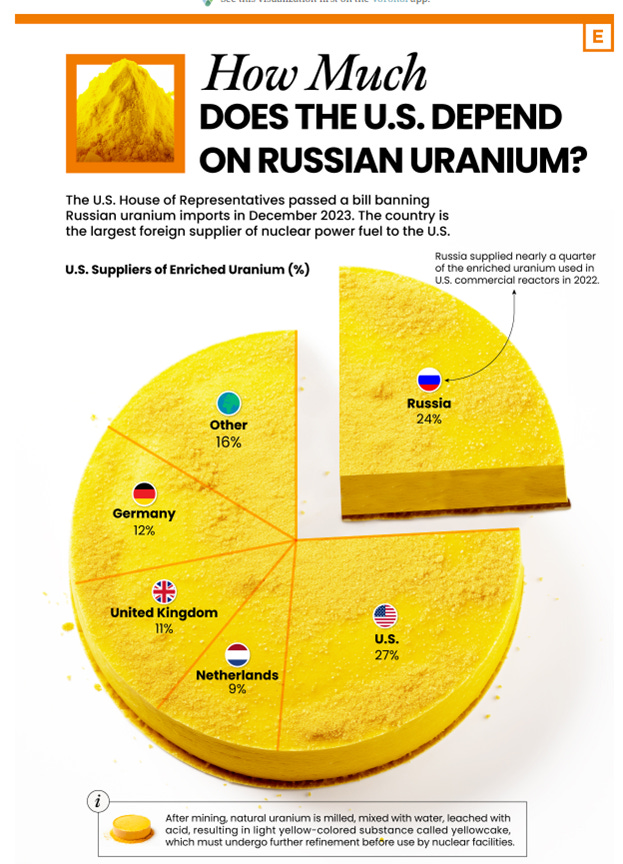
But no. This is where nuclear power plants in the United States get their fuel from, by country, in 2023. 27% of the reactor fuel came from domestic sources. Russia was 24%. Said another way, Russian uranium generates a quarter of all the electricity from nuclear plants in the United States.
The war in Ukraine kicked off in 2022, and two years later Congress and President Biden passed a law called the “Prohibiting Russian Uranium Imports Act.” Ninety days after Biden signed the law, imports of Russian uranium into the US would be banned.
Here’s something we’ve seen a few times—yet another industry that declined in the United States, and is now at about zero.
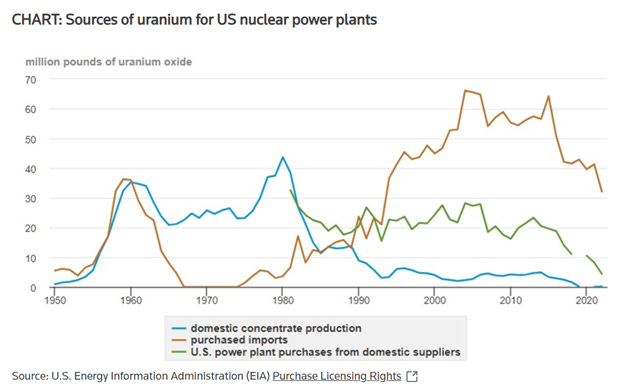
The United States imports over 90% of the uranium it needs—so the United States is still in the refining business, but is refining uranium that is imported from elsewhere. But Russia is way ahead on enrichment too, at 44% of the world total. The blue line on the chart shows domestic production of uranium oxide, going from a peak in 1980 to flatlining a decade ago:
Obviously then, there are some real-world problems with that import ban, if the US is almost out of the enrichment business, and Russia is almost as much as the rest of the world combined. So, Congress put a waiver into the law. That runs through 2027, and enables utilities to continue buying from Russia if “no viable alternative sources” exist or if importing the uranium is “in the national interest”.
Having the lights go out across the United States would be contrary to the national interest, so American utilities are granted waivers to keep buying Russian uranium until new capacity can be built at scale. That won’t happen fast—the first new enrichment capacity since 1954 came online and only recently started some deliveries.
1954 was a long time ago. Global power demand since went straight up, and it didn’t occur to anyone in the United States to build a bit more uranium enrichment capacity at home, let alone build out an end-to-end supply chain. Nobody else thought to do so in Europe either—and today the fuel for nuclear power plants come from the BRICS countries, plus Kazakhstan, who by the way is a neighbor—a friendly neighbor—to both Russia and China.
That’s the reality. The uranium is the raw material, which is enriched to become reactor fuel. And without that enriched uranium, much of global supply of which comes from Russia, nuclear plants cannot run. Nothing about that is complicated, and we might suppose it might give our political leadership some pause, if not outright humility.
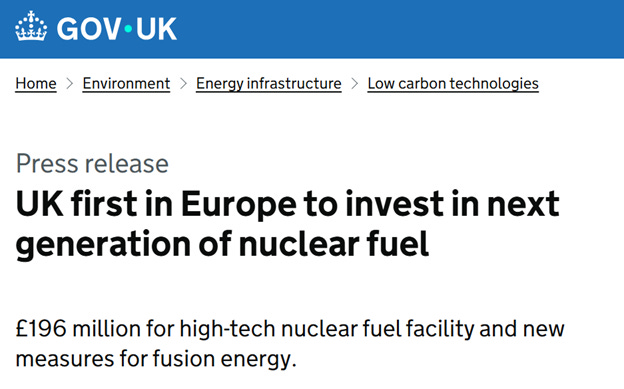
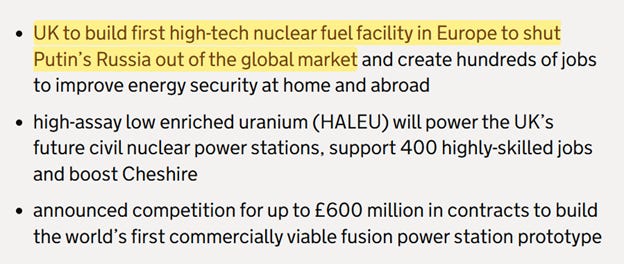
But this is a press release from the UK, from the government of the United Kingdom. Bullet point one: “UK to build the first high-tech nuclear fuel facility in Europe to shut Putin’s Russia out of the global market.” The UK aims to be “the first country in Europe to produced advanced nuclear fuel, a market currently dominated by Russia.” We’ll pause right there to point out that Russia also is a European nation. The objective is to “help isolate Russia from global energy markets” and boost British energy security.
New fuel will come online five years from now, they hope, and if they can export the fuel, they will reduce other countries’ dependency on Russian exports.
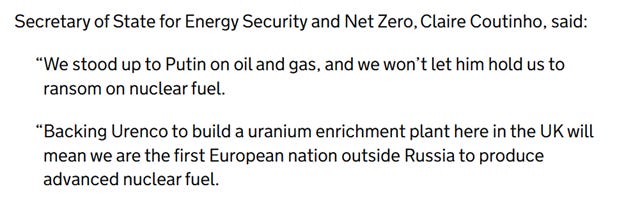
The UK Secretary of State for Energy Security: We stood up to Putin on oil and gas and refuse to be held ransom on nuclear fuel. We’ll pause again to point out that didn’t happen. The Brits are still buying uranium, and the Russians are still selling. Nobody is being held ransom, even though there is a war on.
Here’s the Prime Minister who doesn’t care for Putin much, and says that Russia has been the only provider for too long, and this marks the latest step in getting them out of the energy market entirely:
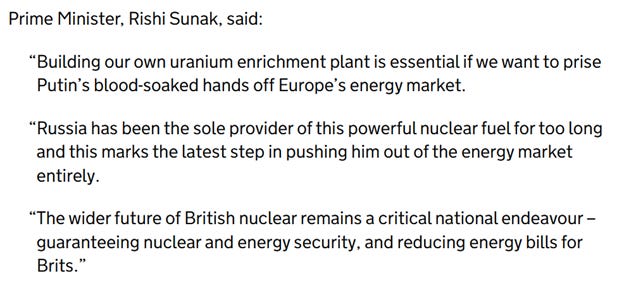
There is a large disconnect here between political rhetoric and objective reality.
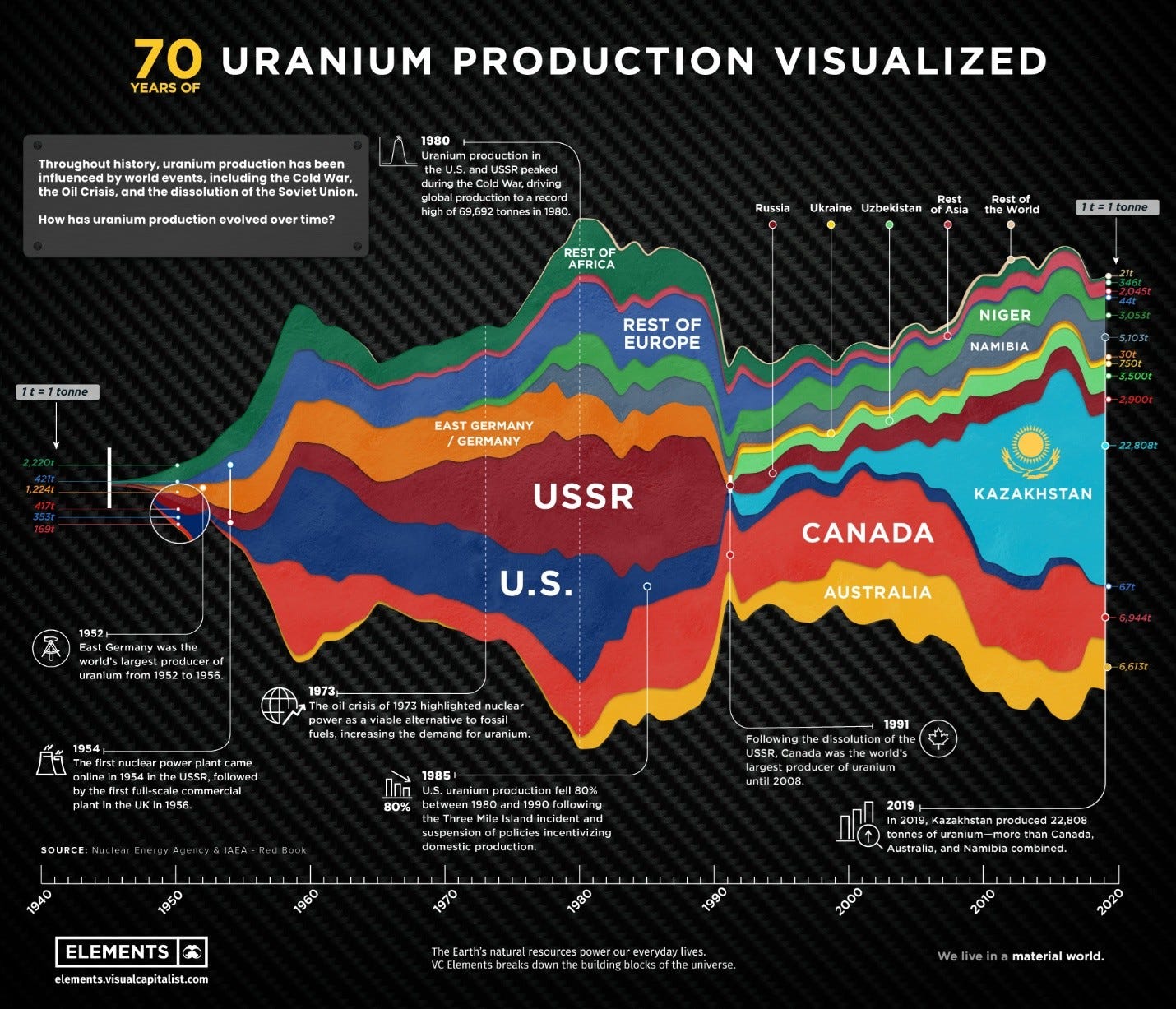
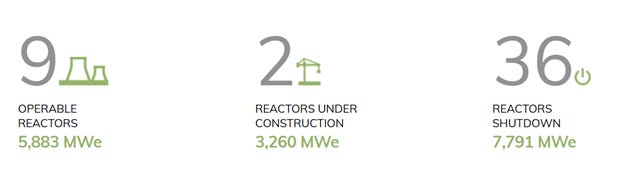
Here’s where the world’s uranium is. The UK just announced plans to start enriching some of their own, by 2031. But their power needs are immediate, and now. Fifteen percent of the UK’s electricity comes from nuclear, and most of that capacity will close down in coming years. 7800 megawatts of power come from 36 reactors that will be decommissioned, and only two plants are under construction now, which will generate just 3,260 megawatts. They’ll be at least 4,500 megawatts short:
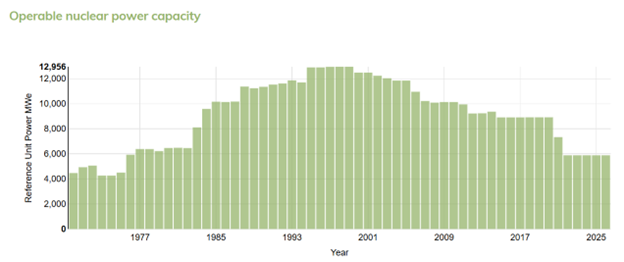
The UK’s nuclear power capacity today is below where it was in 1977. That was a long time ago too. So, the nuclear power industry in the UK is in decline, and will soon be in very steep decline:
Meanwhile, here is nuclear power plant construction across the world, along with the date they will come online. Most of the new reactors will be in Asia, and just a small handful of new builds in the next six years will be in countries that are unambiguously more friendly to the US and Europe. Of the plants coming online in 2026, with just two, Slovakia and South Korea as Western. Online in 2027: just one. For 2028 all of the new reactors will be in China, India, Iran, Russia, Turkey—so zero. 2029: there’s one from the the UK, and in 2030, just one again, and just the UK again. For 2031 and 2032, one plant in South Korea will come online. All of the others will be in the BRICS and Global Majority nations.
So the UK will have those two nuclear plants, and will need fuel for around 3400 megawatts, while decommissioning other plants that total even more. Enriched uranium demand will fall sharply, in the UK. But there will be lots of new demand from other countries, mostly in Asia, and so Russia could simply close the books on their business in the UK and walk away, right now.
That process is already well underway in other energy markets. Russia built new natural gas pipelines to carry energy that previously went West to Europe, and now they’re coming East, to China and Asia. Same for Russian crude. Asia is where the most of the world’s factories are, Asia is where most of the world’s population is, and Russia is making more money than ever by selling to their new customers here. All of which make that UK press release sohard to figure out. Were those officials behind closed doors, saying some of these things, then making policy changes and investments to bullet-proof their energy supply chains, I get it. But until 2031, at the earliest, they will still need lots of Russian uranium. So why say those other things, until 2031, at the earliest?
When scrolling that list of the new nuclear plants coming online, we see China a lot. China is building more than the rest of the world, combined. Over the past decade, China increased nuclear power plant construction, while the utilities in the Western world of the world slowed down new builds, and are shutting down more plants than are being replaced.
And this is an important point—countries that build plants are always learning new things. China is the only country that never stopped building, and China has learned to build new plants less expensively, than plants build decades ago. China has a deep pool of people, with deep experience, whereas other countries do not. The Chinese can build 50 reactors simultaneously, and will be the world’s largest producer of nuclear power by 2030, and will double their power capacity by 2040.
This analyst makes the same point, in a different way. A country that builds one plant every 20 years operates in fits and starts, the system atrophies, and people forget how to build them. It takes a long time to go through permitting and construction in Europe and North America—the national-level agencies, then state and local governments get involved. Then come financing and the inevitable lawsuits. But in China everything happens much faster. China has never canceled a project after national regulators approved it, so developers and projects managers can start right away in lining up the engineers and materials to build. In the US, then, there are huge delays and cost overruns; the last two plants were Vogtle One and Two, in Georgia. The delay was seven years and was $21 billion over budget.
The cost of capital is far lower in China; equity plus loans run about 4% in China, and are at least twice that in the United States and Europe. That is typically the largest single driver of the final cost to build, over time.
China is building a lot of reactors at home and is exporting their reactors to other countries. The analysis here explores why the Chinese are not MORE successful in their nuclear plant exports, and points out that Russian reactors are more widely deployed, at least so far. China is building reactors for Pakistan, but other deals in the UK and in Argentina fell apart. In the case of Argentina, the Chinese company walked away when asked to finance 85% of the total costs.
In the UK, Boris Johnson shut down the project because of China’s involvement in the project, and as of now the UK has not moved forward on new construction at that location at all. Meaning, that when the Chinese were pushed out, there was nobody in line to replace them.
The points we are emphasizing are that Russia, China, and Kazakhstan and a small handful of other countries friendly to them dominate the supply chains for the mining and enrichment of uranium. China dominates the industry for new nuclear power plant construction, and are competing against Russia for new export markets for nuclear reactors.
The raw materials chains, and the uranium enrichment industry, and the hundreds of thousands of nuclear plant engineers and operators who are the only ones today who can bring new projects in on time and on budget: Now this entire industry, end-to-end, is Russia and China.
Be Good.
Resources and links:
Nuclear Power in the United Kingdom
https://world-nuclear.org/information-library/country-profiles/countries-t-z/united-kingdom
UK first in Europe to invest in next generation of nuclear fuel
https://www.gov.uk/government/news/uk-first-in-europe-to-invest-in-next-generation-of-nuclear-fuel
How Houthi attacks on one of the world’s main maritime trade routes have impacted international trade
https://interactive.aljazeera.com/aje/2024/mapping-red-sea-shipping-attacks/
Russia’s $55bn pipeline gamble on China’s demand for gas
https://ig.ft.com/gazprom-pipeline-power-of-siberia/
Plans For New Reactors Worldwide
https://world-nuclear.org/information-library/current-and-future-generation/plans-for-new-reactors-worldwide
Why China Came Up Short in Nuclear Exports
https://neutronbytes.com/2026/02/26/why-chima-came-up-short-in-nuclear-exports/
China to nearly double nuclear power capacity by 2040 in rapid build-up
https://www.scmp.com/economy/china-economy/article/3314794/china-nearly-double-nuclear-power-capacity-2040-rapid-build
As the Hormuz crisis exposes ‘fragile’ global supply chains, how will China respond?
https://www.scmp.com/economy/china-economy/article/3350753/hormuz-crisis-exposes-fragile-global-supply-chains-how-will-china-respond
China Says It Can Now Build 50 Nuclear Reactors at Once. What About the United States?
https://www.zmescience.com/science/news-science/china-says-it-can-now-build-50-nuclear-reactors-at-once-what-about-the-united-states/
China Is Rapidly Building Nuclear Power Plants as the Rest of the World Stalls
https://financialpost.com/pmn/business-pmn/china-is-rapidly-building-nuclear-power-plants-as-the-rest-of-the-world-stalls
中国核电:本公司平均债务成本3%-4%,长期借款普遍采用浮动利率计息
https://news.qq.com/rain/a/20240423A08FU100
China’s vast nuclear power sector now able to build 50 reactors at a time
https://www.scmp.com/economy/china-economy/article/3350847/chinas-vast-nuclear-power-sector-now-able-build-50-reactors-time
Enriched Uranium Fuels Russia’s War Machine. But the US Still Imports It
https://bellona.org/news/nuclear-issues/2025-03-enriched-uranium-fuels-russias-war-machine-but-the-u-s-still-imports-it
How Much Does the U.S. Depend on Russian Uranium?
https://elements.visualcapitalist.com/how-much-does-the-u-s-depend-on-russian-uranium/
China’s vast nuclear power sector now able to build 50 reactors at a time
https://www.scmp.com/economy/china-economy/article/3350847/chinas-vast-nuclear-power-sector-now-able-build-50-reactors-time
Ban on Russian uranium aims to revive American supply
https://www.reuters.com/business/energy/ban-russian-uranium-aims-revive-american-supply-2024-06-04/
Inside China / Business is a reader-supported publication. To receive new posts and support my work, consider becoming a free or paid subscriber.
From Inside China / Business via This RSS Feed.