

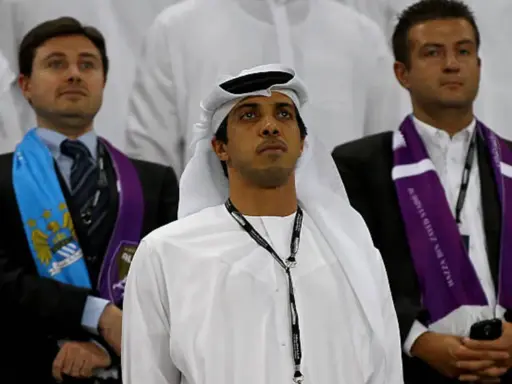

A human rights group says the UK foreign office should investigate Manchester City football club’s owner over his links to the genocidal war in Sudan. As well as his footballing interests, Sheikh Mansour bin Zayed Al-Nahyan is a deputy prime minister of the United Arab Emirates (UAE). UAE has been arming one side in the four-year war which has killed and displaced millions.
But there’s a problem. The UK is culpable too. As the Canary reported on 31 March the Brits have been accused of downgrading the crisis in Sudan to avoid “pissing off” the Emiratis, who are also a major customer for British weapons.
UK military equipment has even turned up on the battlefield in the hands of the UAE-backed Rapid Support Forces (RSF)…
Figures like foreign secretary Yvette Cooper and former Tory leader Iain Duncan Smith have made positive noises about punishment. But there’s been no follow-through.
Manchester City leverage
Human rights group Fair Square have pointed out the Man City owner is an “obvious point of leverage” for the UK. The groupsaid:
FairSquare is writing to request that the FCDO (Foreign, Commonwealth & Development Office) examine the role of the UAE deputy prime minister, Sheikh Mansour bin Zayed Al-Nahyan, in providing support to the RSF in Sudan and consider the imposition of sanctions under the Sudan (Sanctions) (EU Exit) Regulations 2020.
And, as they rightly pointed out, there is no shortage of evidence:
This request takes place in the context of what the UK government has described as overwhelming evidence of RSF atrocities in Sudan, which has included multiple massacres and instances of widespread sexual violence.
The UK government has already sanctioned multiple individuals and entities linked to either the RSF or the Sudanese Armed Forces (SAF), who have been in armed conflict since June 2023.
Meanwhile, the situation in Sudan remains perilous.
Regional tensions and a long war
As the Canary has reported, UAE-originated arms have been smuggled to RSF from Ethiopia. On 7 May it was reported this may escalate into a war between Ethiopia and the Sudanese government, which is fighting RSF:
The question in Sudan is no longer whether Ethiopia has been intervening in the ongoing war but how far that intervention would have to go before triggering a direct clash between the two countries.
Khartoum is now making explicit accusations regarding the drones that targeted Khartoum Airport and other sites that it claims had been launched from Ethiopian territory.
Arab Weekly reported a similar story.
And RSF head Mohamed Hamdan Dagalo told his troops to be ready for a decades long fight:
We do not want this war to continue if they [the army] want it to go on for 40 years, it will continue until they are uprooted.
The EU also had an opportunity to exert leverage on UAE, but seems to have missed it. Middle East Monitor reported on 7 May:
The United Arab Emirates’ ruling Al Nahyan family has benefited from more than €71 million (US $80 million) in European Union farming subsidies, even as campaigners intensify calls for sanctions against senior Emirati officials over Abu Dhabi’s alleged role in the Sudan genocide.
While one thinktank asserted that gold was still at the heart of the conflict:
The United Arab Emirates serves as the primary destination for as much as 70 percent of Sudan’s smuggled gold, coming from both RSF and SAF-controlled areas.
The RSF has established strong control over major gold-mining operations in Darfur and Kordofan, using gold extraction as a key source of funding for its activities.
Sanctions
The war in Sudan looks intractable. But one way to reduce the fighting would be for the UK – and EU – to pressure on UAE with sanctions. There is no ethical reason this process should not include Manchester City football club. Politicians and campaigners of all stripes need to put their money where their mouths are. Whether they will is a different question.
Featured image via the Canary
By Joe Glenton
From Canary via This RSS Feed.