

This column by Saúl Escobar Toledo originally appeared in the May 6, 2026 edition of El Sur. The views expressed in this article are the authors’ own and do not necessarily reflect those ofMexico Solidarity Mediaor theMexico Solidarity Project*.*
On May 1st, at an official ceremony attended by the President of the Republic and several union leaders, Labour Secretary Marath Bolaños declared that Mexico is experiencing a “labour spring.” He argued that the neoliberal past had weakened all workers’ rights, leaving a “deep mark of inequality.” He then listed the main achievements of the Fourth Transformation (4T) governments, primarily the increases in the minimum wage and legislative changes regarding profit sharing, subcontracting, pensions, digital platform workers, agricultural day laborers, and the 40-hour workweek. He cautioned, however, that “the current government seeks to consolidate and expand these rights with new reforms since it has not been possible to reverse the effects of more than three decades of neoliberal policies.”
The Secretary is right to point out both things: indeed, the labour climate has changed, and at the same time, there are very important issues still pending. Wage increases have occurred not only in the legal minimum wage but also, although to a lesser extent, in average wages (those used for IMSS contributions), primarily in the manufacturing industry. Thus, while minimum wages (the national average) have grown by more than 134 percent in real terms (adjusted for inflation) between 2018 and 2025, average wages have increased by around 30 percent, and manufacturing wages by almost 39 percent. These increases have reduced working poverty by more than ten percentage points.
The “labour spring,” however, carries with it serious structural problems: the most prominent being informality, which reached almost 55 percent in March of this year (ENOE-Inegi). This level has remained virtually unchanged in recent years. It should be added that this percentage comprises self-employed workers, who do not depend on an employer (29 percent), and those workers who are salaried but lack social security (25 percent). This latter figure is relevant because it shows that, in Mexico, the law is not fully enforced, since registration with the IMSS or another similar institution is mandatory.
The Secretary did not mention this problem, nor did he speak about the downward trend in employment that has been occurring since 2025. In the manufacturing industry, the annual balance (2025-2026) is even negative, meaning that jobs have been lost.
A key problem that must be highlighted is the gap between the law and reality. The neoliberal past was characterized by its wage restraint policies, flexibility, and particularly by the promotion of sham unions and employer-protection contracts—instruments distinguished by a complete lack of democratic practices, which in turn inhibited worker protest. All of this turned collective bargaining into a systemic failure. Very few workers discussed and participated in negotiations with employers to improve their working conditions.
The problem is that this structural flaw has barely been addressed. Despite the constitutional and legal reforms of 2017 and 2019 that promised democracy through direct and secret voting by union members to elect their leaders and decide on contract revisions, the landscape remains dominated by organizations and practices that have not adapted to these new guidelines. Worse still, unions and confederations close to the Morena party have emerged or gained strength, and have been accused of serious acts of corruption and violence. The most blatant example is CATEM (Autonomous Confederation of Workers and Employees of Mexico).
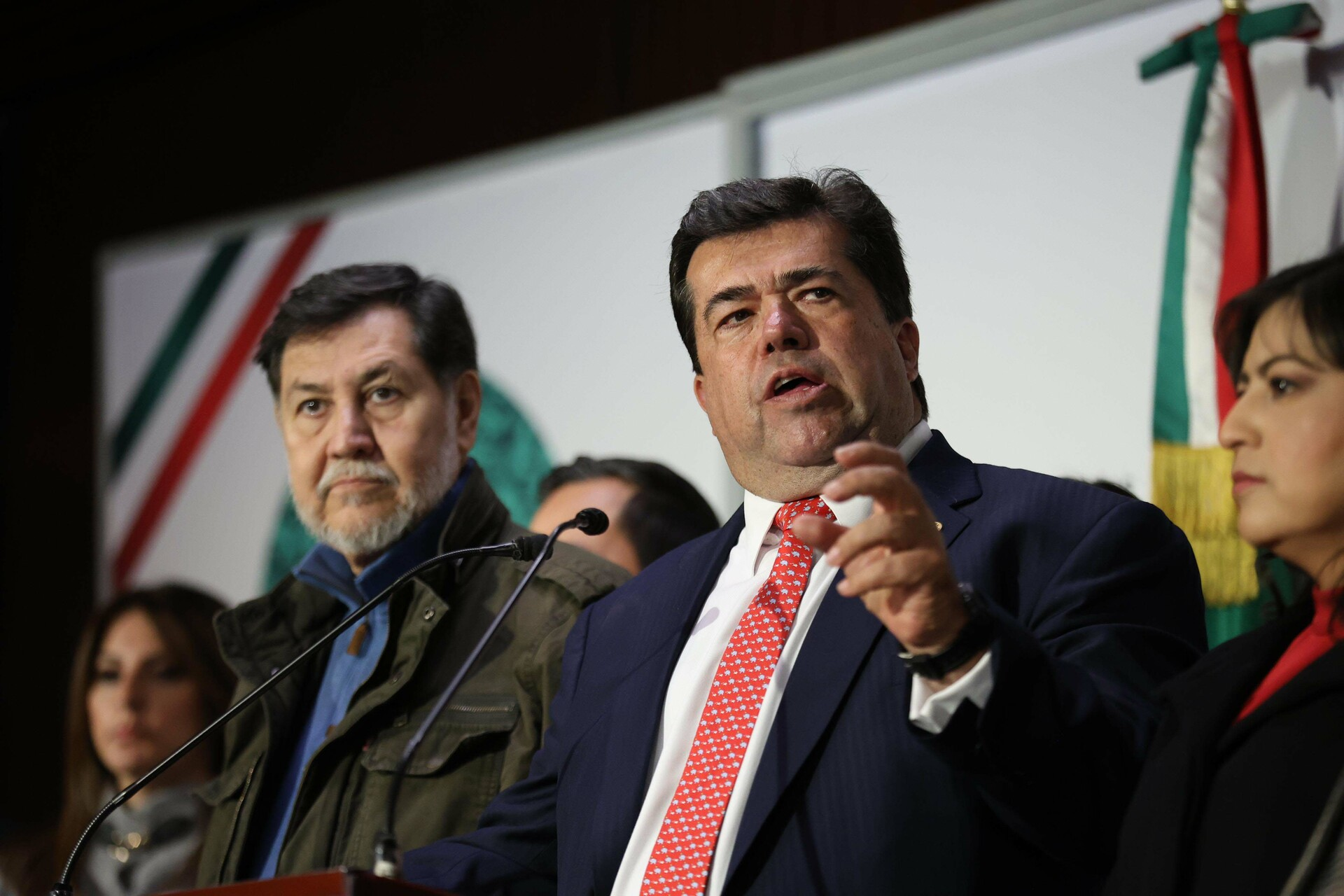
Pedro Haces Barba is General Secretary of CATEM and a federal deputy for Morena who earlier in 2026 attempted to covertly set up a parliamentary friendship group with the genocidal state of israel.
The gap between the law and the daily lives of many workers is also reflected in other areas, such as the public sector. The federal, state, and municipal governments maintain the practice of hiring on a fee-for-service basis or under what is known as Chapter 3000, meaning for a fixed term, without benefits, and with low wages. Furthermore, reforms to the Federal Law for Workers in the Service of the State have not resulted in genuine union democracy.
It should also be noted that some newly created institutions are still in a precarious situation. Labour courts do not yet offer prompt, efficient, and lawful justice. Similarly, the Conciliation and Labour Registry centers themselves do not fully fulfill their function or are subject to the dictates of the governors.
The ratio of labor inspectors per 10,000 employees is 0.84 in Chile, 0.31 in Brazil, and a mere 0.13 in Mexico.
Many problems stem from so-called “republican austerity.” Budgetary resources allocated to law enforcement institutions, such as labour inspectorates, have decreased in recent years, even though, since the neoliberal era, Mexico has consistently ranked among the lowest in Latin America in this area. According to ILO figures, the ratio of labor inspectors per 10,000 employees was 0.84 in Chile, 0.31 in Brazil, and a mere 0.13 in Mexico. And it’s not just the inspectorate that has suffered. The Office of the Attorney for the Defense of Labour and funding for employment promotion have also been cut. Meanwhile, the Federal Center for Conciliation and Federal Registry lacks the necessary enforcement power to compel companies and unions to comply with its regulations and has seen its budget reduced. In short, labour institutions have been weakened overall.
There are also cases where reforms have been either incomplete or poorly designed. For example, the “Youth Building the Future” program; or the one that seeks to provide social security and collective bargaining for digital platform workers. However, the most relevant issue is the contributory pension system, in which workers and employers contribute to AFORES (Retirement Fund Administrators), private companies (with the exception of PENSIONISSSTE) responsible for managing these resources and providing the corresponding pension. Although there have been several reforms, primarily the one in 2020, the system remains very costly for public coffers and offers limited coverage relative to the total number of workers. The replacement rate (that is, the amount a worker receives upon retirement as a proportion of their final salary while employed) has increasingly required government subsidies to raise it to a level between 50 and 70 percent. Furthermore, retired workers complain that their pensions barely increase each year.
An analysis of each reform passed in the last eight years might reveal positive aspects and efforts to improve worker protections, but also weaknesses in their implementation or design. The union mobilizations and the difficult emergence of new democratic organizations in recent years reflect both the recent legal changes and the shortcomings and persistence of old problems.
Thus, the “labour spring” announced on May 1st is still suffering from low temperatures; the sun hasn’t shone in full, nor have many flowers bloomed after the long neoliberal winter. There have been changes, especially regarding wages and legal reforms; however, the government faces blizzards that threaten these shifts. The main one, at the moment, is the decline in employment, particularly in the manufacturing industry.
For a transformation of the magnitude that Secretary Bolaños intends to illustrate to occur, more than just reforms are required: it’s necessary to accelerate economic growth; change the direction of spending; review “republican austerity” where it weakens labour institutions; and for the government and its party to break with certain labour unions that maintain the anti-democratic and violent practices of the neoliberal past.
-
US Doesn’t Give a Shit About Drug Traffic
May 7, 2026May 7, 2026
US drug policy in Latin America is just a means to an end: dominance and control, an extension of their imperialist foreign policy, writes José Luis Granados Ceja.
-

Unpaid Work in Mexico is Equivalent to Cost of 30 World Cups
May 7, 2026May 7, 2026
More than 72 percent of unpaid domestic and care tasks are performed by women; a core part of the daily functioning of the economy that remains outside of remuneration schemes.
-
Restore Campesino Rights, Reject the USMCA
May 7, 2026May 7, 2026
José Jacobo Femat of the Central of Peasant & Popular Organizations, rejects the USMCA entirely, saying free trade agreements have effectively turned Mexico into a colony of US multinationals.
The post Mexico’s Labour Spring… with Low Temperatures & Blizzards appeared first on Mexico Solidarity Media.
From Mexico Solidarity Media via This RSS Feed.