

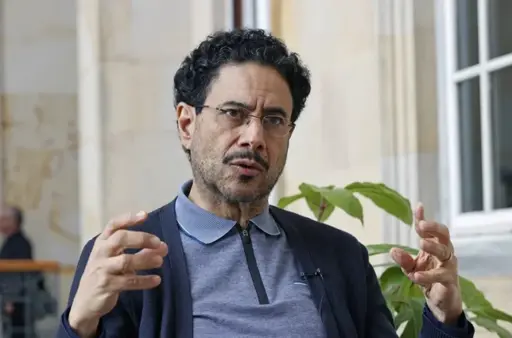
Cepeda denounces armed pressure on voters as Colombia heads toward the May 31 presidential election.
Candidate cites reports of coercion ahead of May 31 elections and calls for investigations
Colombian presidential candidate Iván Cepeda has warned that armed groups are pressuring communities to influence voting behavior, weeks before the country’s May 31 elections.
Cepeda, representing the progressive coalition Pacto Histórico, said he received information from social organizations, local authorities and the Ombudsman’s Office indicating that illegal armed actors are intervening in the electoral process in several regions…
“In recent days I have received information from social organizations, local authorities and the Ombudsman’s Office… This information accounts for pressures exerted by armed groups on the electorate in some territories of the country, aimed at influencing the direction of the vote, in favor of or against presidential candidacies,” he stated.
The candidate rejected such actions and called for legal consequences. “I categorically and strongly condemn any kind of pressure on voters. Neither the Pacto Histórico nor the forces of the Alliance for Life nor my campaign nor I, in my condition as a presidential candidate, accept this kind of actions. Those responsible must be investigated and sanctioned with the full rigor of the law,” he said.
Iván Cepeda denuncia presiones de grupos armados para influir en el electorado y exige sanciones
En los últimos días he recibido información proveniente de organizaciones sociales, autoridades locales y la Defensoría del Pueblo, la cual pongo en conocimiento de la opinión… pic.twitter.com/iAMOJptpgm
— Iván Cepeda Castro (@IvanCepedaCast) May 5, 2026
Text Reads: In recent days, I have received information from social organizations, local authorities, and the Ombudsman’s Office, which I am sharing with the public and which will be forwarded to the appropriate authorities. This information indicates that armed groups are exerting pressure on voters in some parts of the country, aimed at influencing their votes for or against presidential candidates. / I categorically and strongly condemn any kind of pressure on voters. Neither the Historical Pact nor the Alliance for Life, nor my campaign, nor I, in my capacity as a presidential candidate, accept this type of action. Those responsible must be investigated and punished to the full extent of the law.
Cepeda stressed that democratic participation must remain free of coercion. “The only legitimate condition in a democracy is the free, conscious and sovereign decision of the citizen,” he said, adding that any peace dialogue must be based on non-aggression toward civilians.
He warned that negotiations cannot advance under current conditions. “There will be no possibility of dialogue in the midst of killings of social leaders or violent pressure against citizens or institutions,” he stated, adding, “I categorically and strongly condemn any kind of pressure on voters, including those supposedly carried out in my favor through threats.”
Cepeda also condemned recent attacks attributed to dissident factions of the FARC, including incidents that left 21 people dead and dozens injured. He said he will soon release further information on threats, harassment and armed pressure against civilians “aimed at preventing the free expression of the vote” in favor of his candidacy and running mate.
One Month Before Election, Approval Rating of Colombia’s President Reaches Highest Point
Colombia’s presidential election is scheduled for May 31, with 13 candidates in contention. Cepeda leads voting intention in the first round, followed by Abelardo De la Espriella and Paloma Valencia.
Investigations by Señal Colombia and Revista Raya have reported on Project Jupiter (Proyecto Júpiter, in Spanish), described as a large-scale political operation linked to right-wing sectors, allegedly designed to shape the electoral climate by amplifying fear, indignation and uncertainty.
Authorities have also reported an escalation of violence in southern regions. The Ministry of Defense recorded 31 recent incidents: seven in Valle del Cauca, two in Nariño and 22 in Cauca.
The most severe attack took place in Cajibío, where a cylinder bomb explosion struck a bus and several private vehicles. Official figures indicate 21 people were killed and more than 50 injured, with significant impact on civilians. Approximately 15 of those killed were women and five were men.
The national government has deployed military operations in the region to prevent further attacks and contain armed groups. Local communities, however, continue to demand that measures prioritize the protection of life and the strengthening of peace processes.
As the election approaches, reports of coercion and rising violence highlight ongoing risks to free and secure voting in Colombia.
(teleSUR)
From Orinoco Tribune via This RSS Feed.