

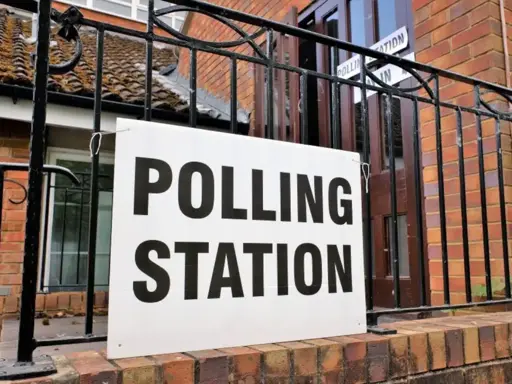

Voters across England, Scotland and Wales head to the polls today in a round of local and devolved elections likely to deliver some of the most destabilising results in a generation.
Polling has for months pointed toward a heavy defeat for the Labour government. Reform UK and the Green Party are expected to take control of councils whose Labour majorities precede the very foundations of our welfare state.
Nationalist separatist parties are also witnessing a surge in popularity. In Scotland, the SNP is forecast to recover the ground it once lost. In Wales, Plaid Cymru is positioned to overtake Welsh Labour for the first time in history.
As previous Canary coverage of the Greens’ campaign trail has set out, the institutions on the ballot today were hollowed out long before this round of voting, and the parties competing to inherit them are offering programmes that seek to overhaul them.
A populist resurgence thought buried
Mainstream British electoral politics has weathered calm seas arguably since 2014, when the Scottish Independence referendum fractured the country, followed two years later by the narrow victory of the Vote Leave campaign in the EU referendum.
The well-known structural pressures of the first-past-the-post system, which historically penalises voters for breaking ranks with the two main parties (hence phrase ‘two-party system’), were for a long time sufficient to insulate labour and the Conservatives from the ramifications of populism in the early to late 2010s.
The 2024 general election was predicted to mark the close of that cycle. A consolidated Labour party returned to office for the first time in 14 years on a platform of stability, change and national renewal. It was assumed that the perceived rot at the heart of the British political system, which gave way to the populist excesses of the 2010s, could be attributed solely to the antecedent Conservative administration who were the supposed champions of Britain’s managed decline.
Less than two years later, the populist wave asserted itself with greater force across both flanks of the political spectrum, simultaneously engulfing Europe and the US.
Bankrupt councils and empty promises
Local elections at the halfway point of a government administration are normally read as general indicators of the national mood rather than decisive verdicts on the competency of the government. Yet, today’s results will not change that, in material terms, local government is no longer functioning.
A growing number of councils have issued Section 114 notices – formal declarations of effective bankruptcy that follow when a local authority can no longer balance its books. The funding settlement upon which English councils depend has been steadily tightened across both Labour and Tory governments, in service of bipartisan economic policies oriented toward capital rather than the populations these councils purport to serve.
The consequence is that the seats for which today’s candidates are competing has been substantially stripped of its capacity to act. The councillor elected today inherits a balance sheet, not a mandate. Reform UK and the Greens have campaigned, albeit in different terms, on bold local programmes that encompass housing reform, the revival of public services and planning powers, which the institutional reality of local government no longer permits a council of any colour to deliver.
To that effect, the May 7 elections are less a possibility of fundamentally altering the structures of governance and power in this country through a contest in local administration, but instead an exercise in national positioning.
Proof of national viability
What this means is that today’s candidates are not competing principally for the chance to govern, but for the proof of national viability. Whether a Green breakthrough in Brighton or Bristol or a Reform sweep through Doncaster or Stoke – each function as a demonstration that the respective party ought to be situated in the wider national conversation.
Without a parliamentary opposition that meaningfully threatens Labour’s majority, and without the prospect of a general election before 2029, today’s local vote has become the principal instrument with which to register disillusionment with the establishment at scale.
The result is a peculiar inversion of the familiar logic of council elections. Voters historically punished the governing party for failures it could plausibly remedy with changes in policy or direction. Today’s voters are registering verdicts on national failures through institutions whose local capacity to remedy them does not exist and cannot do so under the present political and economic arrangement.
A constitutional question with no answer
The picture in devolved nations is structurally similar, with the additional dimension of national identity. Welsh Labour, which has run the Senedd since its creation, faces potentially the most serious challenge of its history in a contest that reads as a referendum on Keir Starmer’s premiership rather than the structure of Welsh devolution. The SNP’s expected resurgence in Scotland is unlikely to deliver an immediate independence vote, but it most certainly will sharpen the constitutional question that the Labour government has failed to address.
The harder problem is that no settled answer is available to anyone. The present arrangement of the British union is visibly losing the inertial legitimacy it has carried through fifteen years of crisis. Yet, no party – unionist or otherwise – has produced a coherent account of what a renewed settlement would look like, what it would cost in economic terms, or how it can be delivered through existing institutions. Today’s elections will not resolve that question. They will, however, register how much further the existing arrangement has decayed since the last time voters were asked, and how much longer it can continue.
What the results will produce, beyond a rebuke to Labour, is a clearer picture of a country whose political institutions no longer match the demands placed on them. The councils, devolved assembly, Westminster parties: each carry a structure that was built for a settlement that no longer commands the popular support it claims to represent. The party that wins the next round of this contest will be the one that stops pretending otherwise.
Featured image via gov.uk
From Canary via This RSS Feed.