

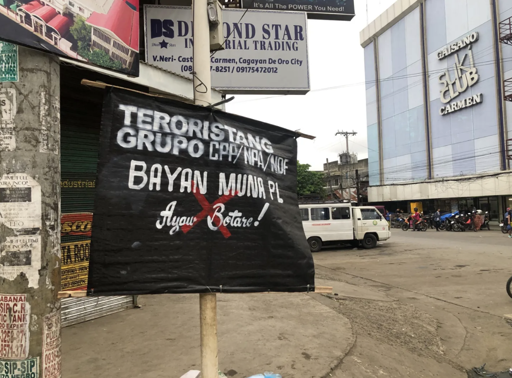
CAGAYAN DE ORO — Human rights groups welcomed the findings of the Commission on Human Rights’ (CHR) national inquiry on red-tagging, saying it affirmed the detrimental outcomes of this dangerous practice.
The commission found that red-tagging posed a threat to a person’s right to life, security, and liberty—a declaration that has already been upheld by the Supreme Court—because of identified assassination attempts, enforced disappearances, and killings that followed this practice of labeling individuals or organizations as communists, terrorists, or subversive group sympathizers without evidence.
The fundamental rights to privacy, freedom of expression and opinion, freedom of association and the right to organize, right to due process of law, and right to defend rights could also be violated if red-tagging persists.
For human rights alliance Karapatan, CHR’s conclusions reinforced its long-standing calls to abolish the National Task Force to End Local Communist Armed Conflict (NTF-ELCAC), a state-run agency that has been blatantly red-tagging progressive groups and advocates.
“These findings put the CHR on a collision course with the dominant fascist state policy and render it vulnerable to red-tagging, the very scourge it is seeking to purge,” Karapatan said in a statement.
Read:UN expert recommends NTF-ELCAC abolition amid rampant red-tagging and media attacks
The CHR stated that labels used in red-tagging included communists, terrorists, fronts, and enemies of the state, among others. These backed the finding, the commission said, that red-tagging is linked to the government’s counterterrorism strategies.
It also documented several red-tagging incidents allegedly perpetrated by former and current members of NTF-ELCAC, including personalities involved in military and law enforcement operations.
The commission did not recommend the abolition of the task force.
It said, however, that it is necessary to review Executive Order (EO) No. 70 issued by former President Rodrugo Duterte in 2017, which institutionalized the “whole-of-nation” approach in attaining peace and created the NTF-ELCAC.
Review of laws, policy
The CHR has also recommended the review of laws such as the Anti-Terrorism Act and the Terrorism Financing Prevention and Suppression Act, stressing the need for a human rights-based approach in responding to terrorism and violent extremism.
According to the commission, several concerns were raised during the national inquiry pertaining to the alleged connection of red-tagging and the implementation of these laws.
Karapatan called these laws “twin evils,” saying these were weaponized to persecute human rights defenders and humanitarian workers.
Read:Solicitor General urged to relieve Cumpio, Domequil in terrorism financing case
Read:Groups demand fund release as NGO leader’s terror financing raps get dismissed
The CHR also urged the high court to review the rules on special protective writs such as habeas corpus, amparo, and habeas data to strengthen their coverage and scope, a move welcomed by Karapatan.
The commission also stressed the need for legislation to ensure protection against red-tagging, citing several proposed measures filed in the House of Representatives and the Senate.
Read:Red-tagged veteran journalist to gov’t: ‘We need laws to criminalize red-tagging’
Report falls short
The Center for Trade Union and Human Rights (CTUHR), a labor rights group, expressed support for most of CHR’s recommendations.
However, the group wanted the commission’s report to recognize the crucial responsibility of the executive department to take the lead in ending red-tagging.
“While strengthening various forms of remedies for red-tagging are welcome, this action should be secondary to stopping red-tagging at its source,” the CTUHR said in a statement.
The group also asserted that EO 97 (Adopting the Omnibus Guidelines on the Exercise of Freedom of Association and Civil Liberties) issued by President Ferdinand Marcos Jr. last year, which was recognized by the CHR in its report as the chief executive’s effort, did not prevent the red-tagging of labor organizers.
Read:Groups press gov’t to probe surveillance, harassment of Southern Mindanao organizers
The CHR acknowledged the EO’s limited scope and stressed the executive department should adopt a more holistic policy.
Karapatan and the CTUHR also pointed out that the CHR report stopped short of acknowledging that red-tagging is state policy, as well as of questioning the “militarist” approach to the armed insurgency and calling for the abolition of the NTF-ELCAC.
The CTUHR said the commission report should have examined calls to resume peace negotiations with the revolutionary movements.
“Peace talks not only uphold international humanitarian law and create mechanisms for its observance, they also seek to address the root causes of the armed conflict, which will mean advancing labor and human rights,” the CTUHR said.
Read:Lawmakers, rights lawyers slam DND’s rejection of peace talks
Nevertheless, the labor rights group called on the Marcos Jr. administration to act on the report’s recommendations. (RTS, JDS)
The post Rights commission report affirms detrimental outcomes of red-tagging — groups appeared first on Bulatlat.
From Bulatlat via This RSS Feed.