

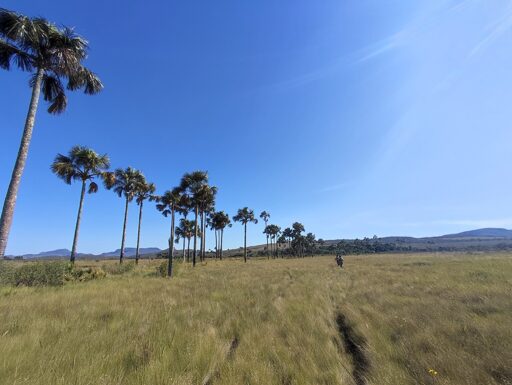
Fieldwork in the wet grasslands of the Brazilian Cerrado often means long trudges through head-high reeds, following tapir trails and watching for tick nests or boggy pitfalls. All this is made more difficult when your equipment is not waterproof. So in February 2024, when a thunderstorm broke over Chapada dos Veadeiros, a national park in the northeast of Goiás state, ecologist Larissa Verona and her team sprinted for their truck. “The rain passed in about 10 minutes, but when we returned, we saw a fire had started right in the middle of the road,” presumably from a lightning strike, she tells Mongabay in a video call. “Oh my god, we need to go,” she recalls thinking. “We don’t want to be here when the fire chief arrives.” Wildfires have become increasingly more common in the Cerrado, Brazil’s second-biggest biome (after the Amazon), which sprawls across 2 million square kilometers (about 770,000 square miles) and hosts a mix of savannas, grasslands and forested corridors. In the past half-century, some 55% of the Cerrado’s native vegetation has been cleared — largely to support the expansion of industrial monocultures and often with the justification that this biome holds less environmental value than the Amazon Rainforest to the west or the Atlantic Forest to the southeast. This has resulted in degraded soils and dwindling groundwater. But draining and clearing vegetation from the Cerrado’s peaty, wet grasslands, known locally as veredas and campos úmidos, could also threaten a critical carbon stockpile, according to recent research.…This article was originally published on Mongabay
From Conservation news via This RSS Feed.