

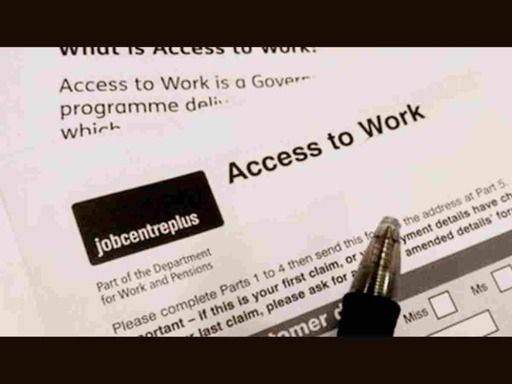

A deaf council worker has turned the Department for Work and Pensions (DWP) fiscal conservative narrative around rising costs of the Access to Work (AtW) scheme on its head.
Away from the state-endorsed corporate media spin over the scheme’s climbing expenditure — the limited support it actually available. This is set to push another disabled employee out of work.
The squeeze on disabled employees
Tomasz Borys works full-time for his local council. He spoke to the Big Issue about how AtW has been failing to fully support him in his role.
He told the outlet the scheme was causing “considerable anxiety and stress” and failed to meet his needs as a deaf person requiring a regular BSL interpreter.
Speaking to the Big Issue reported, Borys explained the difficulty in accessing this provision.
I can’t always afford an interpreter due to rising costs and a cap on his Access to Work grants.
Borys story, separately, has also been amplified by the Royal National Institute for Deaf People (RNID). He told the their news blog how “a big part” of his role involves “booking BSL interpreters for deaf residents.”
The government-funded disability employment scheme provides grants to pay for support to help disabled people to enter or stay in work.
However, the AtW cap is now eroded the employment rights of disabled workers. The grant is capped at £69,260 and does not cover the cost of a full-time interpreter that Borys needs.
He detailed that:
When I do not have an interpreter, I struggle significantly. For example, I can’t make telephone calls without an interpreter, which means I have to delay tasks and my workload builds up.
If I do not have an interpreter for several days, hearing colleagues have to cover front desk and telephone duties. I have to focus on other tasks which are not the main part of my role. If hearing staff are off sick and I need to cover the front desk without an interpreter, my manager has to step in.
This makes me feel very uncomfortable and unprofessional. It really affects my confidence.
DWP stealth cuts compound the issue
The government is taking steps towards reforming the scheme, claiming it does not represent good value for money.
Crucially, the department is using its own failings to justify overhauling the scheme — and to push through changes that could seriously undermine support for recipients.
For one, staggering delays continue plaguing the system. As of March, 66,000 disabled people were awaiting decisions on their awards. Currently, wait times for employees sit at 37 weeks and for employed workers it is 86.
But instead of tackling underfunding and structural problems, the department’s response has been to cut back awards.
The government is hiding behind mealy-mouthed excuses while it makes devastating stealth cuts to disabled people’s grants. Largely, DWP ministers and officials have said the awards decrease has resulted from case managers applying guidance more ‘consistently.’
However, as the Canary reported, its claims have not held up to scrutiny. This is not least because many disabled people have gone on to challenge their award reductions. And from there, the DWP’s own staff have then overturned them.
Repercussions and continued failings
In February, the Canary’s Rachel Charlton-Dailey highlighted how the DWP had made a 50% cut to deaf theatre director Jenny Sealey’s AtW award. Sealey requires a BSL interpretor for her rehearsals for 47 hours a week. But the DWP had slashed her funding so it would cover just 10 hours a week.
Sealey had told the Canary how, as a vocal campaigner against AtW delays, she felt it was “political.”
However, at the beginning of April, the department reinstated her AtW support. Of course, it showed how the DWP had been wrong to reduce her award from the get-go. Nevertheless, it has continued to slash disabled people’s awards despite no changes to their needs.
Now however, Borys’s experience has drawn greater attention to the fact that even without cuts, a full AtW award is woefully inadequate for many disabled workers as it is.
And Borys is also not alone among deaf people the scheme is failing. In July 2025, a damning report campaign group deaf together published exposed a litany of problems. As the Canary reported:
According to the report, only 15% of deaf people who have used DWP Access to Work have had a positive experience, with prolonged delays in claim processing and implementation leaving many without crucial support when they start or continue jobs.
This situation forces deaf workers to begin roles without the necessary communication aids, such as British Sign Language (BSL) interpreters, putting their employment at risk and causing unnecessary
The Canary also pointed out how it had heard personal testimonies from disabled people trying to access the scheme. These revealed that the DWP was making deaf employees wait over a year for AtW decisions.
Forcing disabled people into work, without support
Now, new research from RNID and DeafATW has corroborated these failings.
In a survey of 267 BSL users, the survey identified that the DWP had reduced grants for 37% at renewal. It meant that many BSL users had no access to essential support they needed at work. This is a particularly problematic barrier given that technology and other aids cannot replace BSL interpreters.
And it had significant repercussions for BSL users’ ability to work. It meant that 41% had missed training and development opportunities. What’s more, it had forced 19% to reduce or alter how they do their jobs.
Of course, the scheme’s continued failings are the direct result of a government hell-bent on coercing disabled people into work at any cost.
However, it’s clear once again that the DWP isn’t prepared to put its money where its mouth is and fund the support disabled people actually need to access employment.
To a Labour government prone to treating disabled people more like convenient political scapegoats than human beings, that’s none-too-surprising.
Featured image via the Canary
From Canary via This RSS Feed.