

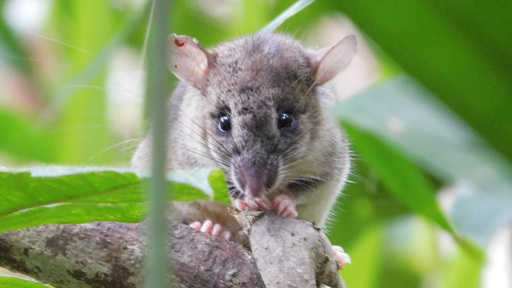
Founder’s Briefs: An occasional series where Mongabay founder Rhett Ayers Butler shares analysis, perspectives and story summaries. In a lowland forest in southeastern Madagascar, what was missing proved as telling as what was found. Researchers working in the Manombo Special Reserve trapped tufted-tailed rats in intact interior forest. But in the nearby degraded littoral areas, their traps never caught the endemic rodents. Instead, black rats, an introduced species, dominated those traps. The finding appears in a recent genetic study of two rodents found only in Madagascar: Webb’s tufted-tailed rat (Eliurus webbi) and the lesser tufted-tailed rat (Eliurus minor). The paper’s primary contribution is technical: it presents the first complete mitochondrial genomes for members of the Nesomyinae rodent subfamily unique to Madagascar. Earlier work relied on shorter gene fragments, which limited the resolution of evolutionary relationships. Whole mitochondrial sequences provide a clearer basis for distinguishing closely related species and identifying variation within them. This matters because the taxonomy of Eliurus remains unsettled. More than a dozen species have been described, and additional diversity is likely. Without reliable genetic baselines, it is difficult to determine how many species exist, where they occur, or whether their populations are changing. The new sequences do not resolve these questions, but they offer a clearer starting point. The ecological observation underscores why that kind of detail matters. Native rodents appear confined to intact forest, while disturbed areas favor generalists like the black rat. The mechanism is unclear: habitat degradation may exclude native species directly, or invasive…This article was originally published on Mongabay
From Conservation news via This RSS Feed.