

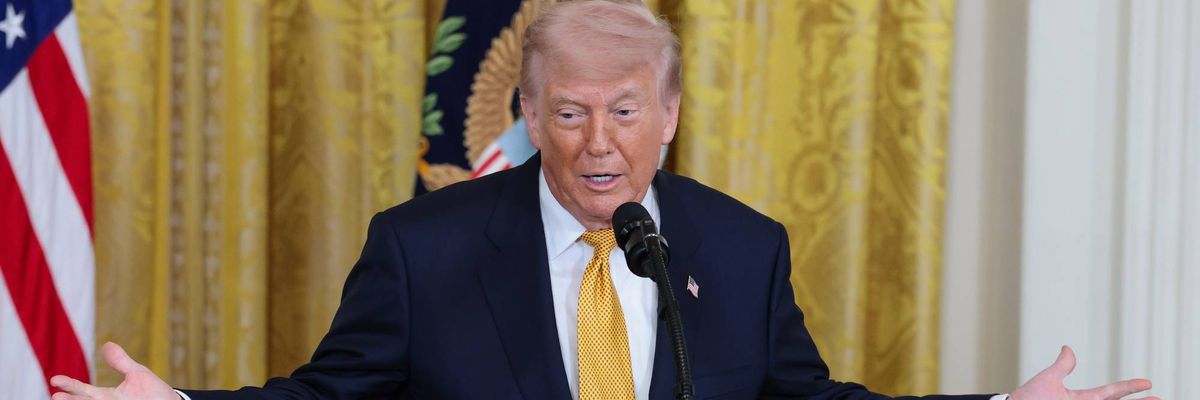
A group of US House Democrats is demanding that President Donald Trump be transparent with the American public about the extent to which his administration planned for the dramatic price hikes caused by the war in Iran over the past two months.
“You have unleashed chaos, undermined our national security, and escalated the conflict by threatening war crimes, including wiping out an entire civilization and destroying civilian infrastructure,” says the letter sent to the president on Wednesday by the five Democrats, who all serve leading opposition roles in House committees.
The letter was signed by Rep. Robert Garcia (D-Calif.), the ranking member of the House Committee on Oversight and Government Reform; Rep. Frank Pallone Jr. (D-NJ), the ranking member of the Committee on Energy and Commerce; Rep. Angie Craig (D-Minn.), the ranking member of the Agriculture Committee; Rep. Jared Huffman (D-Calif.), the ranking member on the Natural Resources Committee; and Rep. Don Beyer (D-Va.), the senior House Democrat on the Joint Economic Committee.
Gas is over $6 bucks a gallon in parts of California. Instead of lowering prices, President Trump is spending a billion dollars a day on a war with no mission and no end in sight. What happened to America First?
— Robert Garcia (@RobertGarcia) May 5, 2026
The Democrats accused Trump of having launched the war “without coherent or realistic strategic objectives,” and without a plan in the event that Iran restricted travel through the Strait of Hormuz, which has led to economic havoc.
“The impacts of your war will be felt for years, and the consequences of your reckless decision to drag America into war are increasingly falling on the American public,” the lawmakers said.
They cited reports that consumer prices are now growing faster than at any point in nearly two years, with no sign of slowing down due to a 50% spike in crude oil prices, which has also driven gas prices above $4.50 per gallon on average across the US, up more than $1 from the war’s beginning.
These oil shocks have rippled through the economy, raising the cost of airline tickets, home utilities, shipping, and numerous consumer goods.). The blockage of the strait has also hampered fertilizer shipments, leading to spikes in food prices.
The lawmakers also noted the cost of the actual war to US taxpayers, which was reportedly about $2 billion per day during the first week of attacks.
While the Pentagon has claimed the war has only cost about $25 billion since it began in late February, Stephen Semler, a senior fellow at the Center for International Policy, estimates that when armament use, troop deployments, and other factors are considered, the true cost over 60 days has been more than $71 billion, almost three times higher.
Trump said during a press conference on Tuesday that when he decided to launch the war, he expected price increases to be even worse than they turned out to be.
“I also thought oil would go up to $200, $250, maybe $300, and I knew it would be short-term, but I thought it would go. I looked today, it’s, like, at $102,” he said, referring to the price of a barrel of oil. “That’s a very small price to pay for getting rid of a nuclear weapon from people who are really mentally deranged.”
The American public does not seem to agree. Trump’s approval rating has plummeted to unseen lows since the war began, with just 35% now approving of his handling of the economy, according to an NPR/PBS News/Marist poll out Wednesday.
The same poll found that more than 8 in 10 said gas price hikes were straining their household budgets, and a majority (63%) blamed Trump for the increases. Roughly the same percentage said the overall economy was not working well for them personally, while 61% said they believed the war in Iran had done more harm than good.
The Democratic lawmakers inquired about the extent to which the Trump administration had prepared for Iran to cut off the Strait of Hormuz, which they said had been “long predicted” by experts.
They pointed to statements by administration officials, including US Secretary of Energy Chris Wright, who said just over a week before the war was launched that, thanks to Trump’s “energy dominance agenda,” prices would likely only “blip,” as they had during June’s 12-day war.
They also cited reports that Trump “did not consult” with Wright, Treasury Secretary Scott Bessent, or Director of National Intelligence Tulsi Gabbard to assess the likely impacts of an attack on oil markets.
The lawmakers noted predictions from the Organization for Economic Cooperation and Development (OECD) in March that the war will push inflation to 4.2% this year, up from 2.6% the previous year. Analysts have predicted that an increase in inflation to just 3% would cost the average household with $5,000 in monthly expenses an extra $1,800 per year.
Asking Trump to provide documents detailing the White House’s communications with executive agencies, the lawmakers said, “Americans deserve to know whether your administration considered the many ways your war would increase the day-to-day cost of living, and what steps you are now taking to protect Americans from the fallout of your foolhardy rush to war.”
From Common Dreams via This RSS Feed.
“a very small price to pay” to pay for what? Dead people? I didn’t want dead people, so no price is worth it.
