

As a reader-funded independent news outlet, we operate free from the influence of governments, advertisers, and corporate backers. This is essential to our mission: to report on what matters most, beholden only to the truth. In that spirit, we made a commitment to ensure that our journalism is free for everyone, not locked behind a paywall. But that means we rely on the voluntary support of our community of readers. Please consider making a tax-deductible donation to support our work today.
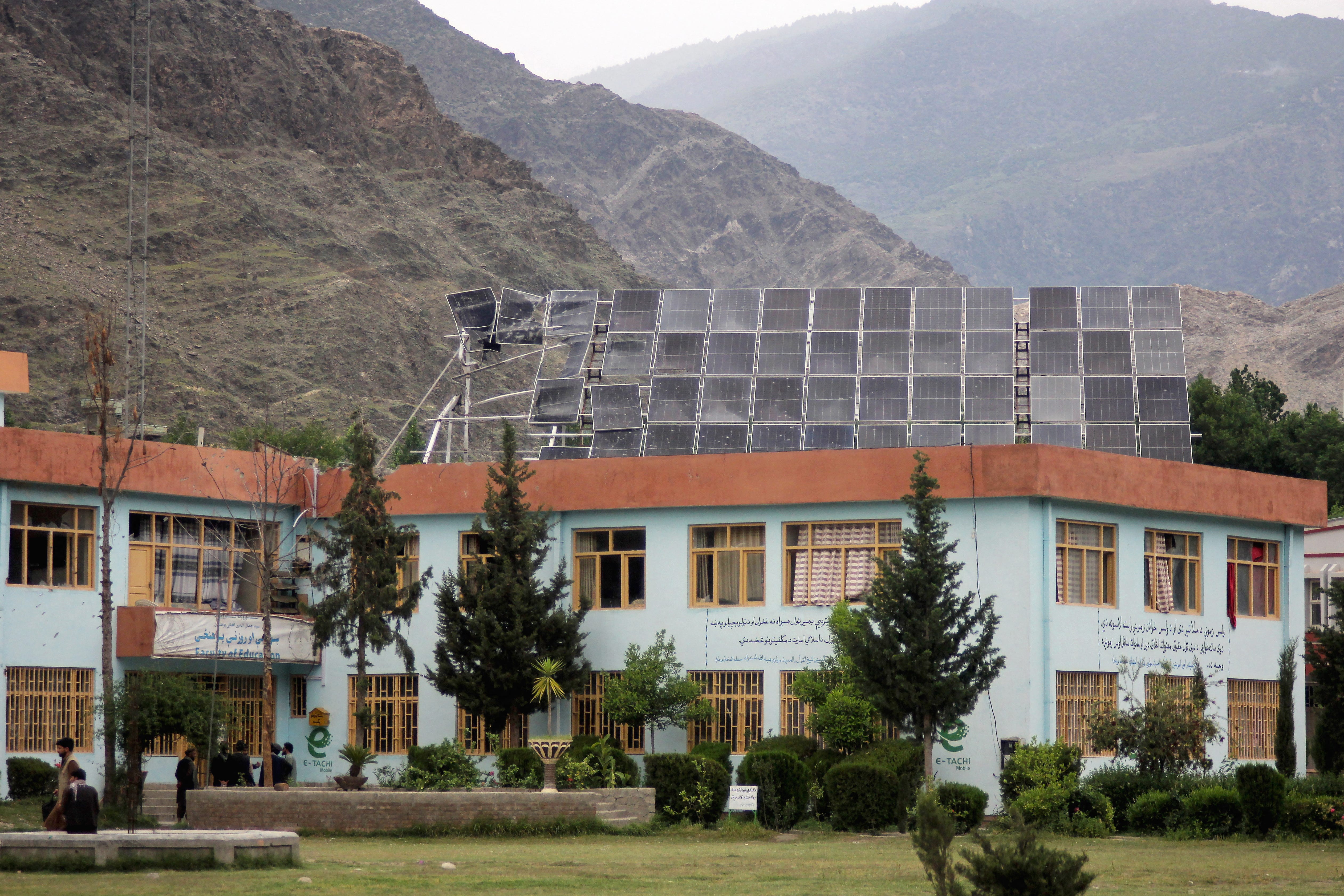
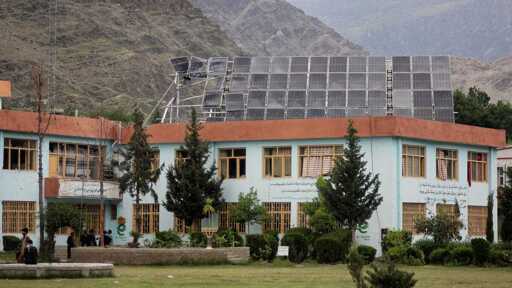
Afghan men walk past broken windows of the Faculty of Education building at the Sayed Jamaluddin University after an attack the previous day by the Pakistani military in Asadabad, Kunar province on April 28, 2026. Photo by Aimal Zahir / AFP via Getty Images.
The morning of April 27 began as just another busy day of classes at Asadabad’s Sayed Jamaluddin Afghani University in Afghanistan’s Kunar province. But then a missile tore through the roof of the university’s main building, suddenly transforming a normal day into a scene of horror.
At least six students were killed instantly in the explosion, with a seventh body recovered later. Dozens more, including several teachers, were wounded by pieces of shrapnel and shattered glass.
“The strike occurred around 2 p.m. They hit the university building harshly and the whole system, including the electricity, broke down within moments,” Abdul Hadi, a student who survived the attack, told Drop Site. “We stopped classes and tried to flee as fast as possible.”
Another student, who asked to remain unnamed for security reasons, was also present during the strike and described a scene of terror in the immediate aftermath. “The blast caused everyone to take cover on the floor,” he said. “Windows were shattered. We were instructed by our teacher to exit one by one to prevent a stampede.”
Witnesses later said the attack that struck the school building was carried out by a Pakistani military drone, as an ongoing war between Pakistan and Afghanistan continues to escalate across Kunar Province.
Following the Asadabad attack, the Pakistani Ministry of Information and Broadcasting issued a quick denial of responsibility, labeling the reports of a Pakistani drone strike on the school as a “blatant lie” and insisting that their targeting remains “precise and intelligence-based.”
The blast did more than destroy the lives of students and teachers attempting to maintain a semblance of normalcy amid the war. It also shattered fragile ceasefire efforts between Afghanistan and Pakistan.
The escalating Pakistani campaign comes just one month after diplomats from Islamabad and Kabul met in the western Chinese city of Urumqi for talks mediated by Beijing that promised to find a “comprehensive solution” to a border conflict between the two neighbors that has spiraled into what both sides now increasingly characterize as open war.
Pakistan has continued to claim that its operations are narrowly targeting extremist groups, including the Tehrik-e-Taliban Pakistan (TTP), which has carried out a wave of suicide bombings against civilian targets inside Pakistan as well as attacks against Pakistani security forces stationed near the border.
Sher Agha, a humanitarian worker and activist from Kunar, dismisses Islamabad’s claim that it is only targeting extremists and says the attack directly struck the school. “The university was hit indiscriminately. It is wrong to say extremists were hiding there. It was just full of students,” Agha said. He noted that the blast’s impact extended beyond the campus, damaging nearby residential neighborhoods and a fuel station, while injuring dozens more civilians.
Agha and many other Afghans accuse Pakistan of pursuing a “scorched earth” policy in its war aimed at rendering the country ungovernable, while inflicting rising civilian casualties among Afghans living near the border, as well as in major city centers.
In March, Pakistani strikes leveled a drug rehabilitation center in Kabul—built on the site of a former NATO base—killing over 400 people. Despite widespread outrage, Pakistani authorities also denied responsibility for that attack and have continued to insist that its strikes are narrowly targeted at the Taliban and their supporters.
Targeting Military-Age Males
The Pakistani attacks on Sayed Jamaluddin Afghani University and the rehabilitation clinic in Kabul received some global attention since they were carried out in major urban areas accessible by local and foreign media. But locals say that violence in rural areas poorly serviced by the government has been far more extreme in recent months.
Saif ur-Rahman Alikozai, a resident of Sarkano district in Kunar, stood in the ruins of his family’s home last week. “Pakistani forces attacked our village and largely destroyed it. My own home was destroyed,” Alikozai told Drop Site. The casualty count in his village alone reached 20 dead. “All of them were men,” he noted, while adding that 15 others, mostly women and children, were also maimed in the shelling. The targeted attacks on men in the area has led many Afghans to believe that the Pakistani military may be adopting a policy of targeting “military-age males” in areas they believe are TTP strongholds—a policy pursued by the U.S. military during its own operations in the region during the U.S. occupation of Afghanistan.
This violence is fueling a massive humanitarian crisis. The United Nations Office for the Coordination of Humanitarian Affairs reports that more than 100,000 people have been displaced since the conflict escalated in February, with over 13,000 students in Kunar and Nangarhar provinces alone experiencing educational disruptions because of damaged schools and insecurity.
In verified photos and videos from Sarkano, the scarred courtyard of a targeted mosque and the rubble of private homes are littered with twisted missile parts and jagged shrapnel. Tail fins and other scorched components from drone-launched missiles were found among the debris of residential living rooms.
In the first days of May—notwithstanding ongoing efforts allegedly aimed at reaching a ceasefire—Pakistani forces continued to attack Sarkano. Again, civilians were targeted. “They killed several relatives of a known elder. Women and children are amongst the victims,” said an Asadabad resident who requested anonymity for security reasons. “We don’t have time to breathe. The deal has brought nothing to our people.”
The April talks mediated by Beijing in Urumqi were supposed to be the breakthrough that prevented a full-scale regional war. Instead, the strikes have shown how much the Pakistani military, led by Field Marshal Asim Munir, an army chief who enjoys the support of the Trump administration, feels emboldened to ignore regional mediators.
“Beijing has not publicly reacted publicly on the renewed Pakistani attacks yet, as far as I see,” said Thomas Ruttig, an Afghanistan expert and former co-Director of the Afghanistan Analysts Network (AAN). “Pakistan might be testing how far they can go with comparatively low-level attacks without jeopardizing their relationship with China by undermining their mediation effort.”
The Taliban government in Kabul has reacted with fury to the attacks. Nida Mohammad Nadim, the acting Minister of Higher Education, called the university attack a “cowardly and brutal act.” The Afghan Ministry of Defence also claimed to have launched retaliatory strikes that killed six Pakistani soldiers in the Spin Boldak region. According to Pakistan, these strikes also caused civilian casualties.
“Kunar has become the main stage of the war,” said one local Afghan Taliban official who requested anonymity. “Pakistan keeps insisting TTP militants are the targets, but when you hit a university and a clinic, you aren’t fighting a terror group. You are fighting a population.”
For decades, Pakistan sought “strategic depth” in Afghanistan and supported every militant group that opposed the central government in Kabul, including the Taliban who are ruling today. At the same time, Pakistan’s establishment, including its powerful military and intelligence service, received billions of dollars from the United States. Now Islamabad appears to believe it can force the Taliban to capitulate over the presence of the TTP on its territory by bombing Afghan villages—turning schools, centers of worship, and family homes into kill zones.
But as the students of Sayed Jamaluddin University pick through the glass and blood in their classrooms, the result isn’t capitulation—it’s a hardening of the Afghan national sentiment against its neighbor.
“They think if we have no schools, we will have no country,” said one Asadabad resident who had fled the school attack. “All they are doing is making sure we never forget who dropped the bombs.”
From Drop Site News via This RSS Feed.