

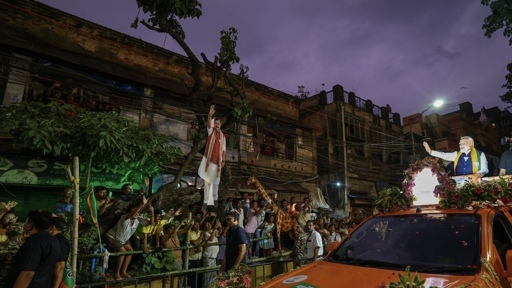
In India, over 123 million people voted in the four states of Assam, Kerala, Tamil Nadu, and West Bengal (home to 290 million people) for their state assemblies. These are influential states: two in the south, one in the east, and one in the northeast. The next national parliamentary election is not scheduled until 2029, so these elections are not being seen as a bellwether for the central government. However, with Prime Minister Narendra Modi’s government facing challenges due to fuel and food inflation, these elections have become an indicator of his popularity.
There are three immediate takeaways from this election: first, the level of state manipulation in the elections through the Special Intensive Revision (SIR) certainlyundermined faith in the electoral process, since it was seen to have enabled Modi’s Bharatiya Janata Party (BJP) to win in West Bengal (population 100 million); second, the Gen-Z phenomenon, or the post-ideological politics wave, has entered India through the victory of film star Vijay’s Tamilaga Vettri Kazhagam (TVK) in Tamil Nadu (population 77 million); third, with the defeat of the Left Democratic Front (LDF) in Kerala (population 36 million), there will be no Communist-led government in any part of India for the first time in five decades.
Anti-incumbency wave?
The prevailing wisdom is that the sitting governments in the three states of West Bengal, Tamil Nadu, and Kerala lost their elections in an anti-incumbency wave. But, on closer examination, this might be too simplistic an argument. For instance, in Kerala, impressive work by the Communist-led LDF government led to theabolition of extreme poverty (the first Indian state to do so, and the first place outside China) and to thereduction of the infant mortality rate below five per 1000 live births (lower than in the United States). There was no reason for the electorate to deliver to the LDF its most severe defeat in recent times.
Modi’s central government used the entire state machinery to tackle the three governments because their leaders had led confrontations against the national government of Modi on several issues. The core problem is that Modi wants to undermine India’s federal system and centralize power in New Delhi. This has been strongly contested by non-BJP state governments, with the sharpest criticism coming from the states in southern India. Theargument made by the southern political leaders is that since they are economically dynamic, their populations have not grown as much as populations in the north, which means that in any revision of the national electoral map, they will lose power in the central legislature. In these state elections, Modi targeted all three leaders (Mamata Banerjee of West Bengal, M. K. Stalin of Tamil Nadu, and Pinarayi Vijayan of Kerala) and defeated them. Part of the use of the state apparatus was by the elimination of atleast 2.7 million voters in West Bengal by the Election Commission of India, as well as the use of highly charged anti-Muslim language (notably of “infiltration” of migrants from Bangladesh into West Bengal) to polarize the electorate along religious lines. Both Banerjee and Stalin lost their own seats in the contest.
Gen-Z comes to India?
Chandrasekaran Joseph Vijay, a major star in Tamil films, launched his party (TVM) through his 85,000 fan clubs, drawing on a long tradition in Tamil Nadu of film stars, fan clubs, and the political establishment. But there was something novel about his campaign. His entire mood was driven by digital fluency, awareness of social issues that captivate online audiences, and impatience with traditional hierarchies. The excitement of his campaign, the unwillingness to accept party loyalties, and the care with which Vijay’s team crafted political messages to induce cultural rather than political appeal stretched his popularity beyond the lines of the polarized electorate. Born in 1974, Vijay reached out to younger voters in a way that eclipsed the otherwise popular administration of Stalin (born 1953) and the other principal opponent, Edappadi Palaniswami (born 1954). But the Vijay phenomenon is strong on imagery and weak on policy or administrative competence. It carries forward theGen-Z protests of Bangladesh, which resulted in aright-wing victory at the polls, and theGen-Z protests of Nepal, which resulted in a government characterized by right-of-centerincoherence.
In many ways, the victory of Modi’s BJP in West Bengal felt as if it were equally formed by a Gen-Z wave, this time a type of cosplay Hindutva, Hindu power masked in casual anti-immigrant, anti-Muslim rhetoric and in the vagueness of anti-politics. Social media platforms ran narratives that focused on young people, with themes such as anti-corruption and transparency sounding like anti-older people. It helped that the BJP’s leader Suvendu Adhikari (born 1970) was younger than Banerjee (born 1955) and so positioned himself as the coming of a new generation. Beneath the smiles of the younger candidate and the social media glitz of the West Bengal BJP lies the disenfranchisement of voters, the religious bigotry of the campaigning, and the hoary nature of the BJP’s Hindutva ideology – rooted as it is in an ancient fantasy created only a hundred years ago. Media-savvy personalities felled the need for real ideas to solve real problems. This is the essence of the Gen-Z phenomenon, much more than young people taking to the streets to demand this or that change.
Migrant voters
The BJP in West Bengal targeted migrants from Bangladesh, but that left a bad taste in the mouth of other migrants. According to the 2011 Census, there were 456 million workers in India who migrated within the country – more than one third of the population. But most of these workers cannot vote in the states where they work because voting is tied to a permanent home address, and most migrants remain registered in their native villages. As a result, workers must return home to vote, which is both expensive and inconvenient and therefore results in low voter turnout in their areas. One of the great limits of Indian democratic institutions is this casual disenfranchisement of migrant workers, mostly from the poorer states in India’s north, who travel to the more dynamic states in India’s south.
Interestingly, a candidate in the constituency of Domkal – Mostafizur “Rana” Rahaman of the Communist Party of India (Marxist) or CPIM—addressed the migrant work issue head-on. A young and dynamic politician, Rana not only campaigned in his district but journeyed through India’s south to galvanize migrant workers to go to the polls. Workerstraveled back to Domkal to vote for Rana, and four hundred families with workers out of the state joined the CPIM before the elections. Rana’s victory spells the end of the Left’s drought in West Bengal, which had begun with the defeat of the Left Front government in 2011 after thirty-four years in power. His victory is that of the migrant worker in India, far less talked about than Gen-Z but perhaps with far more necessity of consideration.
Vijay Prashad is an Indian historian and journalist. He is the author of forty books, including Washington Bullets, Red Star Over the Third World, The Darker Nations: A People’s History of the Third World, The Poorer Nations: A Possible History of the Global South, and How the International Monetary Fund Suffocates Africa, written with Grieve Chelwa. He is the executive director of Tricontinental: Institute for Social Research, the chief correspondent for Globetrotter, and the chief editor of LeftWord Books (New Delhi). He also appeared in the films Shadow World (2016) and Two Meetings (2017).
This article was produced by Globetrotter.
The post Regional elections in India and the growing myth of Gen-Z appeared first on Peoples Dispatch.
From Peoples Dispatch via This RSS Feed.