

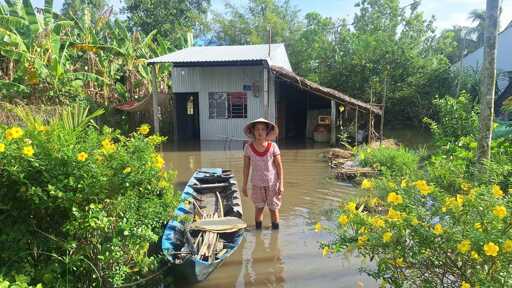
“I would like for me and my children to live here forever,” said Lâm Thu Sang, a resident of Vietnam’s Cần Thơ, a city of more than 2 million people located near the mouth of the Mekong River on one of the world’s largest river deltas. But that may not be possible. In the past, about 160 million metric tons of sediment was annually funneled down the 4,300-kilometer (nearly 2,700-mile) Mekong River to form and nourish the vast delta where the river meets the sea. By 2024, that deposition rate had fallen by 70% per year — starving the delta of much of its source material. The Mekong flows through six Asian nations, draining a roughly 800,000-square-kilometer (309,000-square-mile) basin, until finally releasing its combined sediments into the 40,000-km2 (15,400-mi2) Mekong Delta — a complex ecological system of low-lying fertile lands and a web of waterways the size of the Netherlands, stretching from Phnom Penh, Cambodia, to the South China Sea in Vietnam. Unfortunately, the future of Lâm Thu Sang’s community and this great delta are seriously in doubt, with the delta doubly threatened by land subsidence and sea level rise. Mekong Delta residents say life there is changing. For one, annual floods have become longer and more severe. Image courtesy of Anh Duong Community Development and Support Center. Sang, who helps run the Anh Duong Community Development and Support Center, an NGO focused on eradicating poverty in remote areas of Cần Thơ, said that people know their delta home is…This article was originally published on Mongabay
From Conservation news via This RSS Feed.